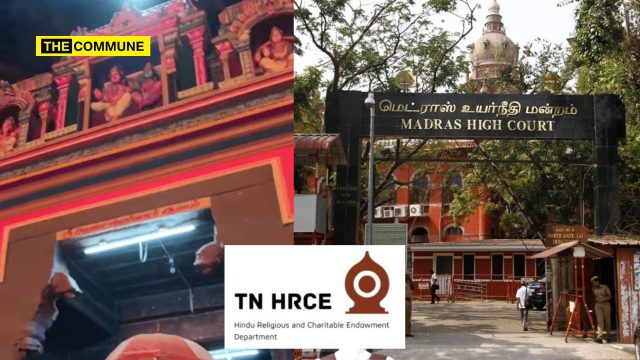
In a significant ruling protecting temple property, a Division Bench of the Madras High Court has ordered the restoration of 3.93 acres of land belonging to the Sri Annamalainathar Temple at Kadayanallur, declaring the auction and subsequent alienation of the land in the 1990s to be illegal and contrary to law.
The judgment, pronounced on 15 December 2025 brings to an end a prolonged legal battle spanning over three decades. The Bench comprising Justice Anita Sumanth and Justice N Senthilkumar held that the sale of temple land permitted by the Temple Administration Board in 1994 violated statutory safeguards under the Hindu Religious and Charitable Endowments Act, 1959.
Background of the Case
The land in question originally belonged to Sri Annamalainathar Temple, forming part of its extensive immovable assets. On 19 August 1992, the then trustees of the temple allegedly passed a resolution proposing the sale of temple lands. This proposal was forwarded to the Temple Administration Board, which granted approval for auction on 21 July 1994, and formally initiated the auction process on 23 August 1994.
A public auction was conducted in June 1995, following which the land was sold to private individuals. Over the years, more than 90 persons came to occupy the land, with residential structures and a mosque reportedly constructed on the property.
Cancellation by HR&CE Commissioner in 1997
The court noted that the then Commissioner of the Hindu Religious and Charitable Endowments Department, Sri Meikandadevan, IAS, had cancelled the auction on 16 May 1997, holding that the mandatory statutory procedure for alienation of temple land had not been followed. The Commissioner recorded that objections from the Hindu public had not been properly invited or considered, rendering the sale invalid.
Background:
The 3.93 acres of lands belonged to Sri Annamalainathar Temple, Kadayanallur, (now Tenkasi District) and August 19, 1992, trustees allegedly passed a resolution to sell temple lands. The trustees then submitted this proposal to the Temple Administration Board to… pic.twitter.com/MsUW2q9Foc
— trramesh (@trramesh) January 4, 2026
Despite this cancellation, subsequent administrative actions and litigations led to contradictory positions being taken by authorities over the years, resulting in prolonged uncertainty over the status of the land.
Court’s Findings
After examining the entire record dating back to the early 1990s, the High Court held that temple lands cannot be sold as a matter of routine, that alienation is permissible only in rarest cases of necessity, and only if demonstrably beneficial to the temple, and mandatory safeguards under Section 34 of the HR&CE Act, including public notice, consideration of objections, and a reasoned inquiry, were violated.
The Bench ruled that the auction approved by the Temple Administration Board was illegal and void, and that subsequent transactions flowing from it could not survive in law.
Accordingly, the court set aside the auction and all consequential actions, directing the authorities to restore the 3.93 acres of land to the temple.
The court stated, “We agree with the private respondents that the HR&CE Department must be more responsible in the stands that it takes. However, the saving grace are the records of the Department that have been produced before us. The records categorically establish the version of events argued by the Department now, to establish the gross illegalities in the conduct of auction. One of the objections related to the valuation of the land, that has simply been brushed aside. The TAB has not even examined the aspect of valuation and whether the upset price had been determined properly. Hence, weighing the contradictory stands of the HR&CE Department, as against the serious damage and prejudice caused to protection of temple property, a public cause, we conclude that this argument has only limited value.
The conflict in the pleadings does not remove the gross illegality in procedure.”
The land is currently estimated to be worth approximately ₹110 crore. Court records indicate that it has been under occupation for several years, with permanent structures having come up during the pendency of litigation.
The decision is being viewed as a landmark affirmation of judicial oversight in protecting temple properties and enforcing statutory discipline on administrative authorities tasked with managing religious endowments.
Subscribe to our channels on WhatsApp, Telegram, Instagram and YouTube to get the best stories of the day delivered to you personally.