


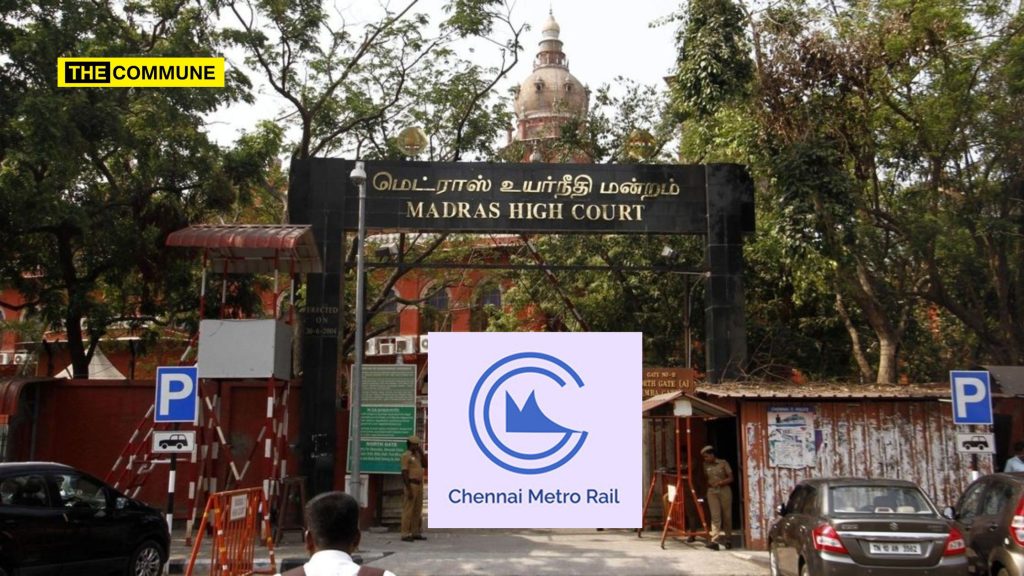
The Madras High Court has set aside a notice issued by Chennai Metro Rail Limited (CMRL) to acquire property belonging to United India Insurance for the construction of a metro station under Phase-II of the project. The court ruled that CMRL could proceed with its original plan of acquiring land from a nearby temple instead.
Justice Anand Venkatesh, borrowing from a Kerala High Court judgment, remarked that the Almighty would show kindness and benevolence toward the development of the metro station, benefiting lakhs of people. Quoting the Kerala High Court’s recent words, he observed:
“This Court, like P.V. Kunhikrishnan, J, fervently believes that the Almighty would undoubtedly shower his kindness and benevolence for the development of a metro rail station, which will benefit lakhs of people from all segments of society, some of whom may well be devotees, who visit the temple. In the words of the Kerala High Court, ‘God will forgive us. God will protect the petitioners, the authorities, and also the author of this judgment. God will be with us.’”
The court also clarified that religious institutions’ lands are not exempt from acquisition and that such acquisitions do not violate fundamental rights under Articles 25 and 26 of the Constitution.
Background
The case arose from a petition filed by United India Insurance challenging a show cause notice issued by CMRL under Section 3(2) of the Tamil Nadu (Acquisition of Lands for Industrial Purposes) Act, 1997. The notice asked why the company’s property should not be acquired for the proposed metro station.
Initially, CMRL had planned to locate the entry/exit points of the station within the premises of the Arulmighu Sri Rathina Vinayagar Temple and the Durgai Amman Temple. However, a public interest litigation (PIL) was filed by an organization representing devotees, opposing the move. Following a joint inspection, CMRL gave an undertaking to the High Court, stating that the metro station’s entry/exit points would instead be shifted to the insurance company’s property. Based on this assurance, the notice was issued to the company.
Arguments And Court Observations
United India Insurance argued that the show cause notice was merely a formality, as CMRL had already decided to acquire its property. The company highlighted that it had invested ₹250 crore in constructing its building after obtaining a No Objection Certificate (NOC) from CMRL, creating a legitimate expectation that the property would not be disturbed. Additionally, the company was not made a party to the earlier PIL and contended that the undertaking given by CMRL in that case could not be binding on it.
CMRL, however, maintained that its initial plan was to acquire temple land but shifted its stance following the devotees’ opposition. The agency argued that no final decision had been made and that objections raised by the insurance company would be considered independently.
The court, after examining the records, noted that the relocation of the Vinayagar deity had already been decided by the Hindu Religious and Charitable Endowments (HR&CE) department. Additionally, the Gopuram of the Durgai Amman Temple was planned to be shifted five meters inside and reinstated after the metro project. It was also observed that while the temples were claimed to be very old, they were, in fact, established only in 1960.
The court sided with the insurance company, agreeing that the notice amounted to a post-decisional hearing, as CMRL had already made a commitment in court. It ruled that CMRL’s actions were restricted by the principle of promissory estoppel, as the company had been led to believe that its property would remain undisturbed.
Court’s Final Decision
The High Court concluded that CMRL could not now take a different stand based on an earlier proceeding where the insurance company was not a party. Justice Anand Venkatesh stated:
“The CMDA, by granting approval, has induced the petitioner to invest funds. To allow the CMDA and the CMRL to sing a different tune at this juncture and that too on the basis of a proceeding, to which the petitioner was not even a party, would be grossly unfair and arbitrary. It would clearly tantamount to an abuse of power violating Article 14. As pointed out supra, the consent given by the CMRL before the First Bench of this Court cannot bind the petitioner since it was not made a party nor was heard before such orders were passed.”
Though CMRL argued against applying the promissory estoppel doctrine in this case, the court ruled that its defenses were not valid. Consequently, the show cause notice issued to the company was quashed.
The court refrained from imposing costs on the State or the devotees’ organization but emphasized that the highest aim of religion is to unite humanity. It reiterated that CMRL was free to proceed with its original plan of acquiring the temple land for the metro project.
(With inputs from LiveLaw)
Subscribe to our channels on Telegram, WhatsApp, and Instagram and get the best stories of the day delivered to you personally.