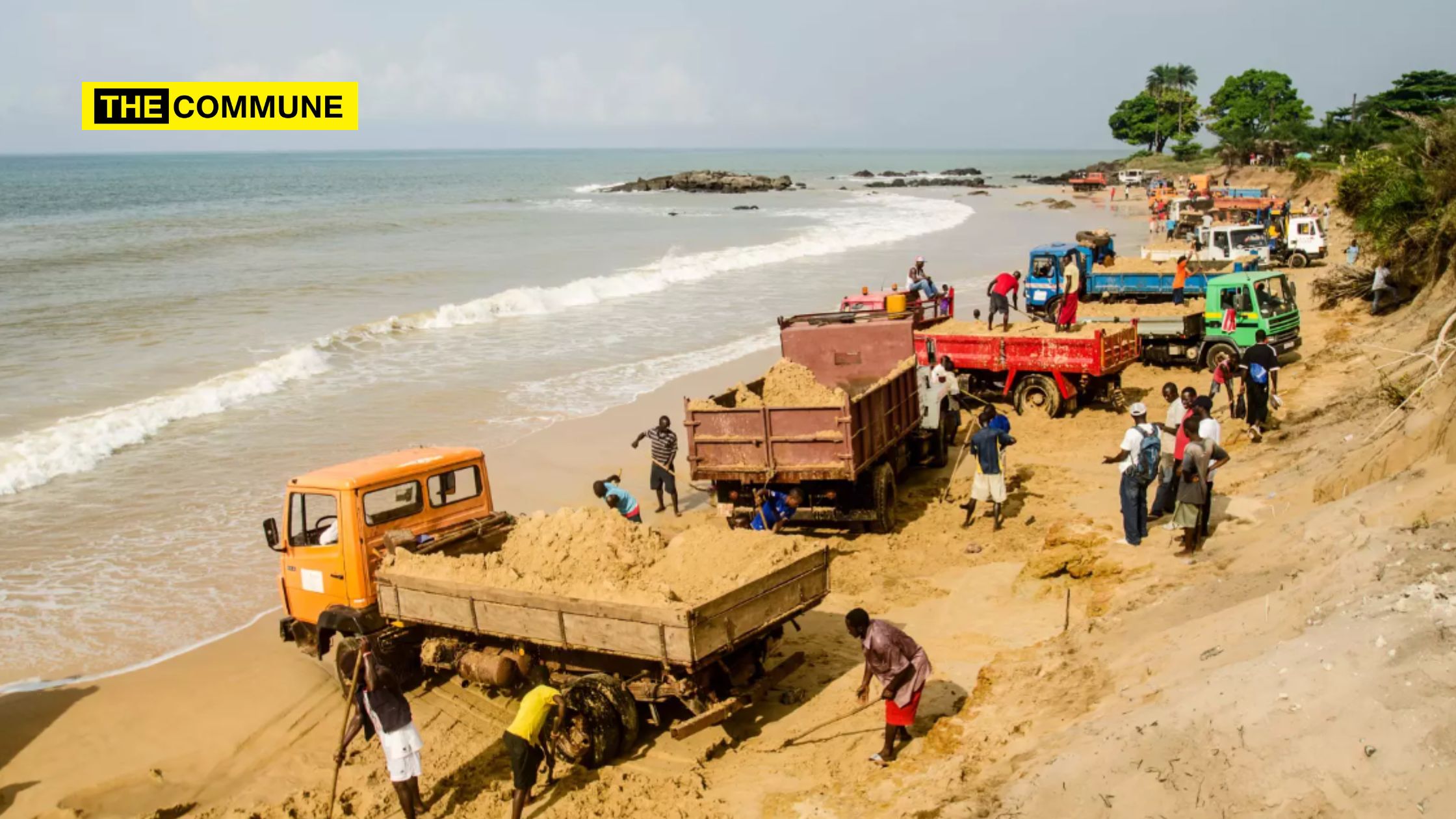
On 17 February 2025, the Madras High Court ordered a Central Bureau of Investigation (CBI) probe into the massive illegal mining of beach sand minerals (BSM) in Tamil Nadu. The Court sought to uncover any potential links between politicians, government officials, and private miners in this unlawful activity that has persisted since 2000-01, despite the State’s blanket ban on beach sand mining in 2013.
Justices S.M. Subramaniam and M. Jothiraman emphasized that such a serious illegal operation, particularly involving the mining of monazite—a radioactive mineral considered an ore of thorium—poses national security risks. The judges believed that such a large-scale crime could not have been carried out without “collusion, corruption, and complicity” among various political figures, government bodies, and private mining entities.
The Court instructed that all pending cases related to illegal beach sand mining in Tamil Nadu be transferred to the CBI. The CBI was directed to form as many investigation teams as necessary, ensuring the inclusion of officials with integrity and relevant expertise. The CBI Director was also mandated to regularly monitor the investigations.
Justice Subramaniam, who authored the judgment, stated that the CBI must investigate whether private miners had been exporting monazite to foreign countries, which could pose a serious threat to national security. Additionally, the Court ordered the Centre to examine the financial transactions of BSM miners and exporters and to initiate inquiries by the Directorate of Enforcement (ED), the Income Tax Department, and Customs officials.
The judges further clarified that disciplinary actions should be taken against any government officials involved in the illegal activities, based on the CBI’s investigation. They also noted that anyone could file a contempt of court petition should any of their orders be violated. This ruling came as part of a suo motu public interest litigation initiated by the court in 2015.
The Division Bench upheld the validity of the reports submitted by IAS officers Gagandeep Singh Bedi, Satyabrata Sahoo, and amicus curiae V. Suresh concerning illegal mining activities. The Court directed the State government to proceed with the actions it had initiated to recover ₹5,832.29 crore in royalties and penalties for the beach sand illegally mined prior to the ban.
The Bench further ordered that the approximately 1.4 crore tonnes of raw beach sand, semi-processed sand, and processed minerals currently stored in sealed warehouses and factories of private miners be immediately handed over to Indian Rare Earths Limited (IREL), a central government entity authorized to handle all beach sand minerals, including monazite.
The 2013 ban on mining was enforced during the tenure of former Chief Minister Jayalalithaa, following a letter from then Thoothukudi Collector Ashish Kumar to Chief Secretary Sheela Balakrishnan, highlighting large-scale illegal mining activities. Subsequently, the government formed a special team, led by senior IAS officer Gagandeep Singh Bedi, to conduct an in-depth investigation and submit a report.
Bedi’s team uncovered illegal mining of 10.29 lakh tonnes of raw sand from 66.18 hectares in Thoothukudi, 90.29 lakh tonnes from 412.99 acres in Tirunelveli, and 54,446 tonnes from 4.05 acres in Kanniyakumari. Around the same time, the High Court began monitoring the issue through a suo motu Public Interest Litigation (PIL).
In 2017, following a complaint by V. Suresh regarding ongoing illegal mining despite the ban, the State government appointed a team headed by Satyabrata Sahoo to conduct another investigation. This team discovered 1.55 crore tonnes of beach sand minerals (1.37 crore tonnes in Tirunelveli, 12.09 lakh tonnes in Thoothukudi, and 5.93 lakh tonnes in Kanniyakumari) stored by private miners in their warehouses and factories.
However, the miners had only declared 85.58 lakh tonnes of sand (64.59 lakh tonnes in Tirunelveli, 13.91 lakh tonnes in Thoothukudi, and 7.07 lakh tonnes in Kanniyakumari). This revealed a discrepancy of 69.89 lakh tonnes, according to Sahoo’s 2018 report. He also confirmed the presence of monazite tailings among the materials held by private miners.
Following his second inspection in 2021-22, Sahoo submitted a new report indicating that despite his initial assessment of 1.55 crore tonnes of beach sand stocks in 2018, and the subsequent sealing of all the warehouses, approximately 16.04 lakh tonnes had gone missing, leaving only 1.39 crore tonnes. Additionally, during his 2021-22 inspection, he discovered new stocks amounting to 6.62 lakh tonnes that had not been included in the 2018 evaluation.
Meanwhile, Suresh conducted his own investigations into the extent of illegal mining and the financial losses the State had incurred due to the actions of private miners. He submitted three detailed reports, which were accepted by the current State government under Chief Minister M.K. Stalin. The government subsequently decided to recover ₹5,832.29 crore from the miners.
To represent the State in the suo motu PIL and defend the writ petitions filed by private miners challenging the recovery notices for royalty and penalties, the State appointed senior counsel Arvin P. Datar, with assistance from Additional Government Pleader B. Vijay.
In this case, the analysis of the Royalty Settlement proceedings reveals discrepancies in the data provided by V.V. Mineral. The company initially declared that only 1,765 MT of Garnet and Ilmenite were exported during the 2005-2006 to 2007-2008 period. However, their own statement made to the Taluk Level Committee of Tirunelveli in June 2016 contradicts this, as they claimed to have exported 8,83,865 MT of beach sand minerals (BSM) during the same period. This inconsistency raises serious concerns about the legality of the process, particularly given the absence of Central Government approval for including certain minerals in the mining lease. The actions of the State Government in granting such a lease to the 8th Respondent must be scrutinized to determine if there was any political involvement or corruption, and whether government officials and the lessees were complicit.
For instance, according to data published by the Indian Bureau of Mines (IBM) in August 2013, the sale price of Garnet in Tamil Nadu was listed as ₹377 per MT, significantly lower than the prices in Andhra Pradesh (₹8,833 per MT) and Odisha (₹5,500 per MT). The export price of Garnet, however, ranged from ₹15,000 to ₹18,000 per MT, indicating substantial benefits to the lessees from this undervaluation.
The Department of Atomic Energy (DAE) has explicitly denied granting permission for the inclusion of Monazite in the mining lease, yet the State Government allowed this without Central Government or DAE approval. This violation of the Atomic Energy Act and its rules is a matter of concern. The role of DAE officials in granting handling licenses, as well as their failure to act despite widespread reports of monazite being handled by private players, raises further questions. Why did the monitoring mechanisms fail to detect and address these illegal activities? The Court believes that the involvement of DAE officials should be investigated by the appropriate authorities to uncover any possible collusion in this significant scam.
Additionally, the mining plans approved by the IBM and Atomic Minerals Directorate (AMD) did not account for these issues and allowed for an increased quantity of minerals to be mined, citing the replenishment of minerals in the intertidal zone. The reports from Mr. Bedi’s Committee and the Amicus Curiae further reveal that many lessees used mechanical mining methods, violating the requirement for manual scooping in the Intertidal Zone and other areas under CRZ-I, where only manual methods are permitted.
In 27 out of 52 leases in Tirunelveli District, the lessees unlawfully mined and removed sand dunes that were supposed to remain intact. Furthermore, of the total 1,51,27,070 MT of raw sand for which transport permits were issued, 86,35,151 MT was unlawfully transported under the 62 mining leases held by V.V. Mineral and Transworld Garnet India Private Limited.
As promised, here are some key observations in the #illegalbeachsandmining verdict today by Madras HC. A solid conscientious judgement indeed. (1) pic.twitter.com/JT9qpceC0N
— Sandhya Ravishankar (@sandhyaravishan) February 17, 2025
Previously, the Tamil Nadu government, through the Tirunelveli district collector, has directed the beach sand mining company VV Minerals to pay ₹2,195 crore in “royalties” and “cost of minerals” for the natural resources it is accused of illegally mining and transporting between 2002-03 and 2013-14 in the district. Demand notices have also been issued to six other companies in Tirunelveli and Kanniyakumari districts, amounting to a total of ₹3,528.36 crore.
(With inputs from The Hindu)
Subscribe to our channels on Telegram, WhatsApp, and Instagram and get the best stories of the day delivered to you personally.