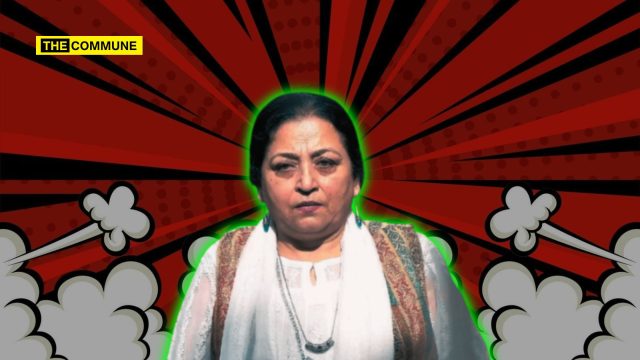
Madhu Kishwar, alleged activist, was in the news for her accusations against PM Modi recently on social media platform X.
This explains why I kept a safe distance from Modi from the time he assumed power in May 2014. I did not even go to gift him a copy of my book on him. Just sent an unsigned copy through his favourite bureaucrat Bharat Lal!
The names of women who were made MPs and ministers by… https://t.co/vgboxAndqq— Madhu Purnima Kishwar (@madhukishwar) March 25, 2026
What followed was an unearthing of a can of worms of not PM Modi’s but Kishwar’s past.
Madhu Purnima Kishwar’s public life spans five decades, multiple ideological homes, and a dramatic arc from Left‑leaning feminist to Hindutva ideologue to fierce Modi critic. In this article, we take a look at her trajectory over the years.
From Refugee Colony To Student Radical
Madhu Purnima Kishwar was born in Delhi in 1951 into a family that had migrated from what is now Pakistan after Partition, a background she has often invoked to underline a childhood shaped by displacement and precariousness. She studied at Miranda House, Delhi University, where she became president of the students’ union, and later at Jawaharlal Nehru University. Early biographical sketches describe her as part of the broad Left milieu of the late 1960s and 1970s, when Naxalbari, Maoism and CPI(M) student politics were powerful reference points on campus.
A professor Shamsul Islam who knows her from her early days stated that she “participated in the Naxalbari movement” and was affiliated to the CPI(M) and its student wing SFI.
This was also confirmed by Grokipedia.

She herself has confirmed that she was the first woman to contest DUSU president election as SFI/SYS candidate.
Apart from Miranda House Student Union President,I was first woman 2 contest DUSU president election as SFI/SYS candidate!!!!.Quite a story https://t.co/8a0hO14ES2
— Madhu Purnima Kishwar (@madhukishwar) October 25, 2017
What is clear, though, is that Kishwar came of age politically in an era when radical Left politics were ascendant, and that she was close enough to that orbit for later critics to weaponise her origins whenever she brands others as “Urban Naxals.”
Manushi And The Feminist Wave
The turning point in Kishwar’s public profile came in 1978, when she and scholar‑writer Ruth Vanita co‑founded Manushi, a journal of women and society that quickly became one of the most influential feminist platforms in India. Launched in the wake of the path‑breaking 1974 government report “Towards Equality” and amid protests over the Mathura custodial rape case, Manushi occupied the heart of a new autonomous women’s movement, covering issues from dowry and rape law to communal riots and agrarian distress.
Amartya Sen would later call Manushi a pioneering experiment in feminist journalism, combining grassroots reportage with theoretical debate. Vanita, who worked as unpaid or minimally paid co‑editor for over a decade, has since written about the emotional and creative strain of that period. A 2009 peer‑reviewed article by Anita Anantharaman in Feminist Media Studies, drawing on Vanita’s memoir and interviews, notes that Vanita experienced “internal censorship and emotional shutting down” within Manushi, and that her creativity “surged” once she left the magazine in 1991.
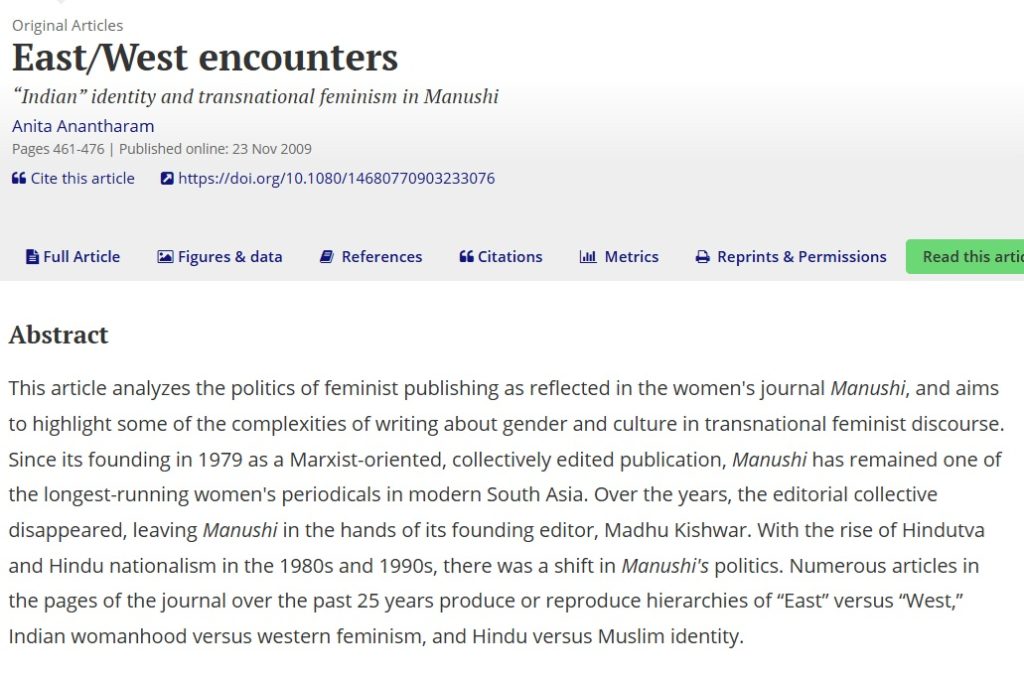
Anantharaman and later feminist commentators also document a clear ideological inflection in Manushi after Vanita’s departure. Under Kishwar’s sole editorial control, the journal began to host, and in many cases endorse, Hindu nationalist narratives – on Ayodhya, personal law and minority rights within what had been a largely secular feminist space. By the early 2000s, most of the prominent feminists who had once published in Manushi had distanced themselves from it, seeing it as part of a growing Hindutva ecosystem rather than an autonomous women’s movement platform.
This shift pre‑dated Narendra Modi’s national rise. The Hindutva capture of Manushi was largely complete by the late 1990s, even as Ruth Vanita went on to become a pioneering scholar of same‑sex love in Indian literature and a Lambda Literary Award finalist – work that sat uneasily with Kishwar’s later attacks on queer rights, such as her criticism of Deepa Mehta’s film Fire as importing “Western” ideas.
Ayodhya, Hindutva And The Logic Of Power
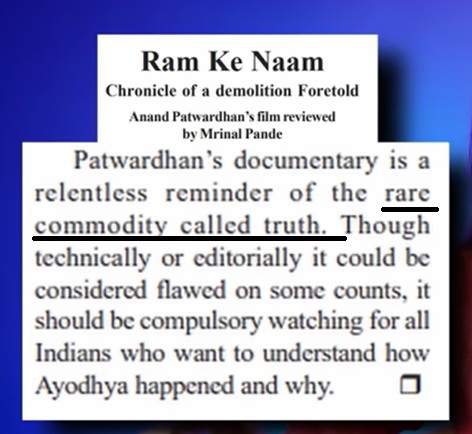
Kishwar’s record on Ayodhya illustrates how her positions track shifting political centres of gravity. In 1992, soon after the demolition of the Babri Masjid, Manushi Issue 73 carried a positive review of Anand Patwardhan’s documentary Ram ke Naam, calling it a “rare commodity called truth.”
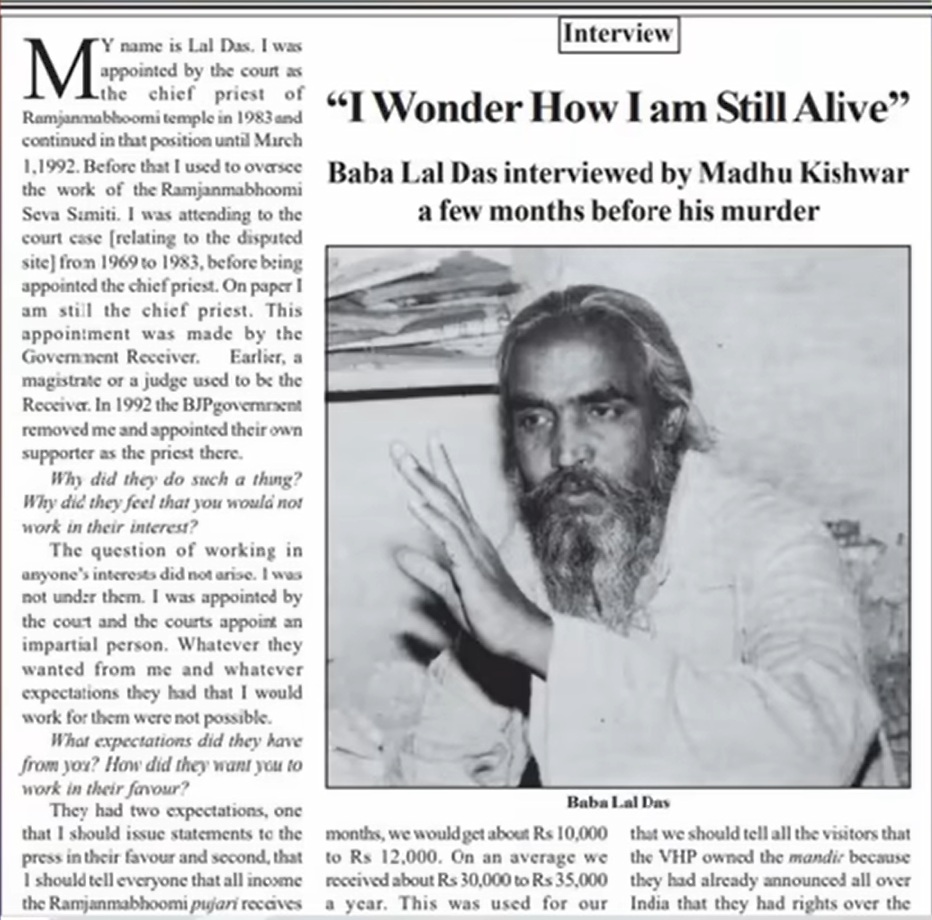
The magazine also published interviews with figures like Ayodhya Pujari Laldas, including pointed questions about the need for another grand temple when thousands already existed – positions broadly aligned with secular opposition to the Ram Janmabhoomi movement.
In later years, however, Kishwar moved emphatically into the camp that celebrated the temple project and framed criticism of the movement as hostility to Hindu civilisational rights. No single doctrinal argument explains this pivot; one plausible reading is that her politics repeatedly recalibrate to match where she perceives power and momentum to lie, whether in Left feminism in the 1970s or Hindutva in the 1990s and 2000s.
Kashmir Dialogues And Separatist Outreach
Her engagement with Kashmir in the UPA years further reinforces that pattern. In November 2009, in the middle of a period when the Manmohan Singh government had opened channels to separatist leaders like Yasin Malik, Kishwar organised a high‑profile dialogue on “The Future of Jammu & Kashmir” at CSDS in Delhi. Accounts from Kashmiri Pandit bloggers and commentators, hostile to the event, describe it as heavily featuring Yasin Malik and other Hurriyat‑aligned speakers, with opposing voices outnumbered and “frequently interrupted.”
One must remember the open letter Kishwar wrote to Malik with the salutation “Dear Yasin, with good wishes, Madhu Kishwar,” using it to argue that she was too indulgent of separatist narratives.
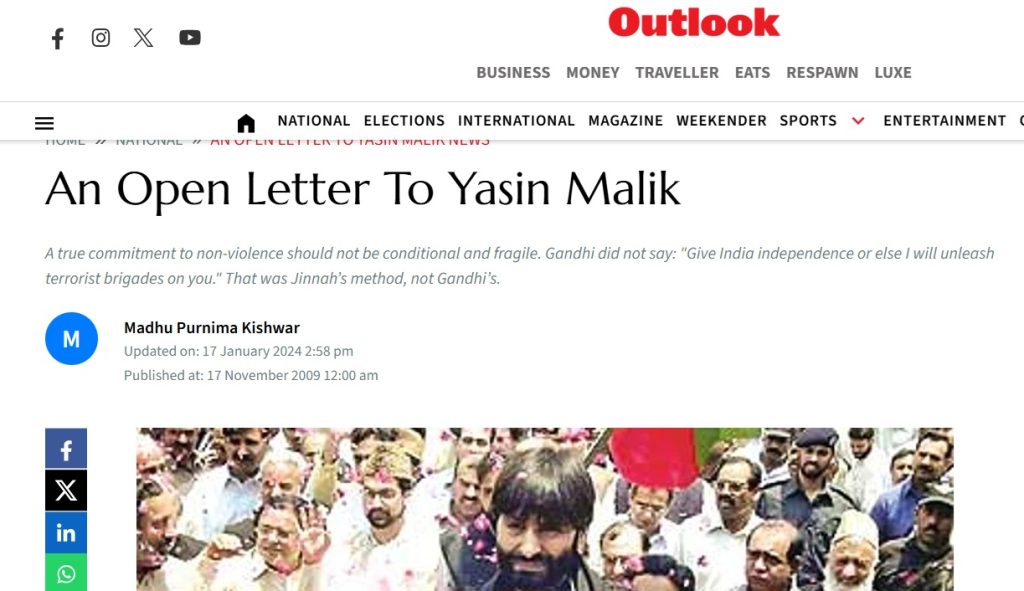
Whether one sees this as principled engagement or opportunistic alignment with the then‑dominant UPA line, it sits awkwardly with her later habit of branding critics of the state in Kashmir as “urban Naxals” and “anti‑nationals.”
Modi, “Modinama” And The Sharma Defamation Case
The next major ideological turn came with Narendra Modi’s ascent from Gujarat chief minister to national contender. By 2012–13, Kishwar had become one of his most prominent public defenders in English media, running a series titled “Modinama” and positioning herself as an independent feminist who had investigated and debunked the narrative of Modi’s complicity in the 2002 riots.
View this post on Instagram
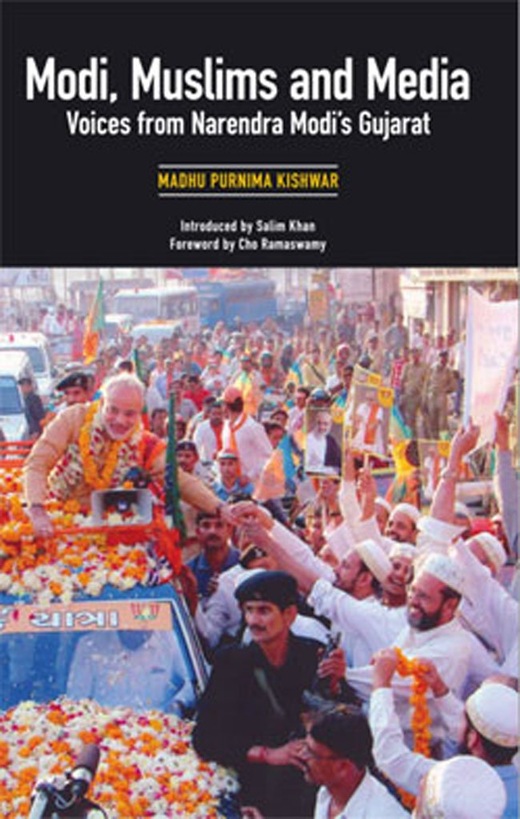
This culminated in her 2014 book Modi, Muslims and Media, a 400‑page defence that frequently likened Modi to Mahatma Gandhi and attacked what she called “conflict entrepreneurs” manufacturing cases against him via rejected petitions and dubious witnesses.
It was in this context that suspended IAS officer Pradeep Sharma filed a defamation complaint against her in November 2013. Sharma’s criminal case before a metropolitan magistrate in Ahmedabad alleged that Kishwar had made defamatory statements about him on television and Twitter while defending Modi, including calling him a “liar” and accusing him of being part of a conspiracy to malign the Gujarat chief minister. The complaint sought ₹1 crore in damages and invoked section 500 of the IPC.
The episode matters because a decade later, Kishwar would invert her stance: where she once insisted Sharma’s allegations were politically motivated and unreliable, she now treats him as a key witness against Modi. The allegations and petitions have not changed; the power equation and her position in the ecosystem have.
Fake news, FIRs and the “factarian” claim
Parallel to her ideological zigzags, there is a documented pattern of Kishwar sharing misleading or false content, often of a communal nature, and facing pushback from police, fact‑checkers and complainants.
In July 2018, she tweeted that J&K Director General of Police S P Vaid had been removed at the behest of then chief minister Mehbooba Mufti to appease “jihadi” forces, implying a terror‑sympathetic purge in the police. This was found to be fake news.
In November 2020, Kolkata Police registered a case against her after she posted a video of a political rally in Bangladesh and claimed it showed Muslims in Kolkata shouting “Pakistan Zindabad.” Hindustan Times and Millennium Post reported that police booked her under sections of the IPC and Information Technology Act for “spreading misinformation” and that she deleted the tweet after a #FakeNewsAlert, blaming the error on “an otherwise reliable friend.”
Fact‑checking outlet BOOM documented a series of such episodes in a 2019 piece titled “Madhu Kishwar’s Never‑Ending Tryst With Fake News.” These include her sharing a fabricated quote card falsely attributed to journalist Rana Ayyub, despite earlier debunks; miscaptioned videos linked to communal incidents; and misleading claims around protests and riots.
Separately, lawyer Prashant Bhushan filed a criminal complaint in 2018 accusing her of promoting enmity and spreading falsehoods about the Kathua rape and murder case, including attempting to link the crime to “jihadi Rohingyas”; in his filing, he described her as a “serial fake news purveyor.” In November 2013, during the Tarun Tejpal sexual assault scandal, a complaint to Goa Police alleged that Kishwar had illegally tweeted the survivor’s identity, violating Section 228‑A IPC.
These episodes complicate her self‑description as a “factarian” whose opinions are rigorously rooted in verified evidence. Far from being isolated mistakes, they form a pattern of amplification of unverified content that aligns with her ideological line, followed by apologies or deflection to unnamed “reliable friends” when pushed.
From Champion To Accuser: The Anti‑Modi Turn
Around 2014, Kishwar appeared to expect that her enthusiastic support for Modi and her book would translate into institutional recognition and proximity to power – at minimum advisory roles, and, according to some political commentary, perhaps even a Rajya Sabha nomination.
She seemed jealous that Smriti Irani was handed a Rajya Sabha seat along with a ministry. In this interview with Vrinda Gopinath, her jealousy is revealed.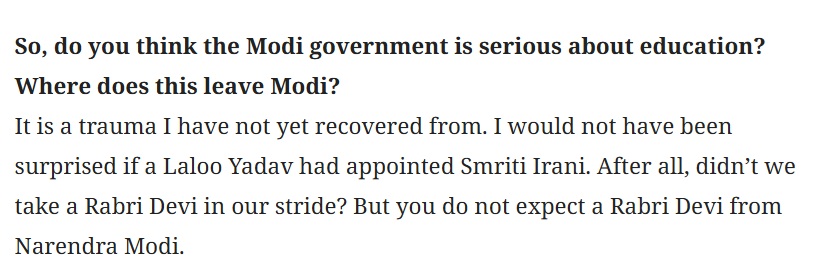 She even claimed someone had done black magic on PM Modi because he gave that RS seat to Irani.
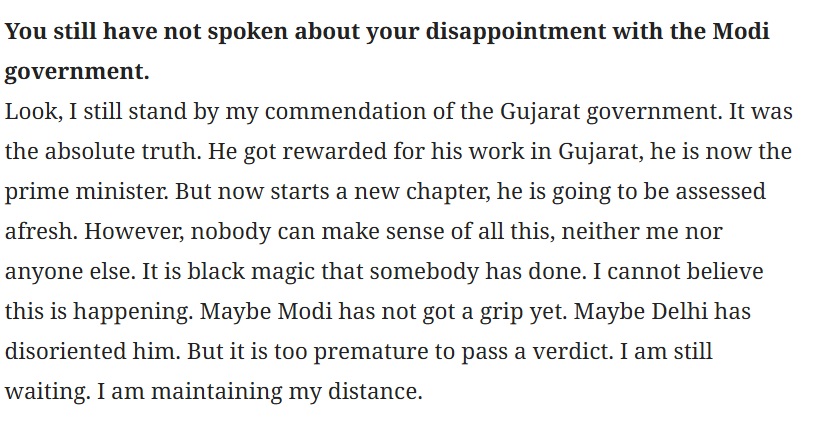
Here is another article from News Arena India.

Whether or not that expectation was realistic, it did not materialise. By the second term of the Modi government, her social‑media tone had cooled; by 2025-26, it had swung to full‑blown hostility.
Recent threads and videos show her calling Modi a “satanic ruler,” a “CIA plant,” and a puppet of the “American deep state,” sometimes weaving these claims into grand narratives about Soros, ISI, PFI and the Indian Left jointly orchestrating a “Ghazwa‑e‑Hind” plot in which Modi is supposedly their agent. These allegations are not accompanied by testable mechanisms or verifiable documentation; they function as classic unfalsifiable conspiracy theory, where absence of evidence is reframed as proof of a cover‑up.
Crucially, the evidentiary backbone of her new anti‑Modi campaign appears to be the same set of Pradeep Sharma petitions and allegations she once dismissed as malicious. In her 2014 book, she attacked “conflict entrepreneurs” who built narratives on discredited petitions and hostile witnesses; in 2026, critics argue, she has become precisely the kind of conflict entrepreneur she once criticised, recycling old material she previously rubbished because it now suits her feud with the regime.
A Career Of Shifting Centres
Seen together, the phases of Madhu Kishwar’s public life sketch a pattern more complex than simple ideological evolution. From Left‑leaning student radical to feminist editor, from Ayodhya sceptic to Hindutva publicist, from separatist‑dialogue organiser to defender and then accuser of Modi, her positions have often moved in tandem with changing power centres and audience markets.
None of this negates the real work she and Manushi did in bringing women’s issues into public debate, nor does it mean every criticism she now levels against Modi is automatically false. But the documented record of court complaints, police statements, fact‑checkers’ archives and peer‑reviewed scholarship shows a repeated pattern of strategic repositioning and casualness with facts.
When a public figure has inhabited so many sharply different ideological selves, and when those shifts so often align with changing incentives, audiences are entitled to ask a hard question: why should people trust her?
With inputs from The Pamphlet
Subscribe to our channels on WhatsApp, Telegram, Instagram and YouTube to get the best stories of the day delivered to you personally.