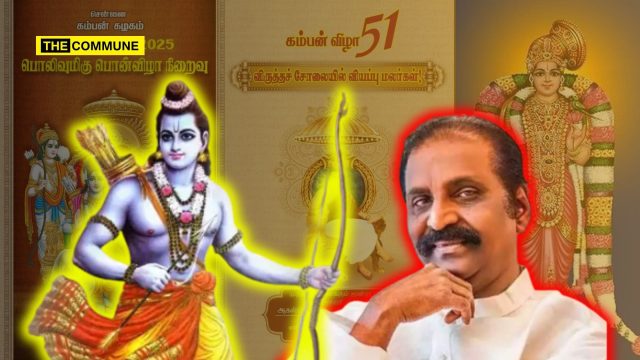
On 6 August 2025, we reported that sexual harassment accused Vairamuthu was going to be awarded the Kavi Chakravarthy Kamban Award by DMK MP Jagathrakshakan’s Azhwar Research Centre.
Speaking at the Chennai Kamban Kazhagam event during the organisation’s 51st year celebrations, Vairamuthu stirred controversy yet again by speaking extensively on how the Tamil epic Kamba Ramayanam reshaped the portrayal of Lord Rama, offering a literary redemption for the deity in contrast to earlier depictions in Valmiki’s Ramayana – how he did this was through his interpretation of Lord Rama’s actions in the Ramayana, drawing parallels between the Vali episode and the legal defence for acts committed by persons of unsound mind under Section 84 of the Indian Penal Code.
Vairamuthu approached the topic by saying, “I had a desire for fame. It was only after I became famous that I realized why this fame is an unwanted desire. When you think you want fame, you have to prepare yourself for slander and humiliation. Defamation and slander are the remains of fame. Only if you are ready to accept these remains of fame can you desire fame. There is no such thing as fame alone. Do you know what that fame does to you? It lulls you to sleep. Sometimes sleep itself becomes intoxicating and kills you. That is what happens. When that fame comes, slander comes.”
Then he jumped on to Kamban. He said, “The one who wiped out this slander is Kamban. The one who wiped out the slander that happened to Rama. Kamban. Do you know why he wrote the poems? That is the reason he writes poems. I am taking this epic and writing it. A poet inserts a head, ears, eyes, into the poem but inserts the words into the heart. What crime did he commit or was committed against him? They asked Variyar, what crime was committed against him? He was born in the Raghu dynasty. Rama should have called him Rama Surya. Why did they call him Ramachandra? Rama Surya is the Raghu dynasty. Why did they call him Ramachandra? Variyar said that he was the one who would kill Vali from hiding and bear the consequences. He was called Ramachandra. Surya has no shame, Chandra has shame. Rama was shamed. So he was called by comparing him to Chandra, said Variyar. Variyar failed to forgive Rama’s crime and shame. Variyar is not ready to forgive. Valmiki did not forgive him either. Every question Valmiki’s Vali asks is like shooting an arrow from the front and it coming out from the back. He asks, “What kind of a royal family are you from? You are not from a royal family. You are a sinner disguised as an ascetic. Who is saying this? Valmiki’s Vali looks at Rama and says, “You are a sinner disguised as an ascetic. An old well covered with grass, if I step on it thinking it is grass, I will die. I will drown. I will be destroyed. You are that well.
He further continues, “The next question he asks is, “Why did you kill me? I am from the monkey family. The sages will not use my skin. And the ascetics will not eat my flesh. Then why are you trying to kill me?” All these questions are not in Kamba Ramayanam. It is in Valmiki Ramayanam. Both Valmiki and Vali are not ready to forgive. After seeing that sword/arrow has entered his body, every word Vali speaks seems like an unforgivable punishment, but Kamban saves Rama, comrades. That is where we realise how much importance was given to poets like us. He says, “You have made a mistake. What mistake have you found in me?” Vali asks, “What wrong have you found in me?” Then he asks, “You did one thing in your country. You did another thing in the forest. You gave your kingdom to your brother in your country. You gave my kingdom to my brother in the forest. Oh, you sinner, you have done two different things. You gave the kingdom that you should rule, to your brother. You gave the kingdom that I should rule, to my brother. How have you done this? But it’s okay, that’s where you changed your mind.”
Then Vairamuthu explains the verses. He says, “If you see the strength, beauty, extension, depth that can be found in this word, you should pay close attention to it. The action, like a bewilderment, is what this bewilderment means. I have seen that the word is the most powerful thing in the world. The word is, not people, not the constitution, not the government, not power, not money, but the word is most powerful. Because this word I have been using this word for 5 thousand years, and it will be ruled for another 50 thousand years. This word does not belong to me. I am completely accepting it. Do you know how much I take a word that does not belong to me? I take that much. The speed of the word is faster than the speed of the light. It takes eight minutes and 20 seconds for the first ray from the sun to touch this earth. The sun’s ray does the work it should do in eight minutes and 20 seconds, but for the earth and the sky. If a poet writes, he touches the sun and returns to the ground in two words. The word is faster than the sun. He said that word. He acted in bewilderment. What is bewilderment? Bewilderment means awe. Another word is bewitchment. This is the word. Beauty is bewitchment. The mind is bewitched. Rama, who separated from Sita, lost his mind.”
This is where he makes even more derogatory interpretations. Vairamuthu explains the Tamil poet Kamban’s Kambaramayanam, saying Kamban “saved Rama” by portraying him as having lost mental clarity after being separated from Sita. This, he claimed, was akin to the IPC’s provision that a person of unsound mind cannot be held criminally liable. He says, “ The crime committed by a person who has lost his mind is not a crime. The Indian Penal Code Section 84 of the Indian Penal Code says that a person who has lost his mind due to a mental disorder cannot be held guilty of an act committed by him. The message of Section 84 of the Indian Penal Code is that whether Kamban knows this or not, he does not know the law. He knows society, he knows psychology. With this forgiveness, a criminal named Rama is also freed. He forgives Rama and makes Rama a human being. Rama becomes a human being at that place, while Kamban becomes a god. The character is a human being; the creator is God. This is the difference between a character and a poet.”
Subscribe to our channels on Telegram, WhatsApp, and Instagram and get the best stories of the day delivered to you personally.