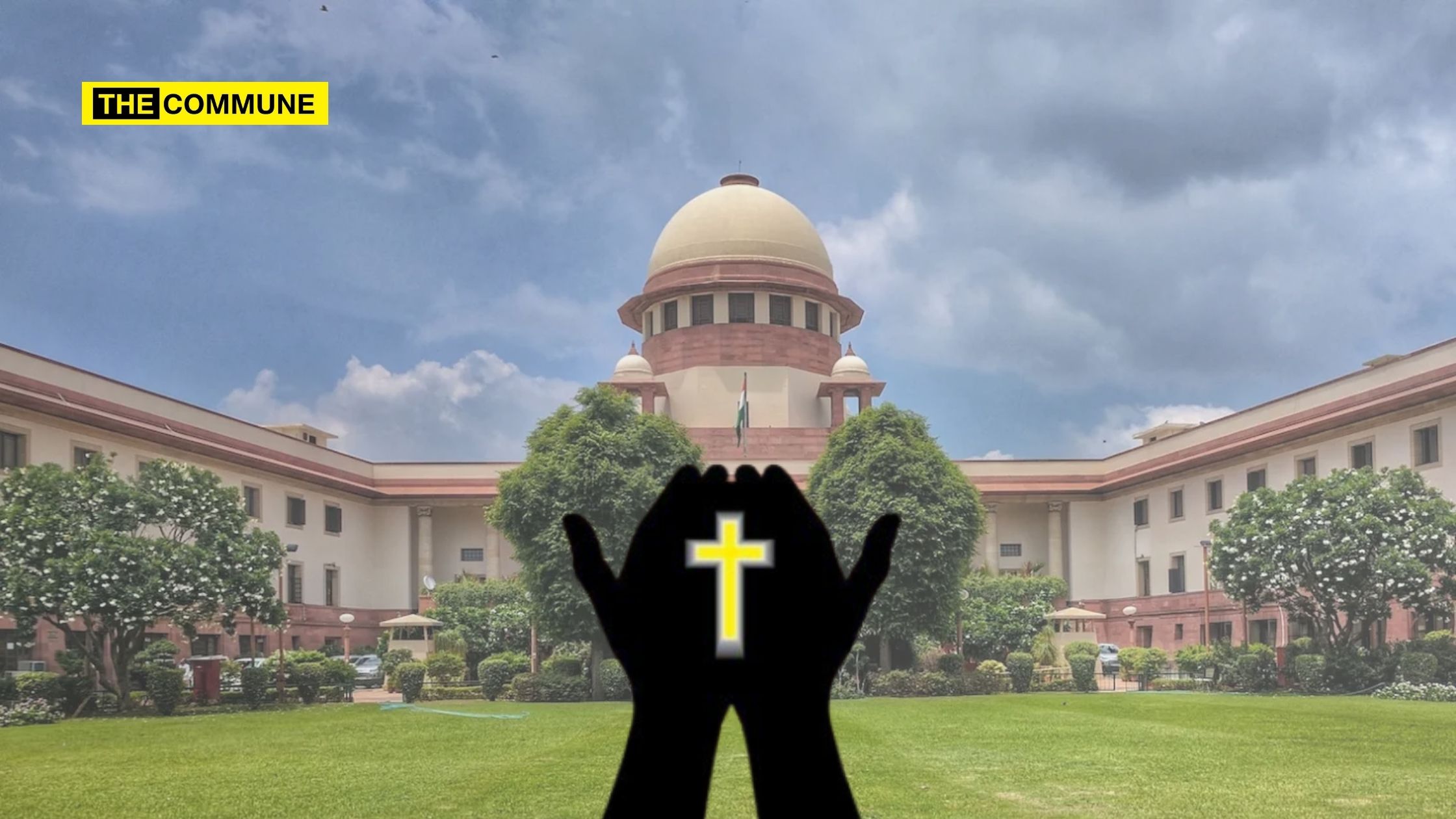
The Supreme Court of India has raised concerns over certain provisions of the Uttar Pradesh Prohibition of Unlawful Conversion of Religion Act, 2021, while quashing FIRs filed against the Vice Chancellor and other officials of the Sam Higginbottom University of Agriculture Technology and Science (SHUATS), Prayagraj, over allegations of forced mass religious conversions to Christianity.
The bench, comprising Justices JB Pardiwala and Manoj Misra, noted that the UP Act places a “very onerous burden on a person wanting to adopt a faith other than the one he professes.” The Court emphasized that the people of India enjoy liberty of thought, expression, belief, faith, and worship, describing this freedom as “an embodiment and expression of the secular nature of the country.”
While the bench clarified that the constitutional validity of the UP Act was not under consideration in the case, it expressed certain prima facie views. The Court observed that the Act’s requirement for individuals to make a declaration before the District Magistrate regarding conversion introduces significant State interference in personal matters. Under the law, the District Magistrate is legally obliged to direct a police enquiry in each case of intended religious conversion. The Court also questioned whether the statutory provision requiring public disclosure of personal details of converted persons aligns with constitutional privacy rights.
“In the preamble to the Constitution of India the words ‘SOCIALIST SECULAR’ were inserted by the Constitution (42nd Amendment) Act, 1976. The secular nature of India is an intrinsic part of the ‘basic structure’ of the Constitution, as held in Kesavananda Bharati Sripadagalvaru v. State of Kerala reported in AIR 1973 SC 1461,” the bench noted. “As laid down in the Preamble, the People of India, have resolved to secure to all its citizens, liberty of thought, expression, belief, faith and worship, apart from Justice, social, economic and political; Equality of status and of opportunity and to promote among them all fraternity, assuring the dignity of the individual, and the unity and integrity of the Nation. It requires no further exposition that the Preamble to the Constitution is of extreme importance and the Constitution should be read and interpreted in the light of the noble and grand vision expressed in the Preamble. The People of India are given the liberty of thought, expression, belief, faith and worship. This liberty is an embodiment and expression of the secular nature of the country.”
The Court outlined the procedure mandated by the UP Act. Pre-conversion, a person desiring to convert must submit a declaration 60 days in advance before the prescribed authority, confirming that there is no force, coercion, undue influence, or allurement. The individual performing the conversion is also required to give a one-month advance notice to the authority, which then directs the police to conduct an enquiry. Failure to submit a pre-conversion declaration can result in imprisonment of up to three years and a minimum fine of ₹10,000.
Post-conversion, the individual is again required to submit a declaration within 60 days. The authority is then mandated to publicly display a copy of this declaration, including personal details such as permanent address, place of residence, and the nature of the conversion process. The convert must appear before the prescribed authority within 21 days to verify the declaration and establish their identity.
The Supreme Court also referenced landmark judgments to highlight the constitutional protections surrounding religious freedom. Citing the KS Puttaswamy verdict, the Court stated that Article 25 encompasses privacy rights, including freedom of conscience and the choice to express beliefs publicly. Referencing Shafin Jahan v. Asokan K.M, the bench underlined that while the Constitution guarantees the right to practice, profess, and propagate religion, an individual’s autonomy is supreme in choices of faith and belief, which extends to personal decisions such as marriage.
During the hearing, the bench remarked that some provisions of the UP Act appear to violate fundamental rights guaranteed under Part III of the Constitution, particularly Article 25, and that the Act’s pre- and post-conversion procedures introduce onerous steps that may require further scrutiny.
The Supreme Court’s observations come amid ongoing challenges to similar “love jihad” laws, including pending cases against the Gujarat Freedom of Religion (Amendment) Act, 2021. A division bench of the Gujarat High Court, comprising then Chief Justice Vikram Nath and Justice Biren Vaishnav, had earlier noted that the law “interferes with the intricacies of marriage, including the right to the choice of an individual, thereby infringing Article 21 of the Constitution.” An interim order was issued ensuring that the Act’s provisions would not apply to inter-faith marriages conducted without force, allurement, or fraudulent means.
(With inputs from LiveLaw)
Subscribe to our channels on Telegram, Instagram and YouTube to get the best stories of the day delivered to you personally.