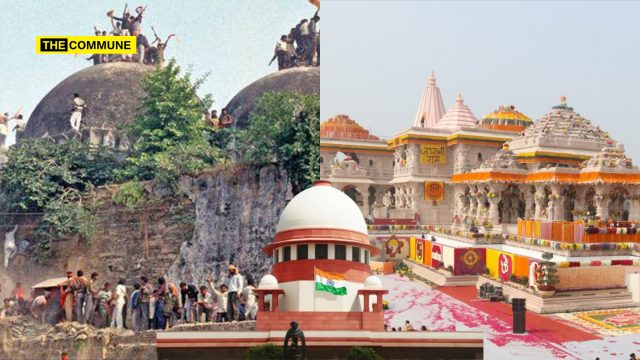
The Supreme Court of India has declined to intervene in the case of Mohd. Faiyyaz Mansuri, a young law graduate who sought to quash criminal proceedings initiated against him for a 2020 Facebook post referencing the Babri Masjid.
The post in question stated: “Babri Masjid too will one day be rebuilt, just as the Sofian Mosque in Turkey was rebuilt.”
Hearing the matter, a Bench of Justices Surya Kant and Joymalya Bagchi said it found no reason to halt the trial and allowed the criminal proceedings to continue before the lower court.
The case originated from an FIR filed in 2020, alleging that Mansuri had uploaded an “objectionable” Facebook post about the Babri Masjid on August 5 that year. His plea challenging the summons was earlier dismissed by the Allahabad High Court, prompting him to move the Supreme Court.
After reviewing the post, the Supreme Court said it saw “no reason to interfere” and observed that the defences raised by the accused could be presented before the trial court. Following these remarks, Mansuri chose to withdraw his plea.
Background of the Babri Masjid Dispute
The Babri Masjid, a mosque in Ayodhya, was demolished in 1992 by Hindus who stated it had been constructed over a temple marking the birthplace of Lord Ram. The demolition triggered widespread communal riots and decades of legal disputes.
In 2019, the Supreme Court ruled that although the demolition was unlawful, the Hindu parties had successfully established exclusive possession of the outer courtyard of the disputed site. The Court granted the land to the deity Ram Lalla, paving the way for the construction of the Ram Mandir in Ayodhya, while directing that five acres of alternative land be allotted to the Muslim parties for a new mosque.
Mansuri’s Arguments
In his petition, Mansuri argued that his Facebook post was an expression of opinion protected under Article 19(1)(a) of the Constitution, which guarantees freedom of speech and expression.
He contended that the post contained no “vulgar or inflammatory language” and that he was being “wrongly targeted” for comments made by other users on the post. Mansuri claimed that third-party remarks were incorrectly attributed to him and formed the basis of the criminal case. One of the accounts responsible for the allegedly offensive comments, he said, was a fake profile run by someone else.
Mansuri also told the Court that he had already been detained under the National Security Act (NSA) for over a year because of the same post. The Allahabad High Court had later quashed his preventive detention in 2021, holding that there was no legal justification for it.
His counsel described the ongoing prosecution as “malicious, selective, and an abuse of criminal law.” The petition argued that the High Court had disregarded the principles laid down in State of Haryana v. Bhajan Lal – a landmark ruling that outlines circumstances under which criminal proceedings can be quashed. Instead, the High Court had passed a “cryptic” order asking for a speedy trial without examining whether the FIR disclosed any offence, the plea said.
Exchange in the Supreme Court
During the hearing, Mansuri’s lawyer maintained that the post contained no vulgar language, asserting that any objectionable content was written by another user.
He told the Bench, “My post doesn’t have any vulgarity. The vulgarity is there in some other person’s post.”
Justice Surya Kant responded that the Court would not make any comment on the post’s content, saying, “Please don’t invite any comment from us.”
The counsel urged the Bench to at least review the post before making a decision, leading to a brief exchange.
“See my post at least,” the lawyer said. “We have seen your post,” Justice Kant replied.
The counsel disagreed, insisting, “My lords have not seen it.”
Justice Kant repeated firmly, “We have seen it. We have read it many times.”
When the lawyer again said, “My lordships have not seen the post,” Justice Kant warned, “Don’t say that we have not seen it. How can you say we have not seen it? If you behave like this, you must face the consequences.”
The lawyer then reiterated that the charges were based on comments from other people, not on Mansuri’s own words. Justice Kant, however, maintained the Court’s position and refused to interfere.
Petition Withdrawn
Eventually, Mansuri’s counsel said he would withdraw the petition to avoid any remarks from the Court that might affect his defence during trial. The Supreme Court allowed the withdrawal, making it clear that the trial would proceed in the lower court.
The Bench also noted that Mansuri could raise all his arguments regarding free speech and alleged wrongful prosecution during the trial.
(Source: LawChakra)
Subscribe to our channels on WhatsApp, Telegram, Instagram and YouTube to get the best stories of the day delivered to you personally.