In a sweeping and unusually evocative judgment, the Madurai Bench of the Madras High Court on January 6, 2026, upheld the lighting of the traditional Karthigai Deepam atop Thirupparankundram Hill, opening its common order with a line from the Bible that set the tone for what followed.
“God said, ‘Let there be light’, and there was light.”
Quoting Genesis 1:3, the Division Bench of Justice G. Jayachandran and Justice KK Ramakrishnan framed the dispute not merely as a question of administration or law and order, but as one involving faith, history, religious practice, and the limits of State power.
The judges described the phrase as symbolising “creation, hope, and divine power,” before proceeding to dismantle the objections raised by the Tamil Nadu government and other authorities to the lighting of the Deepam on the hill’s stone lamp pillar, known locally as the Deepathoon.
The judges observed that a dispute which could have been resolved through dialogue had instead been “escalated by some disgruntled elements,” adding pointedly that attempts were made “to demoralize and demean the judiciary with the might of power.”
In a striking passage, the Bench thanked a senior counsel for reminding the court of the maxim Fiat justitia ruat caelum – let justice be done though the heavens fall.
Background: Appeals Against The Single Judge’s Order
The batch of appeals arose from a December 1 order of a single judge directing the Arulmigu Subramania Swamy Temple administration to light the Karthigai Deepam at the Deepathoon situated on top of Thirupparankundram Hill. When the order was not implemented on the festival day, the single judge permitted devotees to light the lamp themselves.
This led to appeals by the State government, police authorities, HR&CE Department, Tamil Nadu Waqf Board, and the Hazarath Sultan Sikkandar Badhusha Avuliya Dargah, all of whom sought to stay or overturn the direction.
They argued that the order would disturb public peace, that it was against Agama Shastra, it would invent a new custom, and that the matter should be decided by a civil court, not a writ court.
A Hill Laden With History, Faith, And Contestation
The court devoted substantial space to documenting the physical, historical, and religious character of Thirupparankundram Hill, underscoring that the dispute could not be understood without appreciating its layered past.
The hill, rising to about 1,050 feet, houses the ancient Subramania Swamy cave temple at its foothills, several Hindu shrines along its slopes, Jain caves with Tamil-Brahmi inscriptions, water springs (sunai), and the Sikkandar Badhusha Dargah at its highest peak. The judges noted that these structures were built in different periods, not contemporaneously, reflecting successive layers of religious presence rather than exclusive ownership.
Drawing from archaeological records, scholarly works, and earlier judicial inspections dating back to the 1920s, the Bench observed that Hindu religious structures predated later Jain and Islamic constructions on the hill. The presence of the Dargah, the court noted, did not fragment the hill into separate entities, rejecting the claim that there were “two hills” belonging to different communities.
“This is one hill consisting of two peaks and few summits at different levels,” the court held, adding that misconceptions about separate hills had no factual basis.
Privy Council, Precedent, And Property Rights
A significant portion of the judgment revisited earlier litigation, particularly the landmark 1931 Privy Council decision in Re Madura, Tiruparankundram Devasthanam vs Alikhan Sahib. Quoting extensively, the Bench recalled how the Privy Council had described the entire hill as sacred, worshipped as Swamimalai or God’s Hill, and treated as part of the temple’s religious domain.
The Privy Council had categorically held that the unoccupied portions of the hill had been in the possession of the Devasthanam “from time immemorial,” and that British authorities themselves had refrained from interfering with temple rights.
By reproducing these findings, the High Court made it clear that the claim of the State or other bodies that the Deepathoon lay outside established Hindu religious usage was untenable.
No Iota Of Doubt
Summarising the past submissions by all the parties involved, judgements made before in the same case, and also noting some other court orders, the court stated, “No one can have even an iota of doubt about the fact that lighting lamp at the hill on the full moon day of Tamil month, Karthigai is a religious usage and
part of Tamil Culture. The said culture and usage is followed throughout the State and even in neighboring States from time immemorial. Therefore we hold that, writ petitions seeking enforcement of a religious practice in protection of
fundamental right deserve to be entertained.”
The court added, “The prime reason to hold so is that the issue touches upon the religious freedom to profess and practice, which is protected under Article 25 (1) and also the freedom of expression protected under Article 19 (1) (a) as well as Article 29
(1) of the Constitution of India, which guarantees citizens of all sections, residing in the territory of India or any part thereof having a distinct language, script or culture of its own, shall have the right to conserve the same.”
The High Court’s Critique Of The State Government
The Division Bench delivered sharp observations on the role and conduct of the Tamil Nadu Government and its district administration:
a) Failure To Uphold Constitutional Duties
“The State, through the District Administration, should have taken this as an opportunity to bridge the difference between these two communities… Unfortunately, due to lack of conviction, all these years the peace meetings have paved way only for widening the mistrust.”
b) Imaginary Threats To Public Order
Perhaps the most scathing passages were reserved for the government’s repeated invocation of public peace.
“It is ridiculous and hard to believe that a mighty State fears that permitting representatives of the Devasthanam to light a lamp on one day in a year would disturb public peace,” the judges remarked.
The court went further, issuing a warning that bordered on an indictment: “Such disturbance can happen only if it is sponsored by the State itself. We pray no State should stoop to that level to achieve its political agenda.”
“The apprehension expressed by the District Administration regarding probability of disturbance to the public peace is nothing but an imaginary ghost created by them for their convenience sake and to put one community against another under suspicion and constant mistrust.”
c) Accusation Of Bias and Inaction
“The Government failure to bring about comity among the two communities but to keep the line of separation is once again exhibited… The State administration had failed to take note of the observations made by the Learned Judge… The State expects the Temple devotees to surrender for existence.”
d) Refusal To Demarcate Boundaries
The Court noted that the Government repeatedly refused to survey and demarcate the Dharga area despite judicial suggestions, thereby perpetuating the conflict.
The “Deepathoon”: A Lamp Pillar, Not A Survey Stone
A major contention was whether the stone pillar was a Deepathoon (lamp pillar) or a British-era survey marker. The Court categorically rejected the survey-stone theory.
“The submission that the Deepathoon is a figment of imagination of the Judge or the devotees is wholly unacceptable,” the court held, noting that the pillar is a visible physical structure supported by records and site inspections.
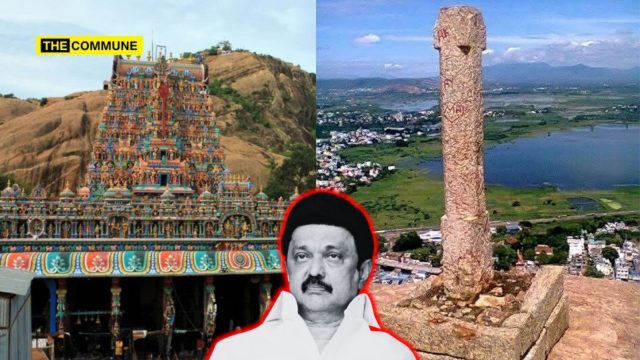
Visual Evidence: The pillar had a carved design, a rectangular base, and a bowl-shaped top suitable for holding oil and wick.
Historical Records: The Court examined Great Trigonometrical Survey records (1879) and noted that survey markers were simple dots and circles on rock, not ornate pillars.
State’s Contradiction: The Court observed that even the State and HR & CE Department did not consistently claim it was a survey stone, instead calling it a “granite stone” or a “Jain lamp post.”
The court stated, “The stone pillar with provision to light lamp, in Tamil called as ‘Deepathoon’. The location of the pillar is in the portion of the hill declared by a competent civil Court as property of the Devasthanam. The Waqf Board, as on date have no locus in this matter. For the first time in the course of argument in the intra Court appeals, on behalf of the Waqf a mischievous submission was made that the lamp pillar belongs to Dharga. This plea we would say, had deterred and added yet another reason for the other side to be skeptical about the offer made by the Waqf Board for Court monitoring mediation.”
The court also said, “The Deepathoon is not an ordinary granite stone pillar or survey stone as contended by the appellants. Neither it is Jain lamp pole. The Deepathoon has a cavity carved in such a way to hold the cotton stick and oil. The pillar has always been identified as ‘Deepathoon’ or ‘Seegara thoon’.”
Rejection Of “Agama Shastra” Opposition
The Court dismissed the argument that lighting the lamp elsewhere was against Agama Sastra.
The court stated, “The Deepathoon meant for lighting lamp to the visibility of surrounding villages, is the most appropriate place to light the lamp during Karthigai Deepam festival. In fact, lighting Maha Deepam at the motchadeepam pole, is against Agamasastra. It is always appropriate to light the mahadeepam during Karthigai month at a vantage point visible to nearby villagers as far as possible. Lighting deepam outside the Temple on one of the peaks in the hill is not in violation of any ‘Agamasastra’. It is well settled by judicial pronouncements, that the essential practices and non-essential practices for a religion has to be considered, when faith and belief of worshippers is involved.”
No Textual Evidence: The Government relied on hearsay from Sthanikars but produced no scriptural proof that the lamp must be lit only straight above the sanctum sanctorum.
Precedents From Other Temples: The Court cited Thiruvannamalai and Thiruchirapalli, where lamps are lit on hilltops visible to the public, not aligned with the deity.
Symbolism Of Light: The Court referenced Thirumoolar’s Thirumanthiram, which describes light as the personification of Lord Shiva, reinforcing the spiritual significance of lighting lamps at elevated sites.
Judicial Overreach? No – Restoration Of Custom
The appellants argued the Single Judge exceeded jurisdiction by “inventing a new custom.” The Division Bench firmly disagreed, “The Learned Judge has not invented any new custom… The order impugned is restoration of the custom already in existence.”
The Court highlighted that the 1996 judgment in W.P.No.18884 of 1994 had already permitted the Devasthanam to consider alternate sites for lighting the lamp, subject to a 15-meter buffer from Dharga properties.
Waqf Board And Dargah Claims: Court Finds No Legal Basis
The Tamil Nadu Waqf Board and the Hazarath Sultan Sikkandar Badhusha Avuliya Dargah argued that the stone pillar belonged to the Dargah and that allowing the lighting of the Deepam would interfere with their enjoyment of land allegedly granted to them in 1920.
The Division Bench rejected this claim in clear terms.
“The submission that the stone pillar belongs to the Dargah has not been substantiated by any formidable evidence,” the court held.
The judges noted that mere assertions of ownership, without documentary proof or historical continuity, could not override long-recognised temple rights.
Importantly, the Bench pointed out that this claim only deepened mistrust rather than resolving the dispute: “The plea that the pillar belongs to the Dargah only adds to the scepticism of the other side regarding the mediation process,” the court observed.
The Bench also rejected the argument that the single judge had denied the Dargah an opportunity to present its case.
“We find no merit in the contention that sufficient opportunity was not afforded. The appellants had ample occasion to place their materials before the Court,” it ruled.
Missed Chance For Mediation
Rather than treating the issue as a flashpoint, the Bench said the district administration and Waqf authorities should have facilitated dialogue.
“The administration ought to have taken this as an opportunity to bridge the gap between the communities through mediation,” the court noted.
Instead, it observed, prolonged indecision and inconsistent positions allowed suspicion and tension to fester.
Final Directions: “Only Light, Not Fight”
The Court disposed of all appeals with the following operative directions:
- The Devasthanam shall light the lamp at the Deepathoon during Karthigai Deepam.
- No public congregation will be allowed; only a limited team from the Temple, with police and ASI coordination.
- The District Collector shall supervise the event.
- All activities must comply with the Ancient Monuments and Archaeological Sites and Remains Act, 1958.
- The 15-meter buffer is only a safety guideline, not an absolute restriction.
The Court concluded with a hopeful note: “We hope, by implementing the below directions, which can be suitably modified whenever festival of respective community falls, then there will be only light and not any fight.”
Subscribe to our channels on WhatsApp, Telegram, Instagram and YouTube to get the best stories of the day delivered to you personally.