


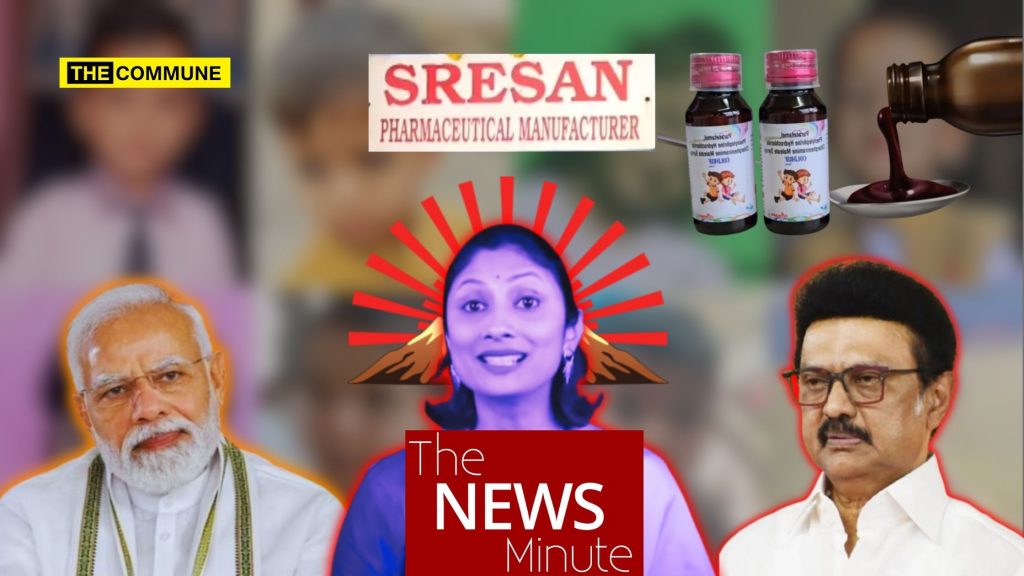
In the wake of yet another tragic cough syrup scandal that claimed the lives of children in India, platforms like The News Minute and its “journalists” like Pooja Prasanna have positioned themselves as fearless crusaders against a failed system. Their narrative, however, is not one of impartial investigation but of a carefully curated, politically convenient hit job. While rightly slamming systemic failures, they perform all kinds of acrobatics to shield their political master – the Dravida Munnetra Kazhagam (DMK) government in Tamil Nadu from the very scrutiny they demand of others.
While she proudly claims that “the truth in the Madhya Pradesh case came out only after the Tamil Nadu Directorate of Drugs Control tested the samples and found them containing nearly 50% Diethylene Glycol (DEG),” she conveniently pushes the blame squarely on the Central and Madhya Pradesh government – lucky for her both are BJP! She said, “But the Madhya Pradesh FDA cleared Coldrif claiming it was free of contamination. The Union Health Ministry repeated the scheme without conducting its own tests.”
Well, the TN Directorate did the tests only after the children died because the origin of the cough syrup was a manufacturer in TN!
The manufacturer of the deadly ‘Coldrif’ syrup, Sresan Pharmaceuticals, operated out of Tamil Nadu. The license to manufacture drugs, a sacred trust to protect human life, was granted to this company by the Tamil Nadu drug regulatory authorities, which operate under the TN government’s Health Department – now the ruling government is the DMK.
Before a drug can kill children in Madhya Pradesh, it must first be produced unsafely in its home state. The primary, most fundamental layer of regulation rests with the state licensing authority.
Under India’s Drugs and Cosmetics Act, 1940, and its rules, the manufacturer (production unit) is legally required to test all raw materials, intermediates, and finished formulations.
Each batch must pass quality control (QC) before release.
The company’s in-house or approved lab conducts these tests for purity, potency, identity, and contamination.
Only after satisfactory results and batch release certificates can the product be marketed or transported to other states.
The Tamil Nadu drug control department, under the DMK government, catastrophically failed in its most basic duty: ensuring that a manufacturer within its jurisdiction was not producing poison. This is the ground-zero failure.
The “Political Donations” Angle: A Reckless And Unsubstantiated Allegation
Pooja Prasanna tries to establish that pharma companies donate to political parties and that some of these companies have violations. However, it does not provide a single piece of evidence that a specific donation led to a specific regulatory favor, such as a dropped investigation or a waived inspection. It implies a direct quid pro quo without proving it. This is the most contentious part from an Indian perspective, as it veers into unsubstantiated conspiracy theory.
The report presents the regulatory system as a monolithic failure. However, India’s drug regulation is a federal matter, primarily implemented by State Drug Control authorities.
The report heavily implies that political donations directly buy immunity from prosecution. However, it provides zero evidence linking a specific donation from a violating company to a specific regulatory favor. In India, where political funding is a complex and legal activity, this is a serious allegation made without concrete proof.
It states that 7 of the 35 donating companies were “under investigation.” Being under investigation is not a conviction. Due process is a cornerstone of any democracy, including India’s. To insinuate that all companies under investigation are guilty and are bribing their way out is a violation of the principle of “innocent until proven guilty.”
Prasanna lists down all the drug related deaths allegedly caused by India’s pharmaceuticals as if to portray India in a poor light. At a time when PM Modi speaks about Atmanirbharta in all sectors, when India is aiming to become the leader in the pharma industry, making drugs in India for the world, Pooja Prasanna and TNM’s attempt to push propaganda seems like an effort to please their western masters and add yet another blackmark to the country.
This narrative, aired without irrefutable proof, can be seized upon by international competitors to unfairly damage the reputation of the entire $50 billion Indian pharmaceutical industry, which is a critical source of affordable medicine for the Global South and a point of national pride.
What Pooja Prasanna does not tell you is that in 2023, the Central Drugs Standard Control Organization (CDSCO) made testing for contaminants like DEG and EG mandatory for all cough syrup exports before release.
The government has blacklisted and cancelled the licenses of several manufacturers involved, such as Marion Biotech and Digital Vision.
The draft New Drugs, Medical Devices and Cosmetics Bill, 2022 is explicitly mentioned but framed as an unfinished failure, without acknowledging it as a proactive (if delayed) step to modernize a colonial-era law.
Lack Of Context On The Scale Of The Industry
The report focuses on the failures but provides no context for the massive scale of the Indian pharmaceutical sector.
India is the world’s largest producer of generic drugs, supplying over 50% of global demand for various vaccines and 20-22% of generic medicine exports. To highlight a few criminal manufacturers without mentioning that thousands of Indian companies comply with global standards (supplying to the US, EU, etc.) creates a distorted image that all “Indian-made medicines” are suspect.
The report dismisses the economic pressures of producing ultra-low-cost medicines for a price-sensitive population like India’s and the developing world. While this never excuses adulteration, a holistic Indian perspective would recognize the challenge of maintaining quality at rock-bottom prices, a challenge Western regulators rarely face to the same degree.
Narrative Of A “Failed State” And Selective Comparison
The tone and framing paint a picture of a negligent state that does not care about its children.
The report praises the US FDA’s response to its 1937 tragedy but fails to mention that the US system itself has had major failures (e.g., the Opioid crisis). Furthermore, it doesn’t acknowledge that the US FDA is a century-old, centrally funded agency with a budget of over $6 billion, while India’s CDSCO and state authorities are severely understaffed and underfunded in comparison, managing a much larger and more diverse market.
The report criticizes the government’s advisories to doctors as “shifting the burden.” From an official Indian perspective, these advisories are a prudent and immediate public health measure to save lives while systemic reforms are implemented. It is a standard practice worldwide to issue such advisories during a health crisis.
There is no denying the tragedy or the need for robust regulation. However, journalism that focuses its fire exclusively on one particular party while ignoring the failures of those actually responsible loses all claim to impartiality. The News Minute, by omitting the Tamil Nadu regulator’s key role and twisting the narrative, scavenges engagement from the deaths of 23 children.
Subscribe to our channels on Telegram, WhatsApp, and Instagram and get the best stories of the day delivered to you personally.