In yet another astonishing display of editorial selectivity, or should we say loyalty to paymasters?, leftist rag The Wire’s coverage of the US-China Economic and Security Review Commission’s 2025 report appears more interested in praising Pakistan’s “military success” and highlighting Chinese weaponry than confronting a far more serious concern: China’s use of artificial intelligence to run an orchestrated disinformation campaign against India during Operation Sindoor.
The article, titled “‘Pakistan’s Military Success over India in its Four-day Clash Showcased Chinese Weaponry’: US House Panel,” gushingly reiterates how Pakistan used Chinese hardware—J-10 jets, HQ-9 missile systems, and PL-15 air-to-air missiles—to allegedly down Indian Rafales, turning the battlefield into a showroom for Chinese exports.
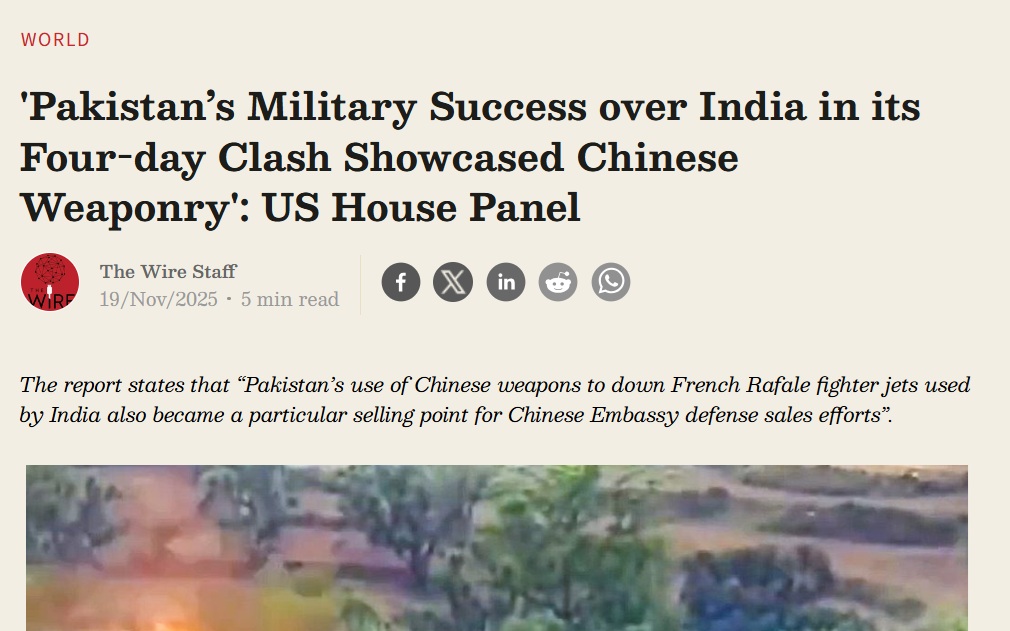
The Wire even echoes the report’s mention of Indonesia pausing its Rafale purchase due to this “success.” But what the rag deliberately omits is perhaps the most damning portion of the US report: China’s fake news operation using AI-generated images and social media bots to push lies.
What The Wire Didn’t Tell You
The same US-China Economic and Security Review Commission report that The Wire selectively quotes from also contains a critical section that the publication chose to completely ignore. The report explicitly states: “Following the May 2025 India-Pakistan border crisis, China initiated a disinformation campaign to hinder sales of French Rafale aircraft in favour of its own J-35s, using fake social media accounts to propagate AI images of supposed debris from the planes that China’s weaponry destroyed.”
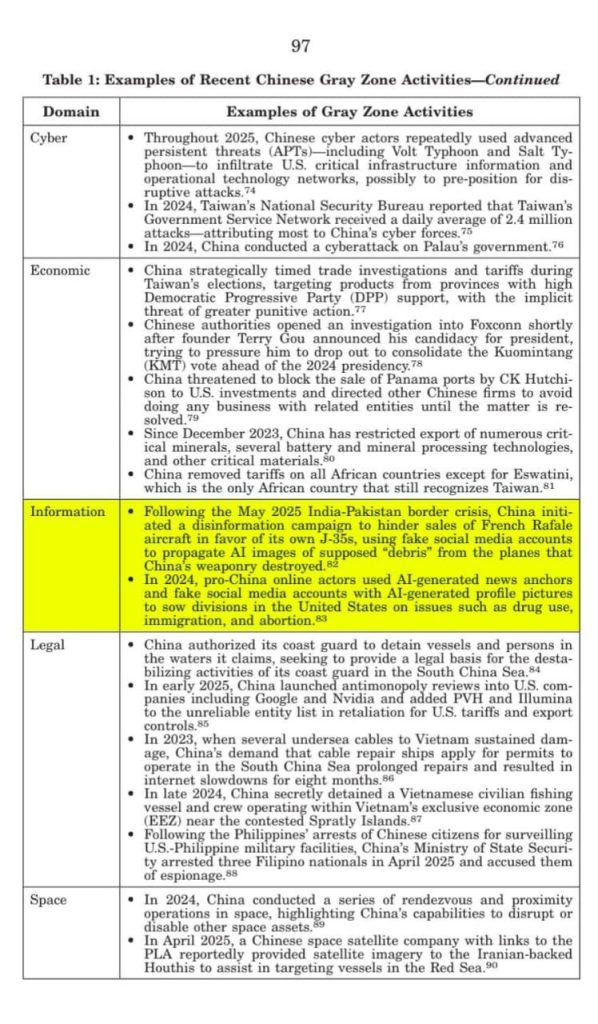
Let that sink in.
The very “success” of Chinese weapons that The Wire uncritically amplifies was actively peddled through a covert influence operation involving AI-generated imagery, fake social media accounts, and a systematic campaign to manipulate global opinion. This wasn’t just battlefield performance; it was information warfare. And The Wire became an unwitting, or perhaps willing, megaphone for it.
This isn’t an isolated oversight. It fits a disturbing pattern where certain Indian media platforms, under the guise of “critical journalism,” consistently amplify narratives that align with the interests of those hostile to India.
- No mention of how Chinese embassy officials led this disinformation drive.
- No mention of how the campaign sought to sabotage Rafale sales to Indonesia.
- No mention of the well-documented collaboration between Chinese state actors and Pakistani propaganda machinery to undermine India’s strategic position.
Despite its self-proclaimed mission of critical journalism, The Wire chose not to report on Beijing’s disinformation war against India, a campaign so blatant that French intelligence flagged it and global media covered it. Instead, it sanitized China’s role, omitted Pakistan’s complicity, and spotlighted Rafale losses without a shred of skepticism. Where was the scrutiny of Chinese propaganda tactics? Where was the outrage over AI-generated lies masquerading as battlefield truth?
Instead, The Wire offers its readers a one-sided glorification of Pakistani military capability and Chinese technological prowess, a narrative that Beijing and Rawalpindi would be hard-pressed to market so effectively on their own.
And let’s not forget the wider implications. China and Pakistan conducted joint “counterterror” drills just months before the conflict, and Chinese naval forces participated in AMAN war games alongside Pakistan in early 2025. By June, China was offering Pakistan 40 fifth-generation J-35s and KJ-500 early warning aircraft. This wasn’t just opportunism; it was orchestration. Yet, The Wire offers no context – is it because it doesn’t serve its purpose of an anti-India narrative setting?
When a supposedly “progressive” Indian outlet echoes Beijing’s propaganda victories and ignores its lies, it ceases to be a platform for dissent and becomes a megaphone for distortion.
Subscribe to our channels on WhatsApp, Telegram, Instagram and YouTube to get the best stories of the day delivered to you personally.