


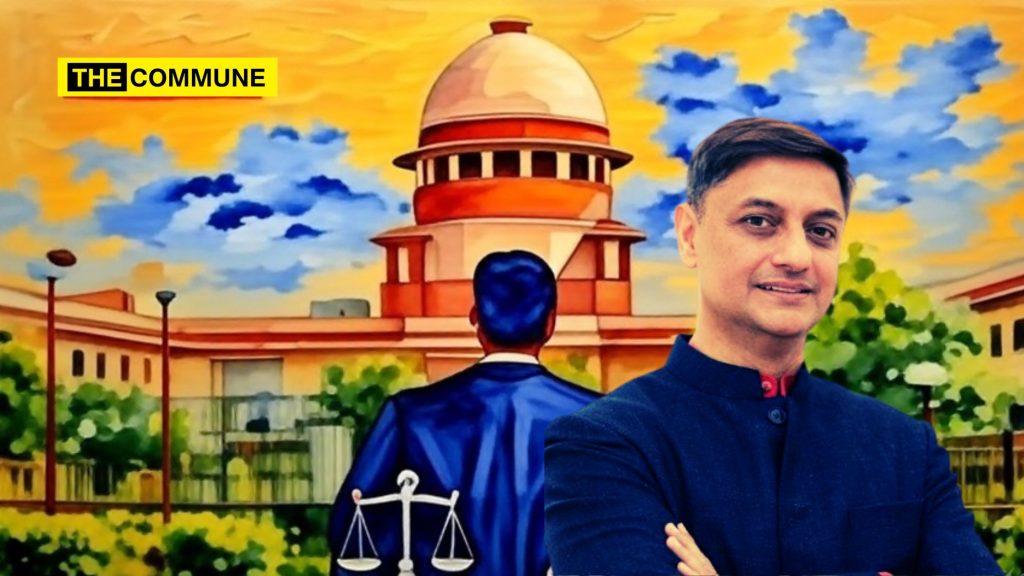
Advocate Shashi Ranjan Kumar Singh has written to Attorney General of India R. Venkataramani seeking consent to initiate criminal contempt proceedings against Sanjeev Sanyal, Member of the Economic Advisory Council to the Prime Minister (EAC-PM), over his recent remarks on the judiciary.
In his petition under Section 15 of the Contempt of Courts Act, 1971, Singh alleged that Sanyal’s comments “scandalize the Supreme Court and undermine public confidence in India’s judicial system.” He said that while Article 19(1)(a) of the Constitution protects fair criticism of judgments, “statements which bring the judiciary into disrepute are not.”
Citing widely reported articles, Singh stressed that Sanyal’s position as a government advisor gave his remarks “significant influence,” making the alleged contempt “particularly serious.” According to him, Sanyal’s statements describing the judiciary as a hurdle to national development exceeded the limits of permissible criticism.
In a related development, Senior Advocate Vikas Pahwa issued a strongly worded letter to Sanyal, objecting to his public remarks characterizing the judiciary as the “biggest hurdle” in India’s aspiration to become Viksit Bharat.
Pahwa cautioned that such sweeping criticism risked undermining the institution which he described as “the backbone of our Constitutional framework.” In his letter dated September 23, 2025, he wrote: “The judiciary does not obstruct progress, it ensures development within the framework of Constitutional values, liberty and fairness. To call it the biggest hurdle is extremely unfortunate.”
While acknowledging the importance of judicial reforms, Pahwa maintained that independence and constitutional oversight could not be sacrificed for efficiency. He noted that delays in justice were often due to shortages of judges and inadequate infrastructure, “failures that require executive support, not judicial blame.” He added: “A nation’s progress cannot be measured merely by the speed of contracts or clearances; it must be judged by whether liberty, justice and equality are preserved along the way.”
What Did Sanjeev Sanyal Say?
Speaking at the Nyaya Nirmaan 2025 conference on 20 September 2025, Sanjeev Sanyal warned that unless the legal and judicial ecosystem undergoes a major overhaul, other reforms would not be sufficient to achieve the ‘Viksit Bharat’ vision.
“We effectively have somewhere between 20-25 years to become Viksit Bharat,” Sanyal told the gathering, stressing the urgency of reform. “The judicial system and the legal ecosystem, but the judicial system in particular, is now, in my view, the single biggest hurdle to becoming Viksit Bharat and growing rapidly.”
He framed his argument around India’s demographic advantage and economic growth prospects. Noting that India has just become the world’s fourth-largest economy and remains the fastest-growing major economy, he cautioned that the window for converting growth into prosperity was limited. “After that we will grow old, just like Japan and Europe today. So, this is the two decades in which we have to grow as rapidly as we can,” he said.
Identifying slow dispute resolution and weak contract enforcement as core issues, Sanyal explained how these shortcomings force regulators to over-engineer rules. “In any functioning system, that 1% of exception should actually get sorted out by the legal system. But because I do not think it will get sorted out there, the rest of the 99% of rules, regulations and laws… I have to do is effectively to take care of that 1%,” he said.
As an example, he criticised mandatory pre-litigation mediation under Section 12A of the Commercial Courts Act, 2015. Citing data from commercial courts in Mumbai, he said, “between 98-99% of pre-litigation mediation actually fails,” arguing that the process only added months, fees, and complexity without reducing court caseloads. He further pointed out that a push to make such mediation mandatory for civil cases nearly passed in 2023 before being halted after objections.
Beyond procedural reforms, Sanyal called for cultural and structural change within the legal profession. He criticised what he described as a mediaeval, guild-like hierarchy of senior advocates, advocates-on-record and others, questioning why many routine legal tasks still required a law degree “in the age of AI.” “If I, as a citizen, can figure out how to argue my case… I should be allowed to do it,” he said, urging clearer procedures and greater accessibility.
He also pressed for modernization of courtroom practices. “You cannot have a profession where you use words like ‘my lord’… It is not appropriate for one citizen to call another citizen ‘my lord,’” he said. He also objected to long judicial vacations, arguing they effectively shut down justice for extended periods. “The judiciary is a public service like any other part of the state,” he remarked, adding that court availability should match public expectations of other state services.
Emphasising the urgency of reform, Sanyal concluded with a direct appeal to the legal community. “We don’t have time to waste. We all have to pull together,” he said. “I’ve really come here to beseech my fellow citizens that you from the legal profession really pull up your socks. Because we are waiting for you to really push for this.”
Earlier in May, Sanyal had also spoken about the need for judicial reforms, describing the present system as outdated. He said: “We will have to change the justice system. Think about this ‘tareekh pe tareekh’ system. What is this? We say this is from the colonial time. For seventy-five years we have the same system… The High Courts and the Supreme Court take leave in summer and then take leave again in Dussehra. What is this system? They work for a few hours. All these old systems will have to be changed, and modernise it. The government can contribute to this to some extent. But in the end, the justice system will have to do it on its own.”
He had also criticized the collegium system, claiming it lacked merit-based appointments and instead fostered nepotism and favoritism. Drawing a comparison with his own role as government advisor, Sanyal argued that meritocracy was essential in judicial appointments “to ensure fairness and competence.”
(With inputs from LawBeat)
Subscribe to our channels on Telegram, WhatsApp, and Instagram and get the best stories of the day delivered to you personally.