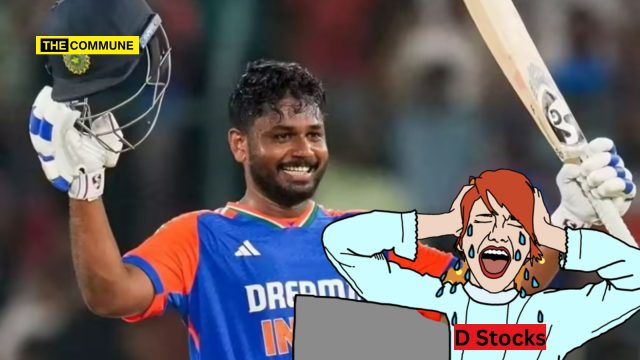
India’s T20 World Cup hero Sanju Samson, fresh off his Player of the Tournament performance, including a stunning 89-run knock that powered India to the title said something in a recent interview that will puncture every Dravidianist stock and Dravidianist politician’s claims in Tamil Nadu.
Asked about his language skills, Samson smiled and said: “Yeah, I didn’t actually learn it consciously, actually. I grew up in Delhi for my first seven, eight years. So, Hindi came very automatically. And then, where I come from, Vizhinjam, that’s a border of Tamil Nadu. So, people speak Tamil there. We watch a lot of Tamil movies. So, Tamil came on very automatically as well. So yes, definitely knowing Hindi and Tamil definitely helped me to connect a bit more with my Indian teammates. So I definitely connect equally with Abhishek Sharma and Arshdeep Singh and also equally with Varun Chakravarthy and Washington Sundar. So, it’s a blessing which automatically came, and I really enjoy it.”
Sanju Samson just casually dropped a reality check for the professional language warriors.
Knowing Hindi and Tamil along with Malayalam didn’t make him less of a South Indian, it made him a better teammate. While the keyboard activists are busy gatekeeping, Sanju is busy winning… pic.twitter.com/AsggCsz7fP— Smita Deshmukh🇮🇳 (@smitadeshmukh) March 17, 2026
The Man Who Naturally Has It All
Sanju Samson was born in Pulluvila, a coastal village near Vizhinjam, Thiruvananthapuram district, a town that sits right on the border of Tamil Nadu and Kerala. His father, Samson Viswanath, was a Delhi Police constable and Santosh Trophy footballer, meaning Sanju grew up spending his formative first seven to eight years in Delhi, before returning to Kerala.
The result? A man who speaks Malayalam, Hindi, Tamil, and English with equal comfort – not as a political stunt, but as the natural outcome of a genuinely Indian life. He watches Tamil films. He grew up in Hindi-speaking Delhi. His teammates span the entire linguistic geography of India. And he sees all of this not as a contradiction, but as a blessing.
What the Dravidian Stockists Have Been Saying
Meanwhile, in Tamil Nadu just across the border from Sanju’s hometown, the Dravidianist political machinery has been running at full blast on the Hindi-imposition issue ahead of the 2026 Assembly Elections.
In January 2026, CM MK Stalin wrote to DMK party cadres calling the 2026 election “another theatre of the Aryan-Dravidian war” and accused the BJP of withholding education funds unless Tamil Nadu accepted the three-language policy.
In January 2026, Deputy CM Udhayanidhi Stalin declared that “Hindi is the language that has devoured several other languages” and vowed to resist any imposition.
DMK MP Kanimozhi led protests against railway signboards in Chennai that she claimed showed “blatant Hindi imposition” by the Central government.
The DMK’s own official website runs a dedicated page on “Tamil Nadu’s Stand Against Hindi Imposition”.
The political message is consistent: Hindi is the enemy. Learning Hindi is surrender. Resisting Hindi is Tamil pride.
Sanju Samson’s remarks reflect lived reality, not politics. He said Hindi came naturally from growing up in Delhi and Tamil from life near the Tamil Nadu border, showing language as connection, not conflict. He highlighted how knowing both helped him bond equally with teammates across regions, offering a quiet rebuttal to decades of linguistic fear narratives. In contrast, political actors oppose Hindi publicly but use it when convenient. Samson, with no such calculation, represents cultural confidence where languages coexist and strengthen unity.
Subscribe to our channels on WhatsApp, Telegram, Instagram and YouTube to get the best stories of the day delivered to you personally.