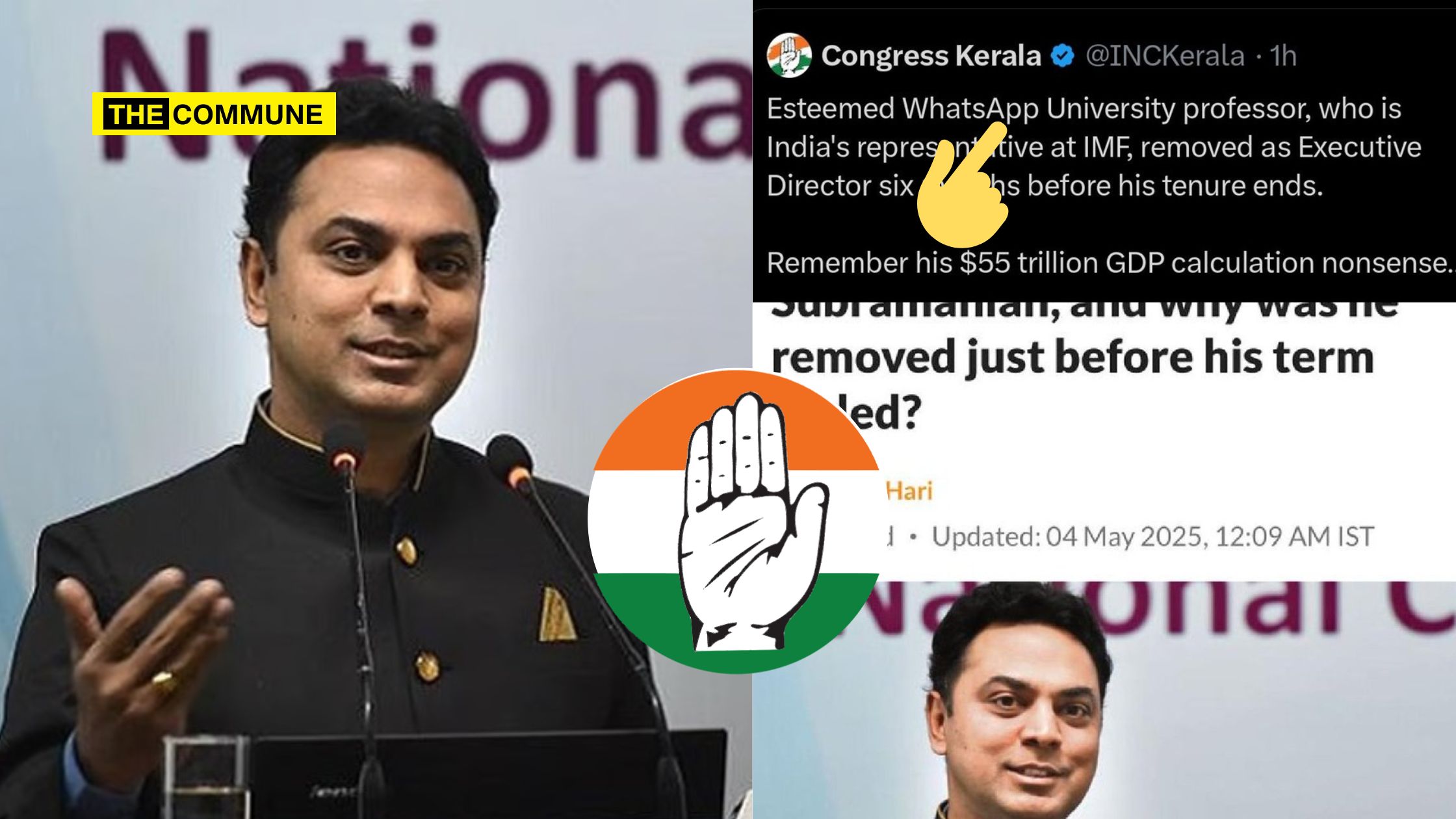
At a time when India is gearing up for a high-stakes vote at the International Monetary Fund (IMF) to block financial aid to Pakistan over terror-financing concerns, the Kerala unit of the Indian National Congress has chosen to mock and belittle the country’s official representative. In a tweet dripping with sarcasm and malice, Kerala Congress on its X handled made a post referring to Dr. Krishnamurthy V Subramanian as a “WhatsApp University professor” and mocked his early exit from the IMF’s Executive Board.
This isn’t just juvenile political banter. It borders on dangerous propaganda—and sounds eerily like something you’d expect from Beijing or Islamabad, not from a party that once led India.
Context Matters: Why Now?
Dr. Subramanian’s abrupt recall from the IMF has raised eyebrows across the diplomatic and economic spectrum. The move came just days before a crucial IMF board meeting scheduled for 9 May 2025, where India is set to oppose funding for Pakistan.
Pakistan, reeling from economic collapse and global scrutiny over its support for terror groups, is once again at the IMF’s door. But this time, India’s stand is rooted in more than just economic rivalry. The 22 April 2025 terror attack in Pahalgam that killed 26 tourists—orchestrated by Pakistan-backed groups—has pushed India to demand a re-evaluation of IMF funds being routed to Islamabad.
Subramanian, known for his independent thinking and forthright positions, had reportedly raised objections to the quality of IMF datasets and was uncomfortable with decisions that could indirectly benefit Pakistan. His exit, therefore, is as much a diplomatic maneuver as it is an institutional reshuffle.
Kerala Congress’s Statement: A Propaganda Gift To China And Pakistan
Into this highly sensitive geopolitical moment walked the Congress’s Kerala unit—with a tweet that does not just criticize policy, but insults a distinguished economist and undermines India’s diplomatic position on the world stage. The post read, “Esteemed WhatsApp University professor, who is India’s representative at IMF, removed as Executive Director six months before his tenure ends. Remember his $55 trillion GDP calculation nonsense and defending the current GDP formula? We are glad that the government has finally realised the embarassment he could cause, even by their standards. Good riddance! Now Mr. Subramanian can return to WhatsApp University as a full time faculty.”
Esteemed WhatsApp University professor, who is India's representative at IMF, removed as Executive Director six months before his tenure ends.
Remember his $55 trillion GDP calculation nonsense and defending the current GDP formula? We are glad that the government has finally… pic.twitter.com/gLrRvneBjp
— Congress Kerala (@INCKerala) May 4, 2025
This comes at a time when that very seat is crucial in a vote to block funds to Pakistan.
This is not a political critique. This is information warfare—conducted seemingly wittingly by a national political party, using language and framing that mirrors what Chinese or Pakistani propagandists might say. It betrays either a deep ignorance of the stakes involved or something far more cynical.
China’s Influence On IMF
China’s influence in the International Monetary Fund (IMF) is growing significantly, even though its financial contribution stands at around 6% of the IMF quota. Over the past decade, China and other fast-developing economies have shifted the global economic balance, which is reflected in increased Chinese representation within the IMF. A major milestone was in 2016, when the IMF included the Chinese yuan (renminbi) in the basket of currencies that make up the Special Drawing Rights (SDR), alongside the US dollar, euro, pound sterling, and Japanese yen. Remarkably, despite being the most recent entrant, the yuan now constitutes 11% of the SDR basket—ranking third, ahead of the pound and yen—highlighting China’s rising monetary clout. This increase in influence is not just symbolic; it potentially allows China to sway IMF decisions, including loans to countries like Pakistan, thereby boosting China’s geopolitical leverage. The inclusion of the yuan also reflects the IMF’s gradual recognition of China’s global economic importance, despite ongoing concerns about China’s own financial stability.
With its Belt and Road Initiative (BRI)—of which CPEC (China-Pakistan Economic Corridor) is a key component, is Beijing lobbying for softer terms for Pakistan. Experts have warned that the IMF is now, in effect, being used to backstop Chinese debt traps.
So when Kerala Congress mocks India’s resistance to the IMF, it is hard to tell whose side they are on. They appear less concerned about a terror-sponsoring neighbour being bailed out, and more excited to attack a former government economist for daring to think independently.
From Economic Debates To National Interests
One may debate the merits of Dr. Subramanian’s $55 trillion GDP vision or his promotion of terms like “Thalinomics.” But to reduce a decorated economist with a PhD under Congress’ own favourite Raghuram Rajan to a “WhatsApp professor” is not just petty—it is reckless.
He has served with distinction at institutions like the University of Chicago, Emory University, and the Indian School of Business. As CEA, he brought fresh ideas and bold thinking to the table. But more importantly, as India’s Executive Director at the IMF, he represented not just India but also Sri Lanka, Bangladesh, and Bhutan. Mocking him in such vulgar terms weakens India’s hand in multilateral negotiations. Worse, it validates China-Pakistan talking points.
Opposition Or Sabotage?
It’s time for the Congress party to ask itself a hard question: Is there a line between political opposition and national sabotage? The Kerala unit’s tweet crossed it.
When a party’s official handle starts sounding like it’s being run from the Communist-Islamist quarters of the China-Pakistan propaganda machinery, it is not just bad optics—it is a national security concern.
The Congress high command would do well to rein in such irresponsible messaging. It’s one thing to critique economic policy. It’s another to aid enemy narratives that seek to undermine India’s credibility at global forums.
IMF, which experts say is now part of the CPEC, is going to have a crucial board meeting for approving funds to Pakistan. It needs a full board to pass any resolution. Now you know why India suddenly made its seat vacant.
But this account as usual peddles China-Pak propaganda as… pic.twitter.com/fq9dyWiRzP
— Aravind (@aravind) May 4, 2025
A Dangerous Pattern
This is not the first time such rhetoric has emerged from Congress-affiliated accounts. Whether it is casting doubt on surgical strikes, questioning the legitimacy of Balakote, or ridiculing India’s diplomatic stands, there is a disturbing pattern of playing into the hands of India’s adversaries. The same handle has also been seen posting fake news not once but several times.
At a time when the global order is rapidly polarizing—with the IMF increasingly seen as a pawn in China’s debt diplomacy—India needs clarity, unity, and maturity in its international engagements.
The Congress needs to decide whether it wants to play the role of a responsible opposition—or remain a propaganda echo chamber for India’s enemies.
India deserves a stronger opposition—one that elevates debate, not one that descends into mockery during moments of international crisis. The Congress’s tweet on Dr. Subramanian isn’t just bad politics. It’s bad for India.
(With inputs from Mint)
Subscribe to our channels on Telegram, WhatsApp, and Instagram and get the best stories of the day delivered to you personally.