


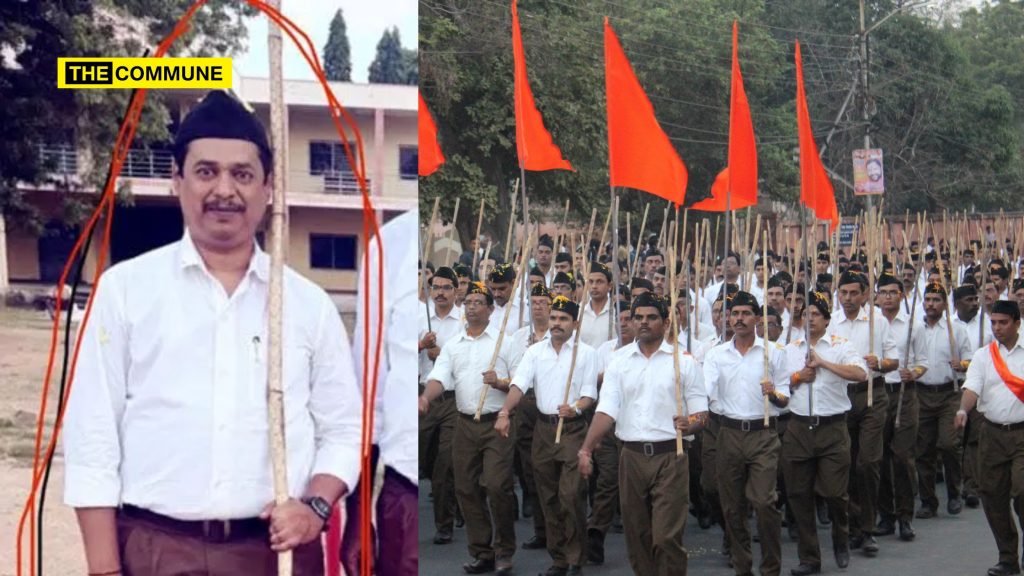
A panchayat development officer in Karnataka was suspended for attending a Rashtriya Swayamsevak Sangh (RSS) centenary event, triggering a political clash between the ruling Congress and the opposition BJP.
The officer, Praveen Kumar K.P., serving in Sirwar taluk of Raichur district, participated in an RSS route march in Lingsugur on 12 October 2025, wearing the organisation’s uniform and carrying a stick. The Rural Development and Panchayat Raj (RDPR) Department suspended him on Friday, citing violations of service conduct rules.
According to the suspension order issued by IAS officer Arundhati Chandrashekar, Kumar’s participation breached Rule 3 of the Karnataka Civil Services (Conduct) Rules, 2021, which requires government employees to maintain political neutrality, integrity, and conduct consistent with the dignity of public service. The order stated that his actions were “inconsistent with the standards expected of a public servant.” Kumar will remain under suspension with subsistence allowance pending a departmental inquiry.
The suspension comes days after the state government introduced rules requiring prior permission for all organisations, including the RSS, to hold public events. The move followed Minister Priyank Kharge’s call to restrict RSS activities in government spaces such as schools and colleges.
I have spoken to the officer suspended for taking part in RSS Pathsanchalan by the State Government.
Assured him that I will personally appear before the concerned tribunal and courts to challenge this illegal and unlawful suspension.
There are multiple judgements from across… pic.twitter.com/mQF8cKLLZm
— Tejasvi Surya (@Tejasvi_Surya) October 18, 2025
It is noteworthy that in July 2024, the central government led by the Bharatiya Janata Party lifted a decades-old ban on government employees participating in activities of the Rashtriya Swayamsevak Sangh (RSS). The order shared by many political leaders from all political parties read, “The undersigned is directed to refer to the OM (office memorandum)..dated 30.11.1966, OM No. 7/4/70-Est.(B) dated 25.07.1970 and OM No. 15014/3(S)/80- Estt. (B) dated 28.10.1980 on the above subject. 2. The aforesaid instructions have been reviewed and it has been decided to remove the mention of Rashtriya Swayam Sewak Sangh (R.S.S.S) from the impugned OMs dated 30.11.1966, 25.07.1970, and 28.10.1980.”
Echoes from A 1966 Judicial Verdict
The current suspension stands in stark contrast to a landmark 1966 judgment by the Mysore High Court in Ranganathachar Agnihotri v. State of Mysore. In that case, the court had ruled decisively in favor of a government servant’s right to RSS membership.
The 1966 case involved Mr. Agnihotri, who had secured the 14th rank in the Munsiff’s competitive examination but was denied appointment solely because he was “an active member and organiser of the local RSS unit.” The state government had then argued, much like its current position, that RSS’s tenets were “subversive and secretive and opposed to secularism.”
However, the High Court, after examining the RSS Constitution and various documents, found no evidence to support these allegations. Justice Sadasivayya, in his ruling, noted that the RSS was not a banned organization and its constitution expressly stated it had “no politics” and was devoted to “purely cultural work.”
The court categorically held that “mere membership of the RSS cannot make a person unsuitable for judicial service” and that “suitability must be judged on character and conduct, not on ideological association.” The judges directed the state to appoint Agnihotri as Munsiff, ruling that the government’s decision was based on “irrelevant considerations” and violated constitutional principles.
Contrasting Approaches
The 1966 judgment established several key principles that appear challenged by the current suspension:
Membership vs. Active Participation: While the current case involves active participation in uniform, the 1966 court made no distinction between mere membership and active organization, protecting both.
Evidence Requirement: The historic judgment required concrete evidence that an organization’s activities were unconstitutional, which the government failed to provide then and hasn’t addressed now.
Individual Conduct: The court emphasized that suitability must be determined by individual character and conduct rather than organizational affiliation.
Justice Sadasivayya observed that while the Government had the power to assess suitability, such discretion “cannot be formed arbitrarily but must rest on relevant considerations.” Since no adverse conduct or criminal antecedents were attributed to Agnihotri, the reliance on his alleged RSS association was deemed irrelevant.
The Court directed the State to appoint Agnihotri as Munsiff, placing him above respondents 2–8 in seniority, subject to medical fitness, and awarded costs of ₹200 against the Government.
While upholding the validity of Rule 4(2), the judgment clarified that the Government’s discretion under the rule must be exercised on relevant and objective grounds. The ruling established that association with a non-banned cultural body, without evidence of misconduct or anti-state activity, cannot by itself justify denial of appointment to a judicial office.
Ranganathachar Agnihotri v. State of Mysore (1966):
1. The State rejected the petitioner’s appointment because he was an active member of RSS, alleging it was “subversive, secretive and opposed to secularism.”
2. The Court found no evidence supporting these allegations.
3. RSS… pic.twitter.com/rVcDvHosrO— Girish Bharadwaj (@Girishvhp) October 21, 2025
(Source: NDTV)
Subscribe to our channels on Telegram, Instagram and YouTube to get the best stories of the day delivered to you personally.