With Bihar elections being the talk of the town, during eveyr campaign Congress scion Rahul Gandhi makes one claim after another, one promise after another. Recently, Rahul Gandhi, during recent rallies in Bihar (particularly Begusarai and Nalanda), promised that if the I.N.D.I alliance came to power at the Centre, his government would open a world-class university in Bihar, comparable to the historic Nalanda University. He stated that students from around the world would come to study there, emphasizing a personal guarantee of reviving Nalanda’s educational legacy.
Pathetic!
Rahul Gandhi claims UPA built Nalanda University with big experts
He does not say how Dr. Kalam resigned from Nalanda in disgust in 2011
Because of mishandling by UPA chamchas like Amartya Sen pic.twitter.com/O7nhEI9k7j
— Abhishek (@AbhishBanerj) November 9, 2025
But did you know that back in 2011 when UPA was in power, former president Dr Abdul Kalam resigned from the university in disgust. His resignation letter reveals a lot about what was going on inside.
The letter, written on 4 July 2011, was not initially made public and remains a stinging indictment of how the project, conceptualised as a 21st-century reincarnation of the ancient Buddhist seat of learning, was, in his view, derailed by Prof. Amartya Sen and bureaucratic overreach.
Dr. Kalam’s letter, kept out of public view until it was retrieved through an RTI application, revealed his deep disappointment with the manner in which Nalanda University was being handled. He wrote that he could “no longer remain associated” with the project, citing opaque decision-making, questionable appointments, and a loss of focus on its foundational vision.
A Project Gone Astray
Kalam had been associated with the Nalanda revival since 2007, playing a key role in conceptualizing it as an international institution rooted in India’s civilizational heritage. However, by 2011 he was increasingly uncomfortable with how the project, overseen by the Ministry of External Affairs (MEA) under the UPA government, had become, in his words, detached from its educational purpose.
The letter argued that the top leadership positions in the new university – Chancellor and Vice-Chancellor – should be filled by individuals of “extraordinary intellect with academic and management expertise” who would live and work full-time in Bihar. Instead, appointments were allegedly made through closed-door decisions.
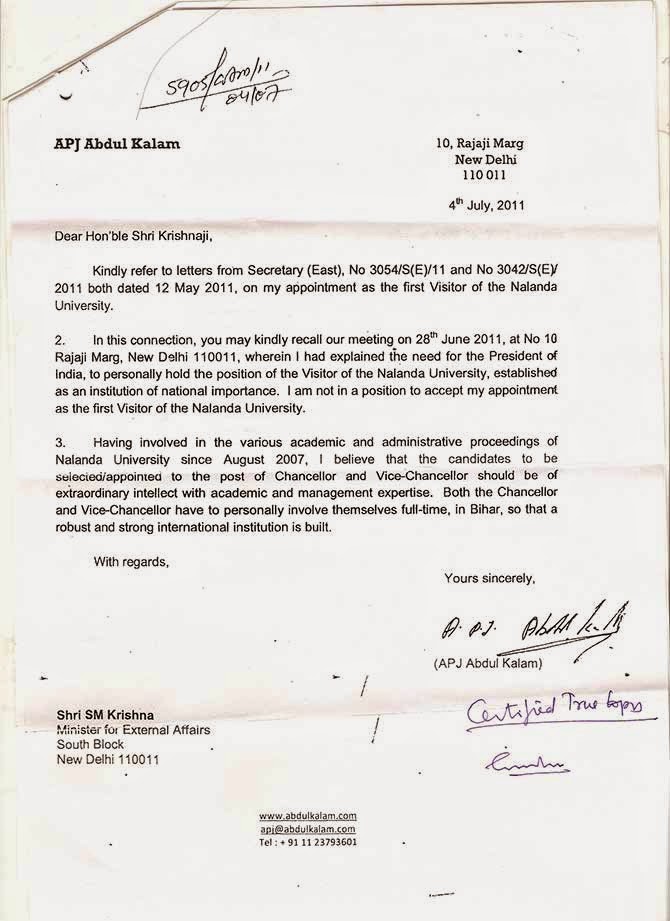
Dr. Kalam’s exit came soon after Prof. Amartya Sen, head of the university’s Mentor Group and later Chairman of the Governing Board, brought in Dr. Gopa Sabharwal, a Delhi-based sociology reader, as Vice-Chancellor-designate without his consultation.
The Rift Between Vision and Vanity
The rift between Kalam and Sen represented a clash of worldviews. Kalam saw Nalanda as a spiritual and intellectual revival of India’s ancient academic traditions, a collaborative Asian endeavour reflecting the legacy of monks and scholars such as Silabhadra, Dharmapala, and Santarakshita. Sen, on the other hand, envisioned an international liberal university modelled on Western academic structures, drawing comparisons to Oxford and Harvard.
This divergence soon became public. By the time the letter surfaced in 2012, it confirmed long-rumoured tensions between the two, between Kalam’s insistence on grounding the project in India’s educational philosophy and Sen’s cosmopolitan institutional approach.
Allegations of Nepotism and Mismanagement
The controversy deepened when RTI disclosures and parliamentary reports revealed that several appointments at the fledgling institution were made without due process. Dr. Gopa Sabharwal, appointed as Vice-Chancellor-designate in 2010, reportedly did not meet UGC norms, which require a minimum of ten years’ experience as a professor and proven academic distinction.
Her associates, including Upinder Singh, Daman Singh, and Amrit Singh, daughters of then Prime Minister Manmohan Singh, as well as her colleagues Dr. Anjana Sharma and Dr. Nayanjot Lahiri, were found to have drawn salaries from the university, some while residing abroad. The Nalanda headquarters, meant to be in Rajgir, Bihar, had also been quietly relocated to RK Puram, New Delhi, soon after the project’s formal notification.
The Standing Committee on External Affairs, in its subsequent report, noted that the project cost, initially pegged at ₹1,005 crore in 2007, had ballooned amid a lack of financial transparency. By 2015, the Finance Ministry was questioning the MEA on why government financial rules were being bypassed in what was ostensibly a publicly funded institution.
A Mentor Group Without a Mission
At the core of the criticism lay the Mentor Group chaired by Amartya Sen, which was tasked with finalizing the university’s blueprint within nine months of its creation in 2007. However, the group continued for three years, conducting meetings in Singapore, Tokyo, New York, and Delhi, costing the exchequer ₹2.11 crore, without submitting a final report or financial plan.
When the project’s Governing Board was finally constituted in 2011, Sen, as its chair, oversaw his own nomination as Chancellor in a meeting held in Beijing. This dual role sparked allegations of conflict of interest and self-appointment, further aggravating criticism of elitism and lack of accountability.
The Fallout and Political Dimensions
In the years that followed, Nalanda University became emblematic of UPA-era institutional controversies. Critics described it as a “private estate with public money,” functioning without adequate oversight or academic grounding.
By 2015, after questions from the Finance Ministry’s Department of Expenditure, Prof. Sen stepped down as Chancellor, complaining of government interference under the new NDA administration. The university continued under interim leadership, struggling to define its academic character even as construction of the Rajgir campus neared completion.
(Source: Shwetank’s Pad)
Subscribe to our channels on WhatsApp, Telegram, Instagram and YouTube to get the best stories of the day delivered to you personally.