


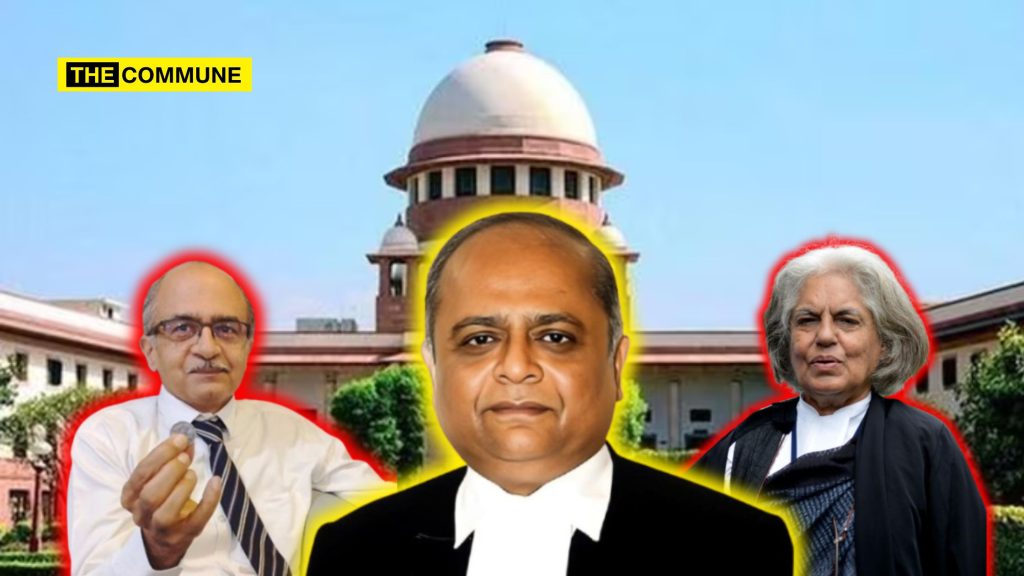
In a classic case of cherry-picking dissent while ignoring overwhelming merit, senior advocates Indira Jaising and Prashant Bhushan have launched a public campaign against the elevation of Justice Vipul M. Pancholi to the Supreme Court, focusing solely on a lone collegium dissent while conspicuously ignoring his decade-long legacy of judicial brilliance, compassion, and overwhelming support from the Bar.
The recent elevation of Patna High Court Chief Justice Vipul Manubhai Pancholi to the Supreme Court of India was a decision ratified by a 4-1 majority of the Supreme Court Collegium, led by the Chief Justice of India. Yet, if one were to follow the narrative being aggressively pushed by a section of the legal commentariat, it was a clandestine and controversial move.
Senior advocates Indira Jaising and Prashant Bhushan have taken to public platforms to question the appointment, citing the dissent recorded by Justice BV Nagarathna. Their critique hinges on two main points: the circumstances of Justice Pancholi’s 2023 transfer from Gujarat to Patna and the supersession of senior women judges. However, a deep dive into Justice Pancholi’s record and the context of his appointment reveals a story they have entirely omitted, one of a judge held in the highest esteem by his peers, known for his groundbreaking jurisprudence and profound humanity.
At least 3 woman judges are Senior to Justice Vipul Pancholi. They are Justices Sunita Agarwal, Revati Mohite Dere&Lisa Gill. This makes three judges from Gujrat, two will be CJI @utkarsh_aanand @barandbench @LiveLawIndia @toi_dhananjayM @TheLeaflet_in
— Indira Jaising (@IJaising) August 25, 2025
In addition , now we know Justice Nagarathna dissented , why are there three judges from Gujrat while other states and women unrepresented ? https://t.co/Oc8Rh98rq3
— Indira Jaising (@IJaising) August 26, 2025
What hypocrisy to talk about empowerment of women! pic.twitter.com/jbZcsz9tHr
— Indira Jaising (@IJaising) August 26, 2025
Statement of the Campaign for Judicial accountability and Reforms on the lack of transparency & problems highlighted by Justice Nagarathna about recent recommendations of the Collegium for appointments to the HCs & SC. pic.twitter.com/RmRjEyNoAZ
— Prashant Bhushan (@pbhushan1) August 26, 2025
In a show of support to Justice Nagarathna, former Supreme Court CJI Markandeya Katju also posted an elaborate post on his X handle.
Long live Justice Nagarathna !
By Justice Katju
I regard Justice BV Nagarathna as the best Judge in the Indian Supreme Court today, erudite, upright and totally independent, as a judge should be. It is because of judges like her that I still have some hope in the Indian…— Markandey Katju (@mkatju) August 27, 2025
However, in all this chaos showing support to the sole lady judge in the name of “diversity” and “gender representation”, they forget what is more important for the Supreme Court, the nation and justice.
The Conveniently Forgotten Truth: A Judge The Bar Fought For
The most glaring omission in the critics’ narrative is the fierce advocacy mounted by the Gujarat High Court Advocates’ Association (GHCAA) to prevent his transfer in 2022-23.
When the Collegium first recommended Justice Pancholi’s transfer to Patna in September 2022, the GHCAA did not see it as a punitive action against a compromised judge. On the contrary, they saw it as the potential loss of a stellar jurist. The Association launched an indefinite strike, wrote detailed representations to CJI DY Chandrachud, and held meetings condemning the move.
In its representation, the GHCAA painted a picture of a judge that Jaising and Bhushan have failed to acknowledge:
A Judicial Workhorse: They highlighted his “staggering” disposal of over 35,000 matters in his eight-year tenure.
An Administrator Par Excellence: He was a key member of multiple committees formed by successive Chief Justices of the Gujarat High Court, a testament to the “faith reposed” in him.
An Invaluable Asset: The GHCAA pleaded that transferring a judge of his calibre, with eight years left in Gujarat, would be “counter-productive to the administration of justice in Gujarat.” They called him a “fine judge” who imbibed “all the good qualities a judge should possess.”
He is also known to be a balanced, patient, and a person with calm demeanour having positive working relationships with the bar.
This was not an isolated incident. The GHCAA has a long history of fiercely defending judges it believes in, having previously stood up for Justices Akil Kureshi and Jayant Patel. Their vigorous defence of Justice Pancholi was based on his proven track record, a fact that finds no place in the current criticism.
Beyond The Numbers: A Jurist Of Profound Compassion and Principle
Justice Pancholi’s courtroom was not just efficient; it was empathetic. His landmark judgments reveal a jurist who balanced the letter of the law with its spirit and a deep concern for the vulnerable.
A Beacon for Victims: In March 2022, Justice Pancholi presided over a heart-wrenching plea by a 17-year-old rape victim to terminate her 6-week pregnancy. In a powerful order, he recognized that a “pregnancy caused by rape may constitute lifelong mental agony, pose socio-economic problems” and that forcing the minor to continue would cause “grave injury to her mental health.” His judgment was a masterclass in applying the Medical Termination of Pregnancy Act with compassion, granting her relief and dignity.
Championing Taxpayer Fairness: In a 2023 verdict, he ruled that the benefit of an amnesty scheme (‘Vera Samadhan Yojna, 2019’) could not be denied to a business, Sky Industries, merely because it had inadvertently paid Rs. 2,000 less towards the principal tax amount. This decision protected businesses from technicalities overriding substantive justice, showcasing his pro-citizen approach.
Managing High-Profile Cases: He also deftly handled the politically sensitive criminal defamation case against Rahul Gandhi concerning the “Modi surname” remark. He initially granted a stay on the trial but later vacated it pragmatically after the petitioner argued that sufficient evidence was on record and a stay would only delay proceedings, demonstrating a commitment to the timely course of justice.
His judicial work spans civil, criminal, and constitutional law with a reputation for detailed, well-reasoned judgments.
The Collegium’s Calculus: A Holistic View Beyond The Dissent
While Justice Nagarathna’s dissent raised valid concerns about representation, the majority of the Collegium likely considered a broader set of factors that advocates Jaising and Bhushan are ignoring. As Advocate Naveen Kumar Murthi, a practicing lawyer in the Madras High Court, pointed out in a detailed analysis, the criticism “conveniently ignores the positive things the Gujarat High Court Association has written about the judge.”
“The resolutions they have passed in his favour, the good things that the bar has spoken about them. Why is that not being highlighted?” questioned Advocate Murthi, cutting to the heart of the selective outrage.
The Collegium’s decision was likely based on:
Merit and Performance: His unparalleled disposal rate and the effusive praise from the Bar are undeniable indicators of judicial efficiency and competence.
Diversity of Experience: His tenure in both Gujarat and, following his transfer, Patna High Courts provided him with a diverse legal exposure across two major jurisdictions.
Succession Planning & Stability: The Collegium is constitutionally mandated to ensure stable leadership. Justice Pancholi is slated for a substantial term as Chief Justice of India from October 2031 to May 2033.
Advocate Murthi remarked judges who have been CJI for a month or few months would not have sufficient time to make substantial reforms or big changes.
It is noteworthy that Justice Nagarathna, though becoming the first Woman CJI in September 2027, will only have a tenure of less than 40 days.
Elevating a judge who can provide long-term leadership is a paramount administrative consideration. Succession planning requires ensuring Chief Justices with sufficient tenure to effect meaningful reforms, a factor supporting Justice Pancholi’s appointment.
Community Diversity: His elevation also adds to the non-traditional social diversity of the Supreme Court bench – we have Chief Justice Gavai who is from the Dalit community, Justice Pancholi is from either the Ahir community – it is not clear if he is from the Ahir-Yadav or Rajput community of Gujarat. In either case, he is from a backward community – BC or OBC, and this serves well for the diversity of the Supreme Court bench.
The opposition’s arguments about bypassed senior women judges and regional representation require understanding the nuanced realities. The Supreme Court has a sanctioned strength of 34 judges with representation calibrated to accommodate larger and smaller High Courts proportionally. Several competent women judges, including Justice Revati Mohite Dere (Bombay HC) and Justice Sunita Agarwal (Allahabad HC), are in line for elevation in the near future, but timing, retirements, and existing representations affect immediate appointments.
High Courts such as Bombay, Madhya Pradesh, and Allahabad already have three judges each in the Supreme Court; appointing a fourth from the same court would disrupt the delicate balance.
A Narrative Of Selective Amnesia
The campaign by Indira Jaising and Prashant Bhushan presents a one-sided narrative that amplifies a solitary dissent while willfully ignoring a mountain of evidence pointing to Justice Pancholi’s merit. It disregards the passionate defence by the Gujarat Bar, overlooks a jurisprudence marked by efficiency and empathy, and reduces a complex collegium decision to a simplistic controversy.
As Advocate Naveen Kumar Murthi aptly concluded, “They are trying to make a fracas over everything conveniently ignoring the good parts.”
In doing so, they risk undermining the public’s faith in a well-considered judicial appointment process and, more importantly, do a grave disservice to a judge whose career has been defined by a commitment to justice, both in its quantitative and profound qualitative forms.
The elevation of Justice Vipul Pancholi to the Supreme Court reflects a decision balancing merit, seniority, continuity, and representational dynamics. While dissent and scrutiny are vital, the opposition’s campaign led by Indira Jaising and Prashant Bhushan appears disproportionate and dismissive of Justice Pancholi’s strong judicial record and community backing.
Subscribe to our channels on Telegram, WhatsApp, and Instagram and get the best stories of the day delivered to you personally.