


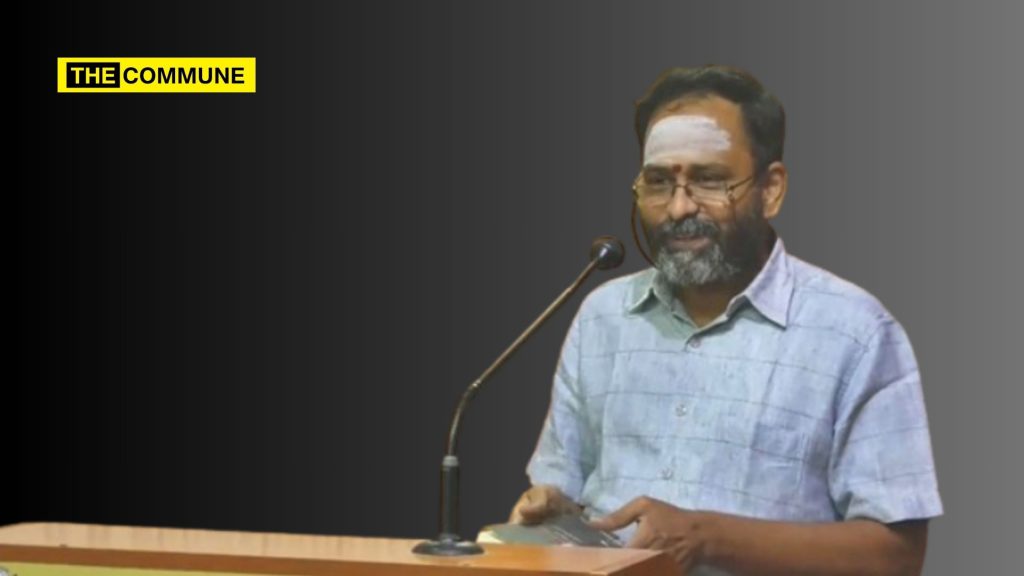
For all the talk about Madurai Bench of Madras High Court’s single judge Justice GR Swaminathan being a ‘sanghi‘, RSS man, and what not, here comes a judgement where he quoted the Prophet Mohammed (PBUH).
Justice GR Swaminathan on Friday (19 December 2025) directed the Madurai City Municipal Corporation to settle long-pending professional fee claims of its former standing counsel, while sharply criticising the practice of appointing a large number of Additional Advocate Generals and paying exorbitant legal fees from the public exchequer.
Pronouncing orders in W.P.(MD) No. 26707 of 2022, the judge began by invoking a saying attributed to Prophet Muhammad (PBUH), stating that a worker should be paid before his sweat dries. He said, “Pay the worker before his sweat dries” is an instruction attributed to the Holy Prophet (PBUH).”
The court held that this principle, rooted in fairness, was applicable not only in labour jurisprudence but also in cases involving unpaid professional dues.
The petitioner, who had served as standing counsel for the Madurai City Municipal Corporation for over 14 years between 1992 and 2006, had approached the court seeking payment of ₹13.05 lakh, claiming that while his total bills amounted to over ₹14 lakh, only about ₹1.02 lakh had been paid. Earlier directions issued in 2006 required the Corporation to consider his representation, following which an adverse order was passed, prompting the present writ petition.
During the hearing, the Corporation submitted that it was willing to honour the claim provided the fee bills were supported by certified copies of judgments and decrees. It was alleged in the counter affidavit that non-submission of such documents had caused losses to the local body in certain cases, leading to the petitioner’s removal from the panel.
Justice Swaminathan noted that the petitioner had appeared in as many as 818 cases and recorded submissions that he was in penurious circumstances and unable to afford the cost of obtaining certified copies. Accepting this position, the court directed the Legal Services Authority attached to the Madurai District Court to verify the list of cases, obtain certified copies, and provide them to the petitioner within two months. Upon submission of the verified fee bills, the Corporation was directed to settle the dues within a further two months, without interest, citing the long delay in raising the claim and procedural deficiencies in earlier submissions.
While disposing of the petition, the judge made strong observations on the broader issue of legal fees paid by government and quasi-government bodies. He remarked that the petitioner’s claim appeared to be a pittance when compared to the volume of work performed and expressed concern over what he described as “scandalously high” fees paid to certain law officers and senior counsel.
Referring to instances from his judicial experience, Justice Swaminathan noted that institutions pleading financial distress had paid several lakhs of rupees per appearance to senior counsel. He also disapproved of the routine appearance of Additional Advocate Generals in minor matters, observing that such cases could be handled by junior government counsel.
The judge stated that good governance required public funds to be spent in a measured manner and not distributed capriciously to a favoured few. He further observed that Tamil Nadu currently had close to a dozen Additional Advocate Generals, contrasting this with the position when he entered the Bar in 1991, when there was only an Advocate General.
Justice Swaminathan expressed hope that such practices would cease at least in the Madurai Bench from 2026 and referred to similar concerns raised earlier by the Allahabad High Court. The writ petition was disposed of accordingly, with no order as to costs, and connected miscellaneous petitions were closed.
Source: Madurai Bench of Madras High Court Order
Subscribe to our channels on WhatsApp, Telegram, Instagram and YouTube to get the best stories of the day delivered to you personally.