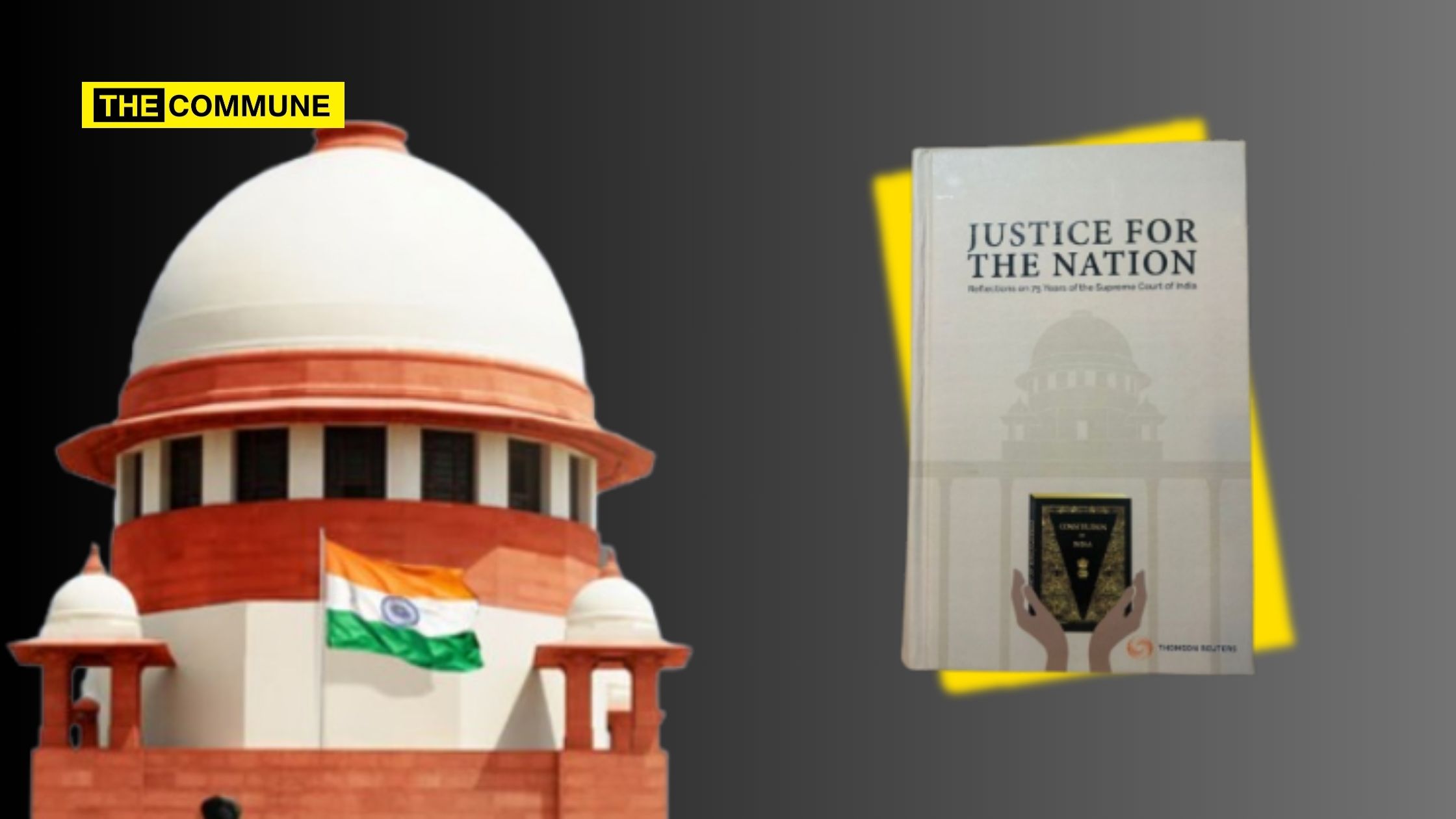
‘Justice for the Nation, Reflections on 75 years of the Supreme Court of India’ is published by Thomson Reuters and was launched by the Honourable President of India in November 2024. This work is a compilation of essays created to honour the 75th anniversary of the Supreme Court and addresses various subjects related to the Supreme Court’s involvement with constitutional and other rights. It features contributions from judges of the Court, distinguished practitioners, learned jurists, and respected academicians. It serves as a reflection on the jurisprudence of the Court and its influence across various aspects of constitutional and social life in India.
The book starts with Justice D.Y. Chandrachud’s essay ‘Bending the Arc of Indian History Towards Justice: 75 Years of the Supreme Court’, which presents a significant analysis and serves as an appropriate summary from one of the foremost authorities on the topics of Constitution. In this essay, he emphasizes the constitutional responsibilities of the apex court and elaborates on its establishment, which was rooted in idealism, aiming to act as a safeguard against injustice and tyranny. Justice Chandrachud articulates how the framers of the Constitution, through Article 32 and Article 226, envisioned a direct connection between citizens and the higher judiciary. He particularly clarifies the function of Special Leave Petitions under Article 136 and discusses its broader scope compared to Article 32. In the initial rulings concerning the interpretation of fundamental rights, the Supreme Court adopted a textual perspective regarding personal liberty and individual autonomy. Subsequently, particularly following the emergency period (1975-77), the apex court embraced a broader interpretation of rights, placing greater emphasis on individual liberties and dignity over strict textual readings of the Constitution. This shift has led to the emergence of a wide array of derivative rights, particularly stemming from Article 21, which has also facilitated the rise of Public Interest Litigations (PILs) as a significant legal instrument where the requirement for locus standi is relaxed. This essay further explores themes such as gender justice, religious rights, disability rights, and environmental rights, democratic reforms, and live streaming of the judicial proceedings. Overall, the essay is a gripping narration by a scholar judge that captivates reader’s mind. It tells us whether through its function as the ultimate interpreter of the Constitution, serving as the court of last resort, enhancing the administration of justice throughout the nation, or acting as a platform for public accountability, the Supreme Court plays a vital role in shaping the democratic future of India.
Justice R. V. Raveendran’s essay ‘Role of Constitutional Courts’ delves deeper into the judiciary’s function as a ‘sentinel on the qui vive’. He warns of the necessity for courts to exercise restraint when conducting judicial reviews, particularly concerning policy issues that remain solely within the purview of the Executive. Justice M. N. Venkatachiliah refers to ‘judicial review as an adjunct of limited government’ and elaborates on the principle of proportionality, which mandates that the administration should not be more drastic than necessary to achieve the intended outcomes. The judicial review process continues to be informed by the ‘Wednesbury principles’, which help to ensure its stability.
Justice A. K. Sikri discusses ‘the dark matter of the Indian Constitution,’ elucidating the distinction between the two schools of constitutional interpretation: the textualist and the living constitutionalist. He delves on the manner in which the Supreme Court has addressed constitutional ambiguities through significant rulings that are rooted in the moral principles of the Constitution and the changing desires of the populace. He attributes the landmark Keshavanand Bharti case as ‘the foundational moment of the living constitutionalist approach.’
A key theme present in all these illustrative contributions is the role of the Apex Court in defining and maintaining the constitutional values of India. These themes resonate in the chapters that follow. Fali S. Nariman presented his insightful analysis of the Preamble’s values shortly before his demise. K. K. Venugopal and Ankur Talwar have explored the basis and influence of the basic structure doctrine, where they describe this doctrine as ‘auxiliary precaution a judicial check on the power of the electoral majority’. The Attorney General of India, R. Venkataramani, elaborates on how the Court’s role in constitutional governance is supported by lawyers who prioritize principle over power. Madhavi Goradia Diwan asserts that without provocative thought & the freedom to disagree, human intellect will suffer stagnation.
The volume comprises a collection of twenty stimulating essays that offer insights into the institutional evolution of the Supreme Court and its shifting relationship with other branches of State. They reflect on the Court’s operations in the past, analyse its current state, and envision its future course of actions. In this process, it showcases a vivid, complex and colourful journey from various viewpoints. The honourable Supreme Court of India has not only delivered a succession of judgements but also stands as a testament to the living stories of aspirations, dreams, and resilience of the Indian populace. It’s landmark judgements have influenced daily lives of almost all the Indian citizens and even beyond, as the judgements have acted as precedents for Courts in other countries too. Peruse this volume to understand and appreciate the remarkable trends in the jurisprudence of the Court over the last seventy-five years.
Kanishk Shekhar is a columnist & also teaches students preparing for Civil Services Exam.
Subscribe to our channels on Telegram, WhatsApp, and Instagram and get the best stories of the day delivered to you personally.