


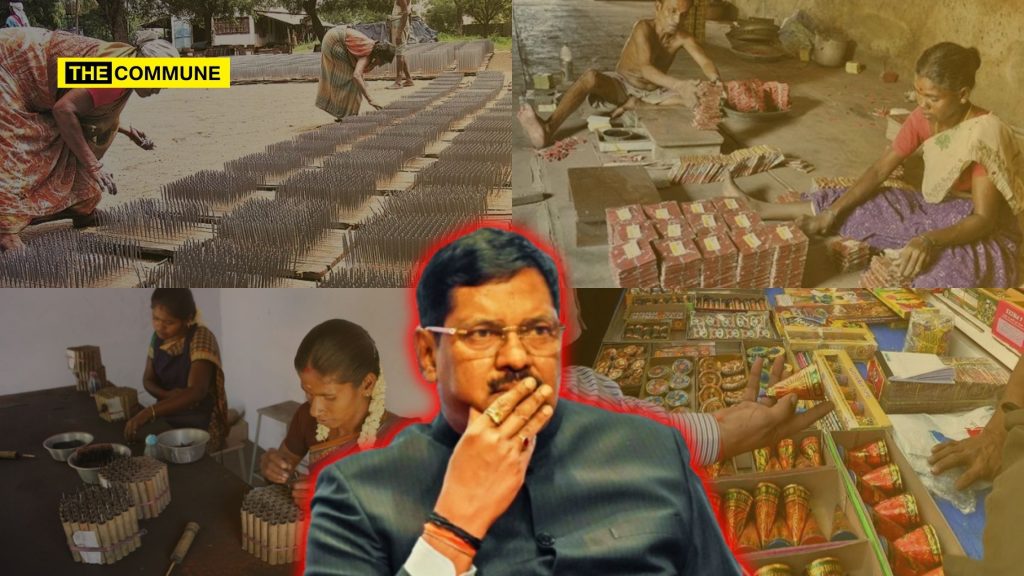
In what can only be described as a severe case of breathtaking judicial overreach that ignores economics, federalism, and common sense, Chief Justice of India B.R. Gavai on Friday mused about imposing a nationwide ban on firecrackers. His reasoning? If Delhi’s “elite” deserve clean air, so should everyone else. This simplistic and dangerously uniform approach threatens to bulldoze a centuries-old cultural tradition and destroy the livelihoods of lakhs of Indians, all while failing to address the complex, regional nature of India’s air pollution crisis.
The Human Toll: A Livelihood Crisis In The Making
Behind every firecracker lies an industry that sustains entire communities. As of 2023, over 800,000 families in Sivakasi alone depend on fireworks for survival. Across India, the industry provides direct and indirect employment to over 500,000 families and sustains a business worth more than ₹6,000 crore annually.
Sivakasi, which produces 90% of India’s firecrackers, employs about 300,000 people directly and another 500,000 indirectly. Most are from economically vulnerable backgrounds; many are women earning about ₹500 per day for 10-hour shifts. They lack alternative job opportunities or transferable skills.
When CJI Gavai rhetorically asks “what about the poor who make their livelihood from this,” it rings hollow. His court’s own bans have already slashed demand—Delhi alone created a 20% shortage for Sivakasi manufacturers, leaving thousands unemployed. While the Chief Justice talks about equality in pollution, the reality is families face hunger and destitution.
Cultural Vandalism Disguised As Environmentalism
The Supreme Court’s interventions have all but crippled a vibrant sector worth ₹6,000 crore. This does not just affect manufacturers. The entire ecosystem of transporters, packaging suppliers, raw material providers, and retailers feels the shockwaves.
The losses ripple outward:
- SMEs supporting the fireworks trade face closure.
- Tamil Nadu alone collected about ₹40 million annually in nuisance tax from fireworks businesses.
- Banks are staring at potential NPAs worth ₹16 billion if the industry collapses.
Far from eliminating firecrackers, bans only push the trade underground. In 2024, Delhi’s Chandni Chowk saw vendors openly selling through carts and covered shops, bypassing regulations. The result is a thriving parallel economy, proving judicial prohibition is both ineffective and counterproductive.
Economic Destruction Through Judicial Activism
The Supreme Court’s approach to the firecracker industry exemplifies the worst kind of judicial overreach – making policy decisions without considering economic consequences or constitutional limits. CJI Gavai’s court has effectively destroyed an entire sector worth ₹6,000 crore annually, affecting not just manufacturers but entire supply chains including transportation, packaging, raw materials, and retail sectors.
The ripple effects extend far beyond direct employment. Small and medium enterprises supporting the firecracker industry face closure, while related service sectors including hospitality and retail suffer massive losses. The government loses substantial revenue – Tamil Nadu alone collected ₹40 million annually through nuisance tax from fireworks businesses. Banks face potential NPAs worth ₹16 billion due to the industry’s collapse.
Most perversely, the court’s ban will push the trade underground. In 2024, in Delhi’s Chandni Chowk, vendors operated cart systems and covered shops, creating a parallel economy that the court’s orders cannot touch. This demonstrates the futility of judicial prohibition against deeply rooted cultural practices.
Constitutional Overreach And Democratic Deficit
Article 19(1)(g) of the Constitution guarantees every Indian the right to practice a profession or trade. The court has no authority to simply extinguish a legal industry. At most, it can impose licensing conditions or safety standards. As Justice S.A. Bobde remarked in 2019: “If the trade is legal and they have licence, how can you stop the trade?”
Today’s court has abandoned that wisdom. Instead of working with industry to create cleaner alternatives like green crackers or encouraging safer practices, it has chosen the blunt instrument of prohibition. This is policymaking by judges, not by Parliament or elected governments. It undermines democracy, federalism, and the principle of proportionality in law.
Elitism At Its Tone-Deaf Best
Ironically, in trying to strike at “elitism” in Delhi, the Court’s approach reeks of elitism itself. Sitting in air-conditioned courtrooms, judges imagine that banning firecrackers will cleanse India’s skies, while ignoring coal plants, factories, and trucks that poison the air every single day.
And what of tradition? For millions, fireworks are not mere entertainment; they are a luminous expression of faith, celebration, and cultural memory. This isn’t about defying science or denying pollution; it’s about asking whether judicial diktats should so easily override collective cultural practice without meaningful dialogue or democratic consent.
This is a tone-deaf, knee-jerk reaction that confuses symbolism for solution.
We will burst crackers in this country because that’s how we celebrate, and we’ve thousands of families dependent on it. And no amount of judicial activism can change that fundamental truth.
(With inputs from The Hindu)
Subscribe to our channels on Telegram, WhatsApp, and Instagram and get the best stories of the day delivered to you personally.