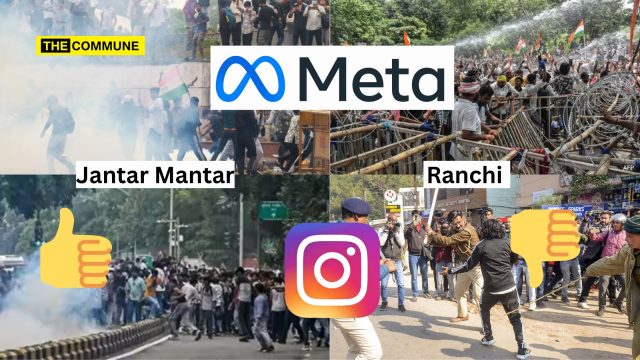
While the Cockroach Party’s Jantar Mantar protest flooded Instagram feeds and became a major social-media phenomenon, a parallel student agitation in Jharkhand struggled to achieve comparable visibility despite dramatic visuals of clashes, tear gas, water cannons and lathi charges.
The stark difference has raised questions over whether Instagram’s algorithm merely reflected differences in audience behaviour and content quality, or whether Meta’s platform played a role in suppressing political content from the Jharkhand protests.
An analysis by NDTV, using data from analytics firm DataBeings, compared the digital footprint of the two student protests and found a significant disparity in the number of posts, accounts involved, reach and engagement.
The analysis also highlighted several caveats. The Delhi protest took place in the national capital and attracted a different demographic, while the Jharkhand protesters were reportedly less active and less sophisticated in their use of social media. Mainstream media coverage, trending music, hashtags, reposts and the ability of users to rapidly create and circulate edited videos may also have contributed to the difference.
However, the scale of the disparity has prompted questions about how Instagram determines which political movements receive sustained amplification.
5,239 Delhi Posts vs 1,062 From Ranchi
According to the DataBeings analysis cited by NDTV, a keyword search for the Delhi CJP protest produced 5,239 Instagram posts. Although that represented only around 0.001% of Instagram’s estimated 48-crore Indian user base, the protest appeared to dominate feeds during its peak period.
The 5,239 posts came from around 3,100 unique accounts and reportedly reached approximately 1.85 crore people. The content generated an average engagement of about 3,547 interactions per post, resulting in an amplification of roughly 5,806 times compared with the number of posts.
By contrast, a search for the Ranchi student protest produced 1,062 posts from only 290 unique accounts, with a total reach of around six lakh people.
The difference was therefore not merely in the number of posts. The Delhi protest reached nearly 1.85 crore people, compared with roughly six lakh for the Ranchi protest.
That raises an uncomfortable question: if both movements involved students and youth protesting against government policies, why did one receive such dramatically greater distribution on the same platform?
Delhi Climbed While Ranchi Disappeared
The disparity became even more striking when views per Reel were analysed.
According to the NDTV-DataBeings analysis, the Delhi protest showed a gradual increase in Instagram visibility. The number of views rose following the clashes on July 20 and eventually peaked at nearly three lakh views per Reel on the day Union Education Minister Dharmendra Pradhan resigned.
The Jantar Mantar protest therefore received sustained visibility over several weeks, with its digital momentum continuing to build after the initial clashes.
The Ranchi protest followed a markedly different trajectory.
Its content initially performed strongly, reaching approximately 2.8 lakh views per Reel during the early days of the agitation. But instead of continuing to grow, the reach subsequently collapsed.
By August 10, when Ranchi witnessed its own confrontation with police, the protest had already almost disappeared from Instagram’s algorithmic visibility.
The contrast is difficult to overlook. The Jharkhand protest was not initially invisible; it was briefly picked up by the platform before its reach fell sharply.
One in Three Reels vs Just 3%
The difference becomes even clearer when measuring the share of coverage among the top 100 Instagram accounts tracked in the analysis.
At its peak, approximately one in every three Reels posted by the top 100 accounts was related to the Jantar Mantar protest. On the day of the Education Minister’s resignation, the Delhi protest reportedly accounted for around 30% of the content from these high-performing accounts.
The Ranchi protest, by contrast, reached a maximum share of only around 3% among the same category of accounts.
In other words, a student protest involving large crowds, police action and clashes received a fraction of the attention given to the Delhi movement.
Journalists and Creators Also Reported Lower Reach
The discrepancy was not limited to aggregate data.
NDTV journalist Padmaja Joshi, who reported from both protests, reportedly observed a significant difference in the performance of similar content.
She said a video she had posted during the Jantar Mantar protest had received around 1.2 lakh views within three hours. A comparable interview with a student protesting in Ranchi received approximately 32,000 views over two days.
According to her account, students in Ranchi were themselves beginning to notice the difference because visibility was important to their movement. Protesters in Delhi naturally received greater attention because they were demonstrating in the national capital, whereas protesters in Ranchi had to overcome a much larger geographical and media barrier to reach audiences elsewhere in India.
She also reported that some Ranchi protesters had noticed videos from the Jantar Mantar agitation receiving millions of views despite allegedly containing abusive language that could potentially violate platform rules, while their own content, which they considered neither abusive nor offensive, struggled to achieve comparable reach.
A local content creator from Jharkhand reportedly observed a similar anomaly. She found that her videos about random local issues often performed better than content concerning the ongoing student agitation, despite the latter being a major political issue in the state.
Is Meta Suppressing Political Content?
The analysis becomes more contentious when possible, explanations for the disparity are examined.
DataBeings founder Sumit Gupta reportedly pointed to several factors, including the different trajectories of the two protests and the timing of mainstream media coverage.
He noted that the Central government had not engaged with the Delhi protesters until the confrontation escalated, whereas the trajectory surrounding the Ranchi protest was different.
Another factor highlighted was a meeting between Meta officials and the Government of India on August 3. Gupta suggested that the subsequent performance of political content on Instagram should be monitored to determine whether Meta had begun suppressing political content more broadly.
He cautioned that it could not yet be established that Meta was deliberately suppressing the Jharkhand protest. He also suggested that the lack of comparable mainstream-media coverage could have contributed to the lower social-media traction.
The data therefore does not by itself establish deliberate censorship. But the possibility raises a serious question about the power of platforms such as Instagram to determine which political movements receive national visibility.
Hashtag Politics and the Algorithm
Journalist Ritika Chandola, who covered both protests, reportedly experienced the disparity herself.
She observed that Reels containing Jharkhand-related hashtags tended to receive fewer views. She also said that videos without conventional captions but with text overlaid on the video appeared to perform differently, suggesting that the way political content is labelled may affect its distribution.
She further described the role of mass reporting. According to her experience, protesters associated with the Jantar Mantar movement had circulated instructions encouraging users to report certain videos repeatedly, with claims that around 80 to 90 reports could lead Meta to remove or restrict a video.
Such mass reporting, she suggested, could result in videos being taken down, having their reach reduced or becoming effectively shadow-banned.
She also cited her experience as a journalist at OpIndia, saying that several videos produced by the organisation had experienced similar visibility problems. One video concerning the BJP was reportedly removed from YouTube for a day, while a newly created channel called Chapter One allegedly experienced a sudden fall in visibility after initially appearing normally.
The Role of Class, Phones and Social-Media Savvy
Not every explanation points towards algorithmic suppression.
Chandola reportedly noted a significant difference between the demographics of the two protest movements.
She observed that many young protesters in Jantar Mantar appeared to have expensive smartphones, including the latest iPhones, and were highly familiar with editing videos, reposting content and using social-media trends.
The Ranchi protesters, by comparison, reportedly had fewer expensive devices and were less accustomed to immediately recording and uploading content from the protest site.
This matters because Instagram’s recommendation system is heavily influenced by user behaviour. When a person likes or shares a Reel, similar content may subsequently appear in the feeds of people connected to that user.
As a result, once a particular protest begins gaining traction among a highly connected group of users, the platform can create a feedback loop in which more people see, engage with and share the same content.
The Jantar Mantar protest appeared to benefit from this effect.
Trending Music May Have Helped Delhi
Chandola also pointed to another factor that could have helped the Delhi protest: trending audio.
She reportedly observed that many Jantar Mantar videos continued to appear in Instagram feeds because they used popular and trending music. Since Meta’s recommendation systems can promote Reels using widely popular audio, the use of trending music may have helped the content circulate beyond the protesters’ immediate networks.
This suggests that virality is not necessarily determined solely by the political importance of an issue.
A protest that has more technologically savvy participants, better editing, stronger creator networks, popular audio and extensive reposting can potentially receive dramatically greater algorithmic distribution.
But Why Did High-Performance Accounts Ignore Ranchi?
Even after accounting for these factors, the disparity among large accounts remains difficult to explain.
The NDTV analysis found that many of the high-performing Instagram handles that helped turn the Jantar Mantar protest into a national social-media phenomenon did very little comparable coverage of Ranchi.
The issue therefore goes beyond ordinary users failing to share content.
If the same high-reach accounts that helped amplify one student movement largely ignored another student movement involving police clashes, tear gas, water cannons and lathi charges, the question becomes whether the platform’s ecosystem is organically reflecting public interest or reinforcing existing attention patterns.
The Ranchi protest had many of the visual elements normally associated with viral youth content: large crowds, confrontation with authorities, anger, dramatic footage and a young demographic.
Yet its visibility declined sharply just as the conflict intensified.
Is Instagram Really Democratic?
The controversy exposes a larger problem with treating social media as a neutral democratic marketplace of ideas.
Instagram has an estimated 48 crore users in India, with young people forming a substantial portion of its audience. NDTV’s analysis cited estimates suggesting that between 84% and 91% of Gen Z consumes news and current affairs through social media.
When recommendation systems determine what millions of young users see, the question of algorithmic visibility becomes a question of political influence.
If a protest receives millions of views while another receives only a fraction of that exposure, the difference can shape public perception before most people even become aware that the second protest exists.
The central issue, therefore, is not whether Instagram has deliberately suppressed the Ranchi protests. The available data does not conclusively establish that.
The more fundamental concern is that Instagram’s opaque recommendation system can effectively determine which political grievances receive sustained public attention and which remain confined to a small digital audience.
Whether the disparity was caused by algorithmic decisions, differences in content quality, class and device access, mainstream-media coverage, trending audio, hashtags, mass reporting, creator networks or some combination of these factors, the outcome was the same: the Jantar Mantar protest became a national digital phenomenon, while the Ranchi student movement struggled for visibility.
For a platform that increasingly functions as a primary source of news for young Indians, that imbalance deserves far greater scrutiny.
The question is no longer simply what users choose to watch. It is who or what decides what they get to see in the first place.
Subscribe to our channels on WhatsApp, Telegram, Instagram and YouTube to get the best stories of the day delivered to you personally.