


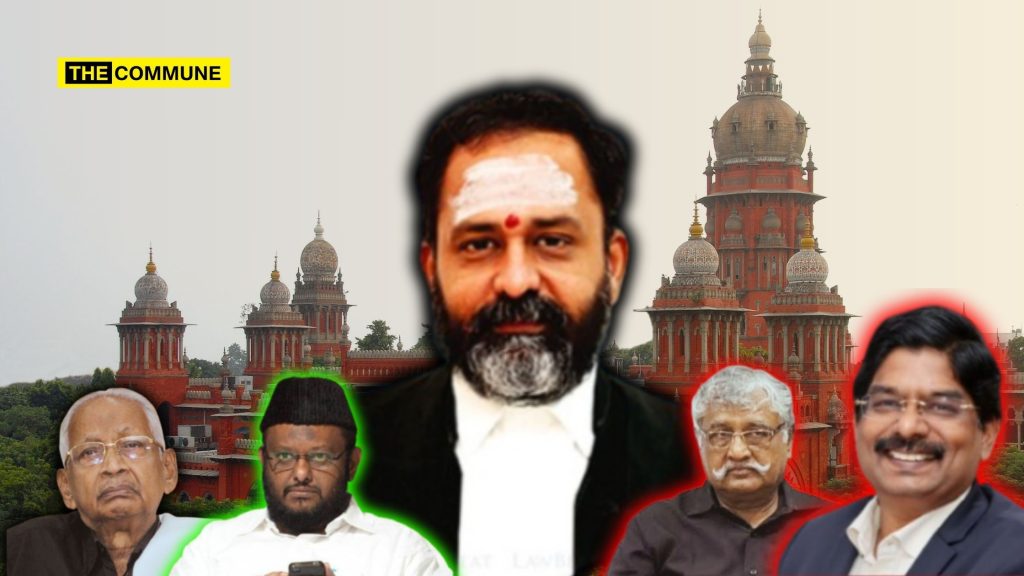
A storm has erupted in Tamil Nadu’s legal and political circles, centered around Justice GR Swaminathan of the Madras High Court. The judge, known for his unbiased, independent and often bold rulings, has found himself at the center of a storm after a controversial contempt case was filed against advocate S Vanchinathan, who had accused Justice Swaminathan of caste bias in a complaint to the Supreme Court.
Now, questions are being raised: is this part of a coordinated assault by the DMK ecosystem against a judge seen as insufficiently compliant?
The Vanchinathan Episode: A Manufactured Controversy?
Advocate Vanchinathan, who once benefitted from Justice GR Swaminathan’s intervention when he was jailed under the National Security Act during the Sterlite protests, has now become a central figure in the anti-judge campaign. He submitted a representation to the Supreme Court accusing the judge of caste and communal bias – a serious charge, but one that lacked evidentiary backing.
Justice Swaminathan, in open court, merely asked whether Vanchinathan stood by these allegations. This was neither contempt proceedings nor a punitive move – it was a fundamental question aimed at clarifying a smear that had been spread in public. Yet, the DMK-friendly ecosystem quickly painted this as judicial overreach and “abuse of power,” with eight retired judges publicly backing Vanchinathan without once engaging with the substance of the accusations.
DMK Ecosystem’s Attack On Justice GR Swaminathan
As the case was heard in court, the DMK ecosystem got activated. We saw condemnations from organizations like Dravidar Kazhagam – the parent organization of the DMK, the DMK ally, MMK (Manithaneya Makkal Katchi) and many others.
K Veeramani, the DK chief, wrote on his X handle, “Madurai lawyer Vanchinathan has sent a complaint letter to the Chief Justice of the Supreme Court against Chennai High Court Judge Honorable Justice G.R. Swaminathan! In this context, is it appropriate for the concerned judge to call and threaten the lawyer who lodged the complaint? The dignity of the judiciary should not lose its respect among the people! It is indeed true that the concerned judge has been continuously speaking on controversial matters! I, who am in the hospital, am writing this statement based on the news I saw on television. The judge issued a summons to lawyer Vanchinathan, who had withdrawn from the case During a case hearing held the day before yesterday (24.7.2025) at the Madurai bench of the Chennai High Court, it is reported that Honorable Justice G.R. Swaminathan summoned lawyer Vanchinathan, who had withdrawn from the case, and after the lawyer stated that he was not currently arguing in that case, the judge asked, “Answer this question,” and raised the question, “Are you accusing me of delivering judgments based on caste?” In the background, it is said that last month, lawyer Vanchinathan sent a complaint letter to the Chief Justice of the Supreme Court, pointing out several judgments of Honorable Justice G.R. Swaminathan. In a democracy, the judiciary is the last hope of the people! Can Honorable Justice G.R. Swaminathan summon the lawyer in person and issue a contempt of court notice through the High Court Registrar? Was this issued with the permission of the Chief Justice of the Chennai High Court, who holds administrative responsibility? In a democracy, the judiciary is the last hope of the people. According to the Indian Constitution, the fundamental principle is that judges, upon taking their oath, must perform their duties without personal bias or prejudice. Condemnations have arisen multiple times! However, we have repeatedly stated in public forums that several judgments delivered by Honorable Justice G.R. Swaminathan at the Chennai High Court and its Madurai bench reflect a bias toward a particular ideology and a sense of caste protection. On one occasion, he unnecessarily spoke about and disparaged the marriage of Thanthai Periyar and Annai Maniyammaiyar. He has also mocked rationalists. The unparalleled leader Thanthai Periyar! Periyar is a leader honored by the Indian government with the Tamra Patra award and commemorated with a postage stamp. He is regarded as the father of Tamil Nadu. In this very court, a judge described him as, “Just as Mahatma Gandhi is the father of India, Thanthai Periyar is to Tamil Nadu.” He is an unparalleled leader whose contributions to social justice have been acknowledged in the Indian Parliament and even mentioned in Supreme Court judgments. We have already pointed out and condemned the fact that, in a case unrelated to him, this judge disparaged such a leader revered by millions in his judgment.A judgment contrary to human dignity and scientific thinking Furthermore, in today’s scientific age, when the government attempted to maintain law and order by banning an inhumane event in Karur where non-Brahmins roll on the leftover leaves eaten by Brahmins, how can we call the judgment delivered by Honorable Justice G.R. Swaminathan against it impartial? We have already pointed out and explained that this judgment is contrary to the human dignity and scientific temperament (51AH) emphasized by the Indian Constitution. The Tamil Nadu DMK government painstakingly introduced the law allowing people of all castes to become priests to eradicate the major social evil of caste and untouchability plaguing India.Even after 50 years of struggle in public forums and courts, and after obtaining a favorable final judgment from the Supreme Court, there have been judgments in various related cases that reflect a biased stance by the Honorable Justice G.R. Swaminathan. Advocates like Vanchinathan have also argued for this cause. In another case related to social justice, when senior advocate and Member of Parliament P. Wilson appeared to argue, the Honorable Justice G.R. Swaminathan addressed him in a manner that violated due decorum, which is a behavior of the judge that must be pointed out at this juncture. Moreover, in a defamation case filed for allegedly making derogatory remarks about a particular community, a woman who always speaks proudly of her caste was arrested and sent to prison. Within a day or two, she approaches the High Court for bail. The matter comes up for hearing. At that time, a news item also appears in the media. Before the case comes up for hearing before another judge, the wife of the Honorable Justice G.R. Swaminathan issues a statement on social media, seeking sympathy for the woman who spoke with caste sentiment. Is this approach correct? Will the courts accept it? The Honorable Justice has continuously spoken on various public platforms about his perspective and the principles he upholds. We have pointed out in public forums that he should change this approach. A retired judge has also expressed his views on the same platform, highlighting such tendencies. Those appointed as judges may have personal beliefs, which is their right. However, it is pertinent to note that a former Supreme Court judge has written in his autobiography that, after becoming a judge, those beliefs should not be reflected in court judgments. If an advocate files a complaint with the Supreme Court, utilizing the opportunity provided under the Constitution to address a well-known public issue, is it acceptable for the judge to personally call and threaten the complainant in court? Is it correct to call and threaten the person who filed the complaint? If a complaint is filed against him, the Honorable Justice G.R. Swaminathan should provide an answer or explanation in the appropriate forum, rather than calling and threatening the complainant in court. How is this justified? Can a judge investigate and deliver justice in a case concerning himself? Is such a peculiar judicial approach appropriate for courtroom justice? Will legal procedures and practices accept this? The Honorable Judges of the High Court and Supreme Court must clarify this. We have publicly highlighted the behavior of the specified Honorable Judge regarding such a judicial approach – with a public welfare perspective! There is no personal like or dislike towards him. Should a solution that ought to be resolved within the court’s boundaries be forced to reach public forums? Beyond the advocate-judge dynamic, should this lead to a public forum struggle? We write this with the general objective that the dignity of the courts should not lose its value among the people. President, Dravidar Kazhagam 26.7.2025 Chennai”
🔹 சென்னை உயர்நீதிமன்ற நீதிபதி மாண்பமை ஜி.ஆர்.சுவாமிநாதன்மீது மதுரை வழக்குரைஞர் வாஞ்சிநாதன் உச்சநீதிமன்றத் தலைமை நீதிபதிக்கு புகார் மனு அனுப்பியுள்ளார்!
🔹 இந்நிலையில், சம்பந்தப்பட்ட நீதிபதியே புகார் கொடுத்த வழக்குரைஞரை அழைத்து மிரட்டுவது சரியா?
🔹 நீதிமன்றத்தினுடைய மாண்புகள்…
— Asiriyar K.Veeramani (@AsiriyarKV) July 26, 2025
Jawahirullah wrote, “Judge G R Swaminathan has committed an injustice against Advocate S. Vanchinathan Statement issued by Professor M. H. Jawahirulla, President of the Manithaneya Makkal Katchi Advocate Vanchinathan from Madurai has filed a complaint with the Chief Justice of the Supreme Court against High Court Judge G R Swaminathan. As a follow-up to this, it is unjust that Judge G R Swaminathan issued a summons to Advocate Vanchinathan, requiring him to appear before him at the Madurai Bench of the Chennai High Court for a sudden inquiry. It is contrary to the administration of justice that the same judge against whom the complaint was lodged is conducting the inquiry. It is in no way justifiable to summon an advocate to appear in a case from which he had previously withdrawn. Referring to the advocate as a coward in the courtroom during the ongoing inquiry is an unjust approach. People come to the courts and justice system, trusting them as their ultimate refuge. It is contradictory for a judge, who has taken an oath under the Indian Constitution to perform duties without personal bias or prejudice, to engage in such actions that are contrary to this commitment. Many advocates and progressive thinkers have pointed out that several judgments by the Honorable Judge G R Swaminathan appear to be biased. Through the media, it is evident that Judge G R Swaminathan has spoken in public forums outside the courtroom in a manner that reflects the ideologies of the organization he is associated with. Everyone may have personal beliefs. However, these should not interfere with the judgments delivered in court. But Judge G R Swaminathan seems to be an exception to this. How will the public perceive the credibility of a judge who speaks in a threatening tone to someone who has filed a complaint against him? On behalf of the Manithaneya Makkal Katchi, I request the Supreme Court to take appropriate action regarding the complaint filed by Advocate Vanchinathan. Sincerely, M. H. Jawahirulla President Manithaneya Makkal Katchi”
வழக்கறிஞர் எஸ். வாஞ்சிநாதனுக்கு நீதிபதி ஜி ஆர் சுவாமிநாதன் அநீதி இழைத்திருக்கிறார்
மனிதநேய மக்கள் கட்சியின் தலைவர் பேராசிரியர் எம். எச். ஜவாஹிருல்லா வெளியிடும் அறிக்கை
மதுரையைச் சேர்ந்த வழக்கறிஞர் வாஞ்சிநாதன் அவர்கள் உச்சநீதிமன்றத் தலைமை நீதிபதிக்கு உயர் நீதிமன்ற நீதிபதி ஜி ஆர்…
— Jawahirullah MH (@jawahirullah_MH) July 27, 2025
Suba Veerapandian of the Dravidar Kazhagam in an interaction with the press launched a scathing attack on Justice GR Swaminathan of the Madras High Court, accusing him of bias and abuse of power in the contempt case against Advocate Vanchinathan. Speaking on behalf of the Tamilar Peravai, Veerapandian questioned the fairness of a judge hearing a contempt case against himself, “If Judge GR Swaminathan thinks it is contempt of court, then the next judge should investigate it. It is strange that the person accused should investigate and give a verdict about himself.”
He slammed attempts to link Vanchinathan’s statements to the DMK, saying, “They say DMK made Vanchinathan speak. If that is incitement, then file a case against those who incited him. What is the evidence?”
Veerapandian also brought up the Savukku Shankar episode: “What happened when two people pressured him in the Savukku case? Why didn’t he name them or have them arrested? Is there any greater contempt of court than telling a judge how to write a verdict?”
He ridiculed the idea that a letter to the Chief Justice constitutes contempt, saying, “Vanchinathan wrote to the Supreme Court. He didn’t shout in the streets. If that’s contempt, then even accountability is criminalized.”
Former Justice Hari Paranthaman spoke to the media focused instead on defending controversial lawyer Vanchinathan, who was recently arrested for defaming Justice Swaminathan online. The event framed the judge’s actions as repressive, completely ignoring the online ecosystem of hate that had vilified him in the days following the judgment. While judicial actions can and should be critiqued, the deliberate attempt to paint Justice Swaminathan as a political operative simply because of his caste or affiliations amounts to a mob campaign to delegitimize an institution.
The Trigger? Stay On DMK Govt’s Amendments
The tipping point came on 21 May 2025, when a vacation bench of the Madras High Court comprising Justices G.R. Swaminathan and V. Lakshminarayanan issued an interim stay on the Tamil Nadu government’s amendments that removed the Governor’s power to appoint Vice-Chancellors of state universities. The Court dismissed the State’s argument that these laws had received “deemed assent” from the Supreme Court under Article 142, calling the claim “outrageous.”
Senior Advocate P. Wilson, appearing for the Higher Education Department, contended that the High Court was interfering with a Supreme Court ruling. The Bench sharply rebuked this, stating, “Mr. Wilson’s claim that we are effectively reviewing a Supreme Court judgment is outrageous.” They further remarked, “We say with utmost sadness and regret that the approach of Shri. P. Wilson was one of obstruction and not assistance.”
The judges emphasized that the Supreme Court had not ruled on the constitutional validity of the amendments and affirmed their authority to assess them. “We are fully aware of our jurisdiction and deeply respect the authority of the Hon’ble Supreme Court. We do not require lectures on this matter,” the Court said.
On the issue of urgency, the Court dismissed objections to hearing the case during vacation, asserting, “While judges may be on vacation, courts cannot afford to be.” Concluding the amendments were “manifestly unconstitutional,” the Bench granted interim relief, warning that ignoring the legal conflict would risk “irreversible harm” and “undermine public interest.”
The ruling, which challenged the DMK-led government’s assertive policy shift, was met not with legal counter-argument but with a barrage of personal, casteist, and defamatory attacks on the judges.
Casteist Abuse Targeted At Justice GRS
What followed was a torrent of abuse from self-described Dravidianists and sympathizers of EV Ramasamy Naicker (hailed as ‘Periyar’ by his followers) – many of whom are ideologically or organizationally linked to the DMK and its affiliates. Justice Swaminathan, who wears traditional Hindu markings like vibhuti and kumkumam, was relentlessly targeted for his Brahmin identity – something irrelevant to the judgment itself, but central to the campaign of delegitimization that unfolded online.
Prominent DMK-linked voices, including student wing functionaries and leaders of Dravidar Kazhagam, invoked Periyarist rhetoric, branding the judges as “Paapans” – a derogatory term for Brahmins and attributing the stay order to caste allegiance rather than constitutional reasoning. One shocking social media post from a Periyarist declared that “the verdict is the right moment to instill anti-Brahmin sentiment among the youth,” while another labelled the judges as “BJP slave Brahmin Sanghi judges.”
Even more disturbingly, some went as far as to accuse the judges of unspeakable crimes, reflecting a complete breakdown of civic discourse and a dangerous normalization of defamatory attacks on the judiciary. These weren’t isolated rants from fringe elements, they included DMK functionaries, influencers, and Periyarist intellectuals with a history of coordinated campaigns.
Abuse & Slander Amplified By Media
Media behavior mirrored this trend. While outlets like Puthiya Thalaimurai, which often avoid naming judges, conspicuously published the names and photos of Justices Swaminathan and Lakshminarayan, further signaling a political or ideological motive behind the coverage. The choice to highlight their identities rather than their legal reasoning betrays a disturbing preference for identity-based attacks over substantive debate.
The DMK’s Playbook: Intimidation Through Public Pressure?
If we analyse the trigger and the events that followed, it seems to be right out of the DMK’s playbook.
Retired Judges & DMK Sympathizers Hold Press Conference
A group of retired judges, including some with known DMK affiliations, held a press meet condemning Justice Swaminathan. Justice KK Sasidharan later denied endorsing the statement, raising questions about the legitimacy of the campaign.
Media & Social Media Blitz
Pro-DMK channels and social media handles amplified the allegations, framing Justice Swaminathan as “biased.” The timing – right after the university case – hints at retaliation.
Justice Swaminathan has delivered pro-Dalit and pro-welfare judgments, including directing funds for sanitation workers. Yet, he is being painted as “casteist” – a narrative that aligns with DMK’s anti-Brahmin rhetoric.
Is DMK MP P. Wilson Behind The Orchestrated Attack?
Wilson, a DMK MP and senior lawyer, had already clashed with Justice Swaminathan in court.
On 21 May 2025, the Madras High Court bench comprising Justice GR Swaminathan and Justice V. Lakshminarayanan while delivering the judgement about the role of Governors in Vice Chancellor appointments, came down heavy on the DMK lawyer for his behaviour and attitude in the court. The judgement noted “We say with utmost sadness and regret that the approach of Shri. P. Wilson was one of obstruction and not assistance. We are fully aware of our jurisdiction and deeply respect the authority of the Hon’ble Supreme Court. We do not require lectures on this matter.”
His continued public statements against the judge suggest a political vendetta.
Targeting Justice GR Swaminathan – Caste Prejudice Or Political Vendetta?
The relentless attacks on Justice GR Swaminathan raise a critical question: Is the DMK ecosystem persecuting him for his Brahmin identity or simply because his judgments defy political expectations? The evidence suggests both factors are at play, revealing a disturbing pattern of using caste as a weapon to undermine judicial independence.
The DMK’s rhetoric exposes a cynical strategy. When legal arguments fail, resort to identity politics. The “paapan judge” slurs and focus on his vibhuti/kumkumam aim to distract from the verdict’s constitutional validity.
They normalize judicial targeting. By framing an independent and unbiased judge like Justice GR Swaminathan as “casteist” or “biased,” the DMK sends a warning: rule in our favor or face character assassination.
They exploit social fissures. The anti-Brahmin vitriol isn’t about social justice – it’s about silencing dissent and keeping the judiciary compliant. Welcome to Dravidian Model Tamil Nadu.
Subscribe to our channels on Telegram, WhatsApp, and Instagram and get the best stories of the day delivered to you personally.