


On 19 December 2025, The Hindu published a long, self-righteous critique of the Hindi film Dhurandhar by Nissim Mannathukkaren, branding it a “prime example of government-embedded filmmaking.”
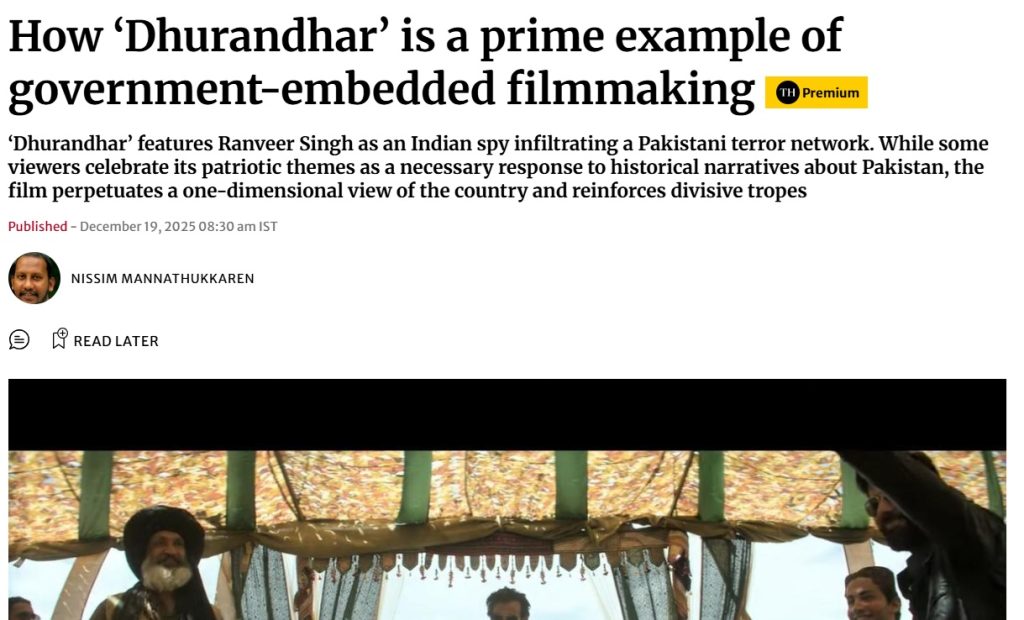

The paper borrows a term from American writer Peter Maas to accuse the film of reproducing the ideological narrative of the present Indian government, even when it appears subtle, technically polished, and commercially driven.
On the surface, the argument sounds sophisticated. Look closer, and it collapses under the weight of The Hindu’s own record.
Because if “government-embedded narratives” are the standard, The Hindu is the master of it.
Embedded Filmmaking Vs Embedded Journalism
The newspaper’s critique rests on the claim that Dhurandhar normalises the worldview of the Indian security state: muscular counter-terrorism, Pakistan as a hostile adversary, internal enemies, and a decisive nationalist leadership. According to The Hindu, this becomes propaganda not because it lies blatantly, but because it aligns seamlessly with the political imagination of the ruling establishment.
But this raises an obvious question: Who audits the auditor?
For decades, The Hindu has functioned as one of India’s most consistent platforms for foreign-state-embedded narratives, particularly when it comes to China.
Here are instances when The Hindu propagated Chinese propaganda.
The Hindu Glorifies Communist China On CPC’s 100th Anniversary
On the centenary of the Communist Party of China (CPC), The Hindu, a known left-leaning outlet, published a piece that read more like praise for Beijing’s authoritarian regime than objective journalism.
The article, authored by Alka Acharya, a professor of Chinese Studies at JNU and often presented as a “China expert,” lauded the CPC under Xi Jinping, describing it as Qiang Qilai—a “rising power.” She credited the Party for effectively overcoming internal and external challenges and positioning China as a global force to reckon with.
In the piece, Acharya celebrated the CPC’s role in shedding China’s so-called “colonial mindset” and promoted the narrative of a ‘resurgent China’ ready to challenge global powers—a vision tightly aligned with Beijing’s propaganda.
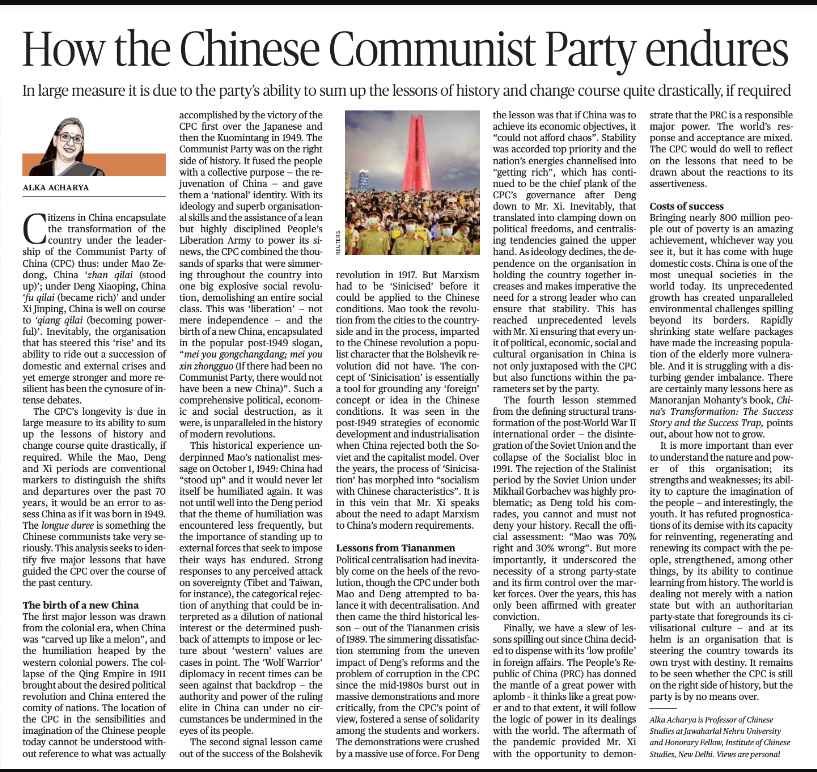

That The Hindu chose to publish such a glowing endorsement of China’s totalitarian regime on a landmark occasion for the CPC raises serious concerns about the outlet’s editorial leanings and its willingness to amplify Chinese state narratives.
The Hindu Runs Full-Page Chinese Advertorial Celebrating 100 Years Of Communist Rule
On 1 July 2021, The Hindu published what can only be described as a glaring example of soft propaganda—a full-page advertorial paid for by the Chinese government, marking the 100th anniversary of the Communist Party of China (CPC).
This sponsored content appeared on Page 3 of the newspaper, blending seamlessly with regular editorial content, making it difficult for casual readers to recognize it as a paid promotion. However, a closer look revealed that it was clearly planted by Chinese interests, designed to celebrate the CPC’s rise and present it in a flattering light.
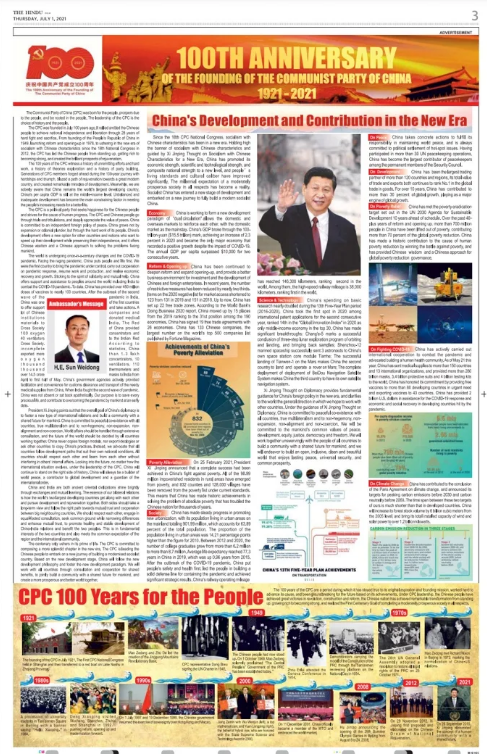



(Image Credit: OpIndia)
Adding to this coordinated media push, The Hindu also released a podcast discussing the CPC’s achievements, growth, and global influence—further amplifying China’s narrative through a platform widely seen as sympathetic to left-wing ideologies.
By offering its space and credibility to Beijing’s state-funded propaganda, The Hindu raised serious ethical concerns about its editorial independence and willingness to serve foreign influence under the guise of journalism.
The Hindu Glorifies China’s Political Evolution Under The Communist Regime
On 26 June 2021, The Hindu published an article titled “CPC Back to the Future for China’s Communists,” authored by Ananth Krishnan. The piece paints a glowing narrative of the Communist Party of China (CPC), portraying its political transformation as a sign of strength and adaptability.
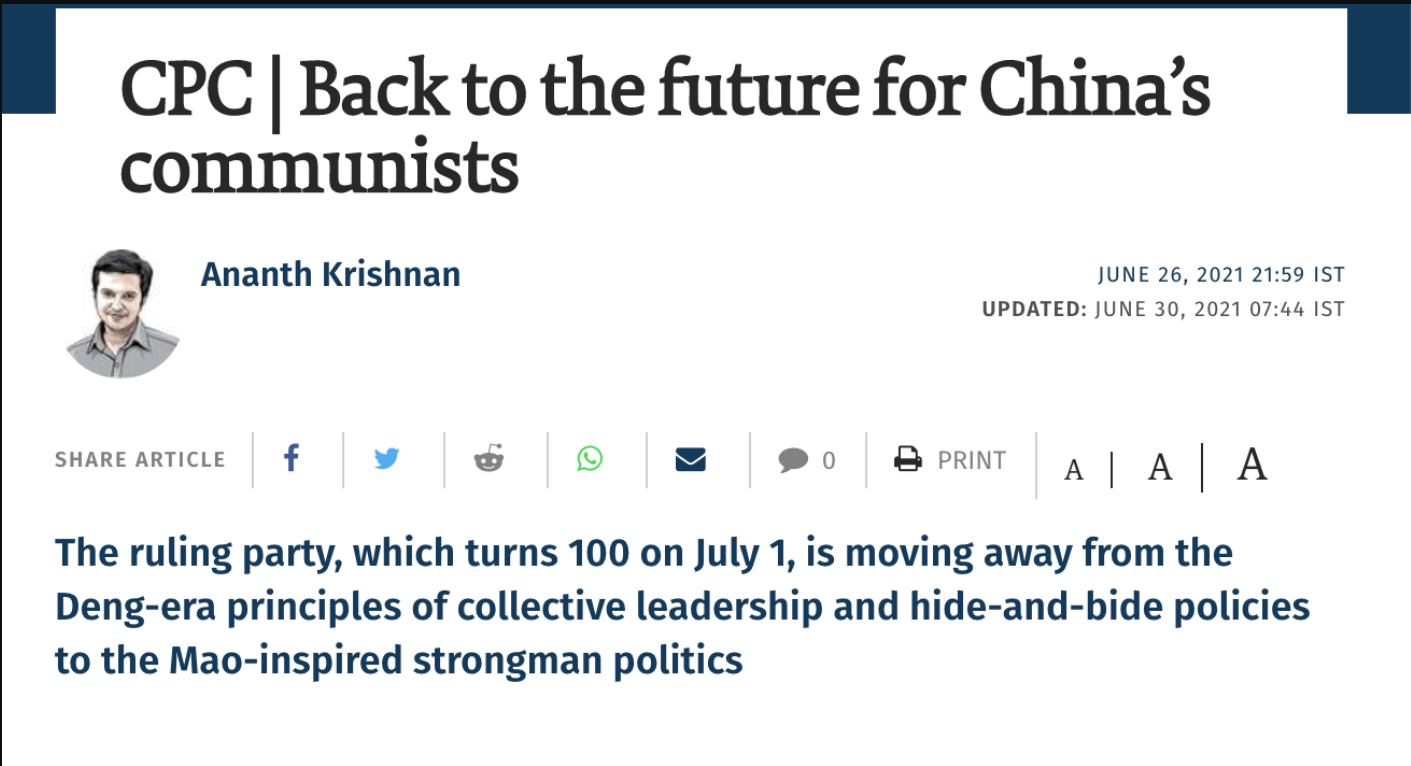

The article highlighted how the CPC has shifted from the era of collective leadership under Deng Xiaoping to a centralized, authoritarian model under Xi Jinping, which the piece describes as a revival of Mao-style strongman rule. Rather than critiquing this consolidation of power, the article frames it as a natural and effective evolution of China’s political structure.
In simple terms, the article attempts to legitimize the CPC’s increasingly autocratic governance, presenting its journey from 1921 to the present as a model of resilience and strategic leadership—downplaying the lack of political freedom, human rights concerns, and international criticism surrounding China’s regime under Xi.
Once again, The Hindu appears to champion Beijing’s narrative, raising questions about its editorial intentions and alignment with Chinese interests.
The Hindu Publishes Distorted India Map Omitting Sikkim, Faces Backlash, Issues Apology Later
In a glaring and controversial oversight, The Hindu published a map of India that completely omitted the state of Sikkim in its 13 May 2025 edition. The map accompanied an article titled “With a New Pope, an Understanding of Catholicism in India” and appeared in the newspaper’s Data Point section. The state’s boundaries were missing, effectively erasing Sikkim from the national map.


Following a wave of public backlash and criticism over this “grave error,” The Hindu issued an official apology the next day, on 14 May 2025. The editorial team acknowledged the mistake and attempted to downplay the incident as a technical glitch. Their corrigendum read, “Due to a data input error, the India map in the article, ‘With a New Pope, an Understanding of Catholicism in India’, which appeared in the Data Point section on May 13, 2025, was incorrectly presented with the contours of Sikkim State being shaded out. We apologise for the error. The map and the references have been removed from the story online and corrected in our e-paper editions.” — The Editor.
Due to a data input error, the India map in the article, “With a new Pope, an understanding of Catholicism in India”, which appeared in the Data Point section on May 13, 2025, was incorrectly presented with the contours of Sikkim State being shaded out. We apologise for the…
— The Hindu (@the_hindu) May 14, 2025
Despite the correction, the incident added to growing concerns about The Hindu’s editorial integrity and its recurring tendency to mishandle sensitive national subjects, reinforcing its image as a publication pushing questionable narratives under the guise of journalism.
The Hindu Spreads False Report On Crash Of Three Indian Fighter Jets
On 7 May 2025, The Hindu published a misleading report falsely claiming that three Indian Air Force aircraft had crashed in different parts of Jammu and Kashmir — specifically in Akhnoor, Ramban, and Pampore. The report included photographs to support the claim, suggesting that the debris belonged to downed jets.
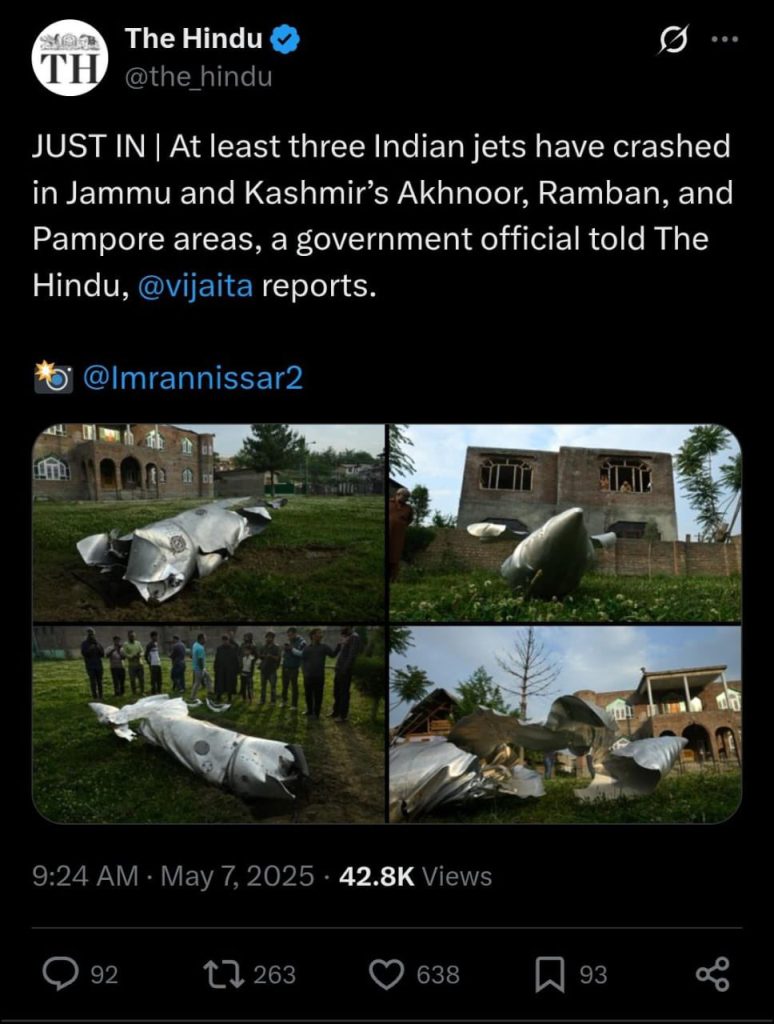

However, the images used by The Hindu were later revealed to be misleading — the so-called “crashed jets” were actually external fuel tanks, not aircraft wreckage. The publication failed to verify basic facts before running the story, leading to widespread confusion and panic.
Once the false claim was exposed, The Hindu quietly deleted the article from its platform and issued a weak clarification, merely expressing “regret” for the confusion caused.
We have deleted an earlier post about Indian aircraft involved in Operation Sindoor. There is no such on-record official information from India. We therefore decided to remove the post from our platforms. We regret that it created confusion among our readers.
— The Hindu (@the_hindu) May 7, 2025
This incident further solidified The Hindu’s growing reputation as a purveyor of unchecked and irresponsible journalism — a media house increasingly accused of spreading misinformation, especially when it involves India’s defense and security matters.
The Hindu Echoes Chinese Talking Points On BRI Deal With Nepal
On 4 December 2024, The Hindu published an article that openly praised China’s Belt and Road Initiative (BRI) following the signing of a cooperation framework between Nepal and China. Instead of offering a critical or balanced perspective, the piece amplified pro-China narratives, portraying the BRI as a game-changing opportunity for Nepal’s economic development.
The article highlighted supposed benefits of the BRI, including improved infrastructure and regional connectivity, while praising China’s influence in Nepal—particularly under the leadership of former Prime Minister KP Sharma Oli, known for his Beijing-friendly stance. It even echoed the Chinese propaganda line that BRI could help transform Nepal from a “landlocked” to a “land-linked” nation.
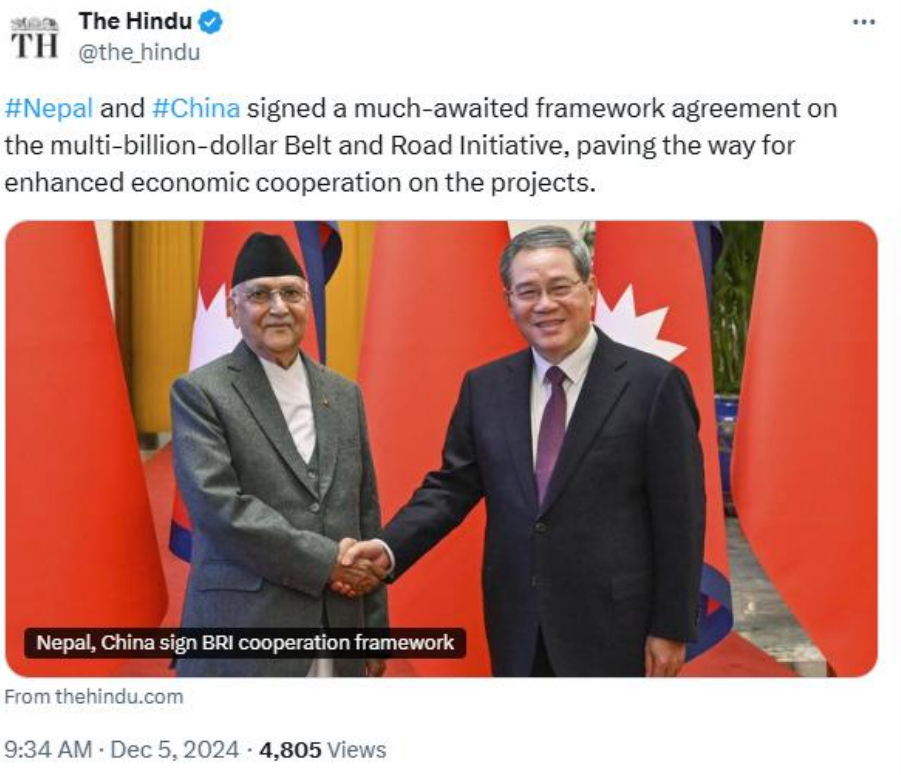

By uncritically promoting China’s strategic initiative—which many countries and experts have criticized as a debt-trap diplomacy tool—The Hindu once again demonstrated its inclination to align with China’s geopolitical agenda, further fueling concerns about its editorial loyalties and its role in shaping public opinion in favor of foreign interests.
These are just 3 instances; here is the entire list.
The N Ram Problem That The Hindu Never Resolves
Under the long stewardship of N. Ram, former Editor-in-Chief, current director, and an unapologetic, self-described communist, The Hindu cultivated editorial positions that routinely mirrored Chinese Communist Party talking points, has even been seen participating in events organized by communist-affiliated groups and political figures.
Self-awareness is so overrated. https://t.co/l6z61HNOxK pic.twitter.com/FitHaHe7Ei
— Abhijit Iyer-Mitra (@Iyervval) November 4, 2025
Comrades should stfu https://t.co/nDDF2RjEjn pic.twitter.com/9bYzS4By3p
— Aravos (@_Asynchronus) November 4, 2025
This was not an occasional lapse. It was a pattern.
In its coverage of the deadly Galwan Valley clash, where 20 Indian soldiers were martyred in a brutal confrontation with Chinese troops, The Hindu appeared to amplify Beijing’s version of events rather than India’s official stance.
The article gave prominence to statements issued by the Chinese People’s Liberation Army (PLA) and the Chinese Ministry of Foreign Affairs (MFA), which accused India of breaching prior agreements and provoking the skirmish. It went so far as to reiterate China’s claim that “the sovereignty of the Galwan Valley has always belonged to China”—a position that India categorically denies.
Instead of fairly presenting India’s viewpoint or underlining the loss suffered by Indian forces, The Hindu seemed to minimize India’s position by focusing heavily on China’s diplomatic protests and its portrayal of the incident as a defensive response. This coverage reflected a pattern of favoring adversarial narratives over national interest, even in matters of national security and territorial integrity.
If Dhurandhar is accused of embedding the Indian government’s worldview, what exactly should we call a newspaper that spent years embedding a rival authoritarian state’s worldview into Indian elite discourse?
Selective Outrage Is Not Critique – It Is Politics
The Hindu’s review of Dhurandhar is not objectionable because it critiques nationalism. Criticism is legitimate. The problem is selective moral outrage.
The review objects to Pakistan being portrayed largely through terror networks, absence of “good Pakistani Muslims” in the film to counterbalance terrorists. It also feels that the film echoes slogans associated with the Modi government (meh) and has security officials resembling present-day power centres!
Yet the same paper has normalised Chinese state narratives without demanding “good CCP dissidents” in every report, treated an authoritarian one-party state with kid gloves while lecturing India on pluralism, shown no comparable anxiety about propaganda when it aligns with its ideological comfort zone.
You think this is media ethics? Naah, it is ideological policing.
Dhurandhar unsettles The Hindu not because it is propaganda, but because it is not their propaganda.
The Real Discomfort: Loss Of Narrative Monopoly
For decades, The Hindu enjoyed disproportionate influence over how India’s English-speaking elite interpreted national security, foreign policy, Pakistan, China, Kashmir and the Indian state itself.
Films like Dhurandhar, and the popular response to them, represent a loss of that monopoly. A cultural product is now shaping public memory and emotion outside the paper’s ideological frame.
Calling it “government-embedded filmmaking” is a way to delegitimise that loss.
Subscribe to our channels on WhatsApp, Telegram, Instagram and YouTube to get the best stories of the day delivered to you personally.