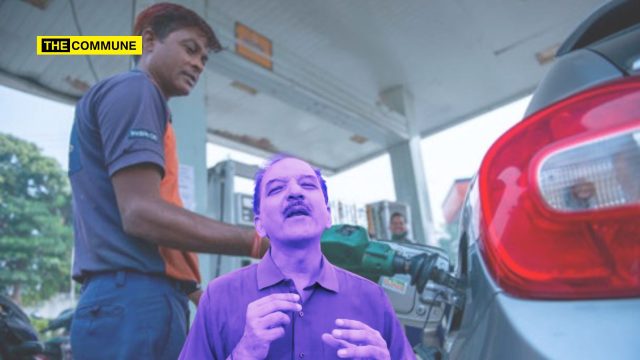
As tensions continue to escalate in West Asia, India has witnessed a wave of rumours on social media warning of imminent shortages of LPG, petrol, and diesel. While the government and petroleum authorities have repeatedly clarified that there is no shortage of fuel, some social media commentators have continued to amplify panic narratives. Among the most prominent of them is all-in-all commentator Sumanth Raman.
Sumanth Raman, a Congress simp and an arm-chair commentator who weighs in on virtually every issue under the sun, has repeatedly posted messages that have been fuelling public panic rather than calming it.
The specific behaviour began on 9 March 2026, when reports circulated that hotels and restaurants in cities such as Mumbai, Bengaluru and Chennai were facing temporary disruptions in commercial LPG supplies due to logistical pressures linked to the ongoing Iran-Israel tensions affecting shipping routes in West Asia.
Some industry associations warned that if the supply disruptions persisted, hospitality businesses could face operational challenges. Chennai’s hotel industry, representing more than 10,000 establishments, even wrote to Prime Minister Narendra Modi flagging possible cascading impacts on hospitals, college hostels and railway catering services.
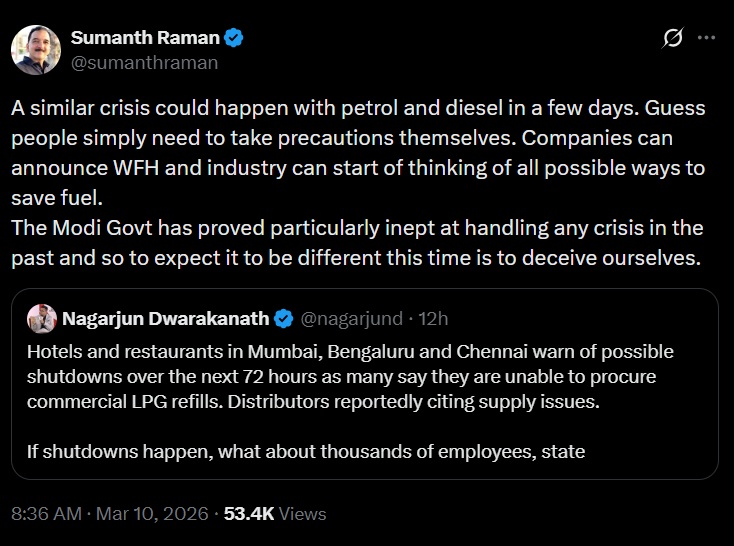
Instead of urging restraint or waiting for official confirmation, Raman took to X (Twitter) to speculate about a broader fuel crisis. In a post responding to journalist Nagarjun Dwarakanath’s report about LPG disruptions, Raman wrote, “A similar crisis could happen with petrol and diesel in a few days. Guess people simply need to take precautions themselves. Companies can announce WFH and industry can start of thinking of all possible ways to save fuel. The Modi Govt has proved particularly inept at handling any crisis in the past and so to expect it to be different this time is to deceive ourselves.”
In a follow-up post the next day, he doubled down, writing, “And we need to start saving NOW” quoting another handle that was pushing rumours about cooking gas shortage, further stoking fear with zero factual basis for a fuel crisis.

These posts appeared despite the fact that the central government had already issued clarifications on the evening of 9 March stating that there was no shortage of fuel in the country and no immediate plan to increase petrol or diesel prices.
Government sources informed ANI that India had adequate petrol, diesel and aviation fuel stocks. Officials also explained that the country had diversified crude sourcing routes beyond the Strait of Hormuz to reduce vulnerability to geopolitical disruptions.
Authorities also clarified that retail fuel prices were expected to remain stable unless global crude prices crossed roughly USD 130 per barrel, while global projections suggested prices would likely remain closer to the USD 100 range.
Despite these assurances, panic buying scenes were witnessed at petrol pumps in Chennai as rumours of fuel shortages spread rapidly online. Long queues formed as residents rushed to fill tanks and stock fuel.
Such panic behaviour is often triggered by irresponsible speculation on social media, particularly when influential commentators amplify worst-case scenarios without verification.
Raman’s latest post on 12 March 2026 again appeared to mock the situation, writing: “To know how much people trust the Central Govt all you need to do is drive past a nearby petrol pump today.”
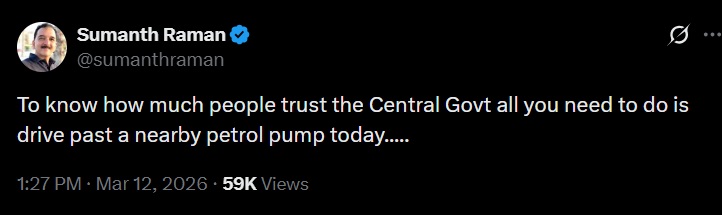
Sumanth Raman seems to be heavily indulging in a pattern that first amplifies fears and then uses the resulting panic as political commentary.
In moments of geopolitical uncertainty, the role of public commentators should be to inform responsibly and avoid fuelling panic. When rumours spread faster than facts, even a few speculative posts can have real-world consequences – from panic buying to unnecessary public anxiety.
And in this episode, Sumanth Raman’s posts demonstrate exactly how social media commentary can aggravate a crisis rather than contribute to calm.
Subscribe to our channels on WhatsApp, Telegram, Instagram and YouTube to get the best stories of the day delivered to you personally.