


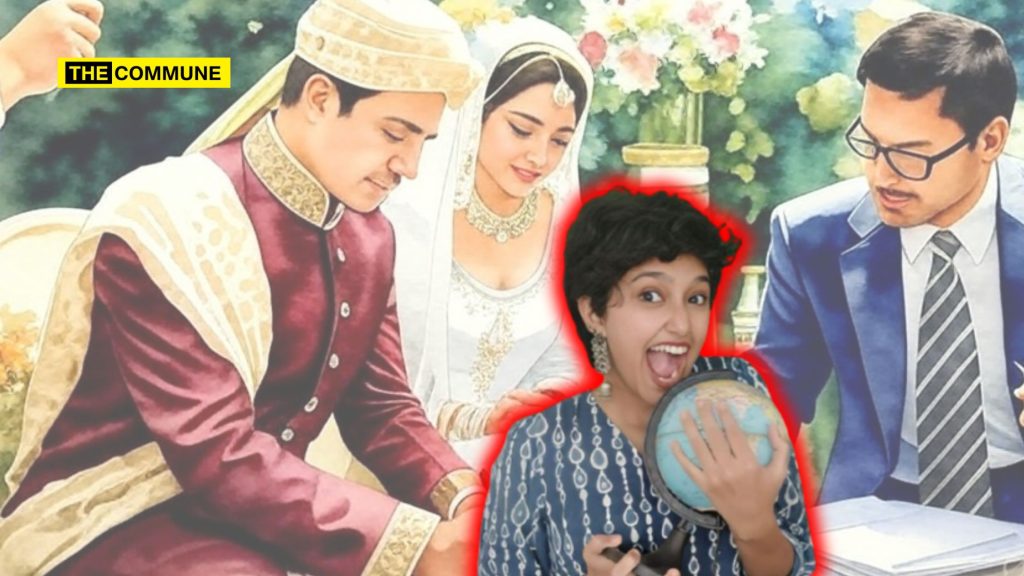
Over the past few years, social media users would have noticed a trend – the glorification of Islamic practices as inherently feminist and superior, often through a deliberate and sly comparison with distorted versions of Hindu customs.
In a recent video, self-styled influencer Kavya Karnatac who is known by her handle @kk.create, tried to glorify Islamic marriage by presenting Mehr as a woman’s golden ticket to security and independence. She confidently declared that brides receive mandatory payments in the form of cash, gold, or property, and that marriages can only happen if the bride agrees to it.
Sounds empowering… until you scratch beneath the surface. What Kavya is doing is not an objective discussion on women’s rights. It is a sly attempt to project Islam as superior for women while subtly painting Hindu traditions as regressive. But reality paints a very different picture.
While presenting this half-truth, she conveniently omits the grim realities millions of Muslim women face under the very same Personal Law system that governs Mehr.
This woman is a perfect example of Liberal sweet poison.
She is promoting Islamic marriage like it’s the best thing for a woman 🤡 pic.twitter.com/gSWUZkRZRR
— Sunanda Roy 👑 (@SaffronSunanda) September 1, 2025
The Selective Showcase: The “Mehr” Half-Truth
The speaker correctly states that Mehr is a mandatory payment from the groom to the bride, enshrined in the marriage contract. She highlights that it becomes her exclusive property and is a debt upon the husband’s estate.
This is technically true. However, this rosy picture is a fraction of the whole story. What she deliberately omits is far more telling:
The Reality of “Deferred Mehr”
While Mehr can be paid upfront (Mu’ajjal), it is very often “deferred” (Mu’wajjal), meaning it is only payable upon divorce or the husband’s death. In practice, this means a woman may never see this money unless her marriage ends. It is not an empowerment fund she can access during the marriage for her needs or independence; it is often a theoretical safety net that is notoriously difficult to enforce legally without a prolonged court battle.
The Illusion of “Choice”
The speaker claims, “the bride can demand anything.” In reality, the amount is frequently negotiated by male guardians (wali), and societal and familial pressures often lead to women accepting token amounts to not appear “greedy” or to make the marriage easier for the groom. The idea of a woman freely dictating a high price is often a fantasy, not the norm.
A Right Does Not Equal Empowerment
Having a right on paper and having the social, legal, and financial agency to enforce it are two different things. For many women, claiming Mehr from a resistant husband or his family can mean inviting social ostracization and a grueling legal fight.
The Glaring Omissions: The Reality for Muslim Women Under Personal Law That Karnatac Will Not Discuss
While Kavya boasts about Mehr, she conveniently ignores the systemic inequalities that Muslim women face:
- Polygamy Legal for Muslim Men – Under Muslim Personal Law in India, men are allowed four wives at a time. Hindu men are legally restricted to one wife. Which system respects women more?
- Triple Talaq and Divorce Insecurity – Though “instant” triple talaq has been banned, Muslim men still hold disproportionate power in divorce. Women have far less autonomy and are often left vulnerable.
- Halala Exploitation – In cases of divorce, women are sometimes forced into humiliating “Nikah Halala,” where they must marry another man, consummate the marriage, and then divorce again before returning to their first husband. This is sanctioned by certain interpretations of Sharia, not Hinduism. Research reveals that Nikah Halala has become a commercial enterprise where “professional Maulvis” charge between ₹20,000 to ₹1.5 lakh for facilitating what amounts to legalized rape. Women are forced into temporary marriages, sexually exploited, and then divorced; all to satisfy male egos and religious technicalities. A 2022 case exposed how a woman was gang-raped by her former husband and others under the guise of Nikah Halala, while another incident involved a woman being forced into this practice after her husband lost her to a friend in gambling. These aren’t isolated incidents but systematic exploitation enabled by Islamic personal law.
- Inheritance Inequality – Muslim women inherit only half of what male heirs receive, whereas Hindu daughters now enjoy equal inheritance rights under the Hindu Succession Act.
- Hijab and Control Over Women’s Bodies – From Iran to India, Muslim women are pressured or forced to wear hijab, niqab, or burqa—often not out of choice but compulsion. Hindu women, despite social pressures, face no such legal impositions.
- Mehr as Illusion – While marketed as “mandatory security,” Mehr is often set at token amounts in many Muslim marriages (sometimes as little as a few rupees) and deferred indefinitely. Many women never actually see it. In reality, it’s a paper shield, not real empowerment.
- Custody Rights (Hizanat) – The mother’s right to custody of her children is often limited to a very young age (usually 7 years for boys, puberty for girls), after which custody typically reverts to the father.
- Legal Battles for Equality – Muslim women’s groups have repeatedly had to go to court (e.g., Shah Bano, Shayara Bano cases) to demand basic rights—alimony, equality, dignity. Hindu women already enjoy such protections under codified Hindu law.
To promote Islamic marriage as the “best thing for a woman” while ignoring these patriarchal pillars is pure dishonesty on Karnatac’s part.
The Sly Dig: The False Equivalence with “Dowry”
The most insidious part of this narrative is the sly, derogatory comparison with Hinduism. The speaker sets up a strawman: “Is dowry only given to the boys? No.” This implies that Hindu marriages are solely defined by the illegal practice of dowry (giving from the bride’s family to the groom’s), while Islamic marriages are defined by the “gift” of Mehr to the bride.
This is a malicious false equivalence. it is a deliberate attempt to make one faith look inherently oppressive and the other inherently progressive.
Furthermore, she completely ignores the concept of Stridhan in Hindu law, which is the woman’s exclusive property – gifts given to her by her parents, relatives, and husband before, during, and after marriage. This, like Mehr, is her absolute right. But acknowledging this would ruin the false narrative.
By glorifying Mehr, Kavya Karnatac indirectly suggests that Hindu traditions shortchange women. This is a distortion and a half-truth:
- Hinduism does not mandate dowry; it condemns it. Dowry is a social evil, not a religious requirement. Kavya conveniently ignores this.
- Hindu law ensures equal rights of inheritance, monogamy, alimony, and maintenance – clear legal safeguards that Muslim women are still fighting for.
- Hindu marriages treat women as equal legal partners, not as dependents subject to religiously sanctioned male control.
Final Word
If Kavya Karnatac truly cared about women’s rights, she would speak about the urgent reforms Muslim women desperately need such as ending polygamy, abolishing halala, ensuring equal inheritance, and enforcing Mehr properly. Instead, she cherry-picks half-truths to romanticize Islam and subtly insult Hinduism. Empowerment is not about covering up oppression with pretty words. It’s about confronting injustice honestly – something Kavya will never do.
Subscribe to our channels on Telegram, WhatsApp, and Instagram and get the best stories of the day delivered to you personally.