


In the comfortable echo chambers of India’s liberal commentariat, intellectual debates often mask a dangerous undercurrent. A recent podcast conversation, a cosy “co-therapy session” between two heavily left-leaning voices – Meghnad and Dr Medusa, has ripped away that mask, revealing a shocking and chilling comfort with political violence, bloody revolution, and the dismantling of the state.
To jog your memory – Meghnad S who contested from Delhi’s Malviya Nagar seat after Prime Minister Modi’s call for youth in politics, faced a humiliating defeat. He secured only 192 votes, finishing behind NOTA, which got 532. Despite over 80K YouTube subscribers, his political debut collapsed.
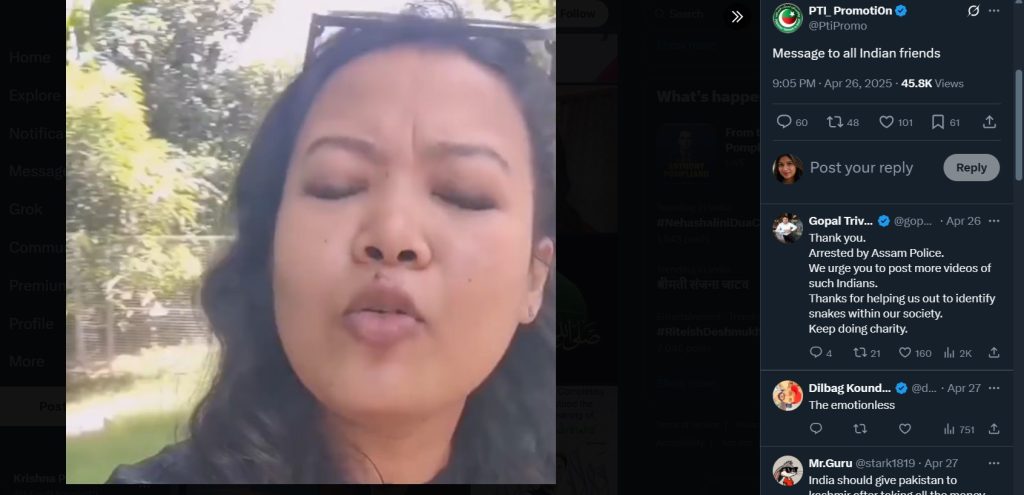
Dr Medusa, was seen accusing the central government and mainstream media of exploiting the April 22 Pahalgam terror attack for TRP. On 26 April 2025, Pakistani handle PtiPromo reshared her video. She questioned why no officials were held accountable and criticized intelligence failures, asking how such a major lapse occurred without the Home Minister’s knowledge.

Now let’s get back to the topic at hand.
The speakers, while discussing the violent protests in Nepal, didn’t just report on events; they openly theorized, justified, and even celebrated the use of extreme violence as a necessary and inevitable tool for political change. Their conversation is a damning indictment of a fringe mindset that bayes for blood in the name of revolution.
The “Necessity” Of Violence: A Core Belief
The most alarming takeaway is the hosts’ firm belief that non-violent, constitutional methods are futile against a system they deem oppressive. Medusa explicitly states, “I have never shied away from the fact that I like a good revolution… and when something like this happens. We can’t be naive enough to accept like a bloodless revolution hai na, woh to hoga violence.”
She further goes on to quote someone she follows. She said, “When you have created a system and when you are part of the and you have contributed towards creating a system where the methods of retribution and justice have been reduced to the extremely inaccessible, they have been deliberately made inaccessible – for example a compromised judiciary or a corrupt judiciary, which was also the case in Nepal, but then judiciary was very good in Nepal judiciary was the only thing which was kept by the people. When you don’t have that, it is very easy to condemn violence it is very easy to say no no, it’s very wrong.”
People should see the dangerous stuff on Indian liberal Youtube ecosystem
Here they are discussing Nepal
And they are openly saying there can be no such thing as “bloodless revolution”
It is almost certain that these people want violence… pic.twitter.com/KLgwYCnMFo
— Abhishek (@AbhishBanerj) September 12, 2025
She draws a direct parallel to India’s freedom struggle, not to laud Mahatma Gandhi’s non-violence, but to valorize the path of Bhagat Singh and Chandrashekhar Azad. She said, “We had people like Bhagat Singh. We had people like Chandrashekhar Azad who were not who did not shy away from violence. We don’t ignore that the violence of the oppressed and the violence of the oppressor are two completely different things.”
This dangerous moral relativism seeks to create a justification for violence, painting it as a noble act when employed by those they deem “oppressed.”
Redefining Violence To Suit A Narrative
To build their case, the duo engage in semantic gymnastics, broadening the definition of “violence” to include systemic issues while downplaying actual physical harm. They argue that focusing only on bloodshed is myopic. Medusa said, “I want you to rethink the definition of violence. What we categorize as violence. We only look at violence, whether blood is being shed or fighting is happening, or vandalism is happening somewhere. That is violence… But then there is another form of systematic violence of using courts, using judiciary, using police, using all of these different using capitalism for God’s sake, to create this structure where there is no thriving for the majority. They are only surviving, okay, survival is just survival, there is no meaning in life.”
By equating judicial processes, economic systems, and political opposition with physical violence, they create a pretext where any retaliatory physical violence can be framed as a justified response. Medusa reads out some passage and passionately argues that when the state is violent, violent retribution is inevitable, “Humans will fight for sense and justice with the tools that they have in their hands. So if you are creating a world in which we have weapons, our weapons are in our hands, we don’t have to debate or for bribing or there is no other option for justice, then a person will do it in whatever way he understands, with the tools that he has in his hand, you talk about debate or you do that but if you have not given the marginalized oppress the platform to come and debate you. How has anything changed? You will say your point and leave. So, what other option does marginalized have?”
This is a clear, albeit intellectualized, call to arms. It suggests that if their voices are not dominant in the public sphere, then taking up physical “tools” is a legitimate next step.
Legitimising Violence
The duo went on to portray violence as inevitable and even desirable in any uprising saying, “…there has to be the requirement of this violent faction. I think it is not a matter of requirement, it is inevitable because in their society you will not be equal everywhere, everyone’s feelings and reactions will not be equal. So there will be a person, there will be a certain group of people who will be violent in nature.”
A Contempt for Democratic Processes
The podcast reveals a deep-seated contempt for India’s democratic institutions and processes. They mock MPs as “idiots” during a discussion on the Vice-Presidential election and speak glowingly of opposition spokespersons who engage in abusive, non-constructive debates on television, celebrating their “laughter” as a weapon.
Their solution isn’t to win elections or build persuasive arguments; it is to threaten the system itself. As one host says, drawing a bizarre analogy, “…forgiveness suits a cobra who has poison… forgiveness is simple… only if you are able and you are capable of causing some harm… a successful society does need both the actions.”
From Salon Discussions to Street Violence
This podcast is not merely an analysis of current events. While they cloak their arguments in academic terms like “systemic violence” and “oppressor-oppressed dynamics,” the underlying message is clear and simple: they believe bloodshed is not just inevitable but desirable for achieving their political goals. They speak of “burning the whole thing down” with an alarming casualness.
Simply put, this is sedition, an incitement to chaos. The call for a “bloodless revolution” has been abandoned. What remains is a baying for blood.
Subscribe to our channels on Telegram, WhatsApp, and Instagram and get the best stories of the day delivered to you personally.