


An opinion piece by Savio Fernandes, an Auxiliary Bishop, Archdiocese of Bombay, in the Indian Express on 25 December 2025 brazenly rewrites history, claiming Christianity is an “indigenous tradition” predating colonialism via St. Thomas’ 1st-century arrival. This is ahistorical propaganda.
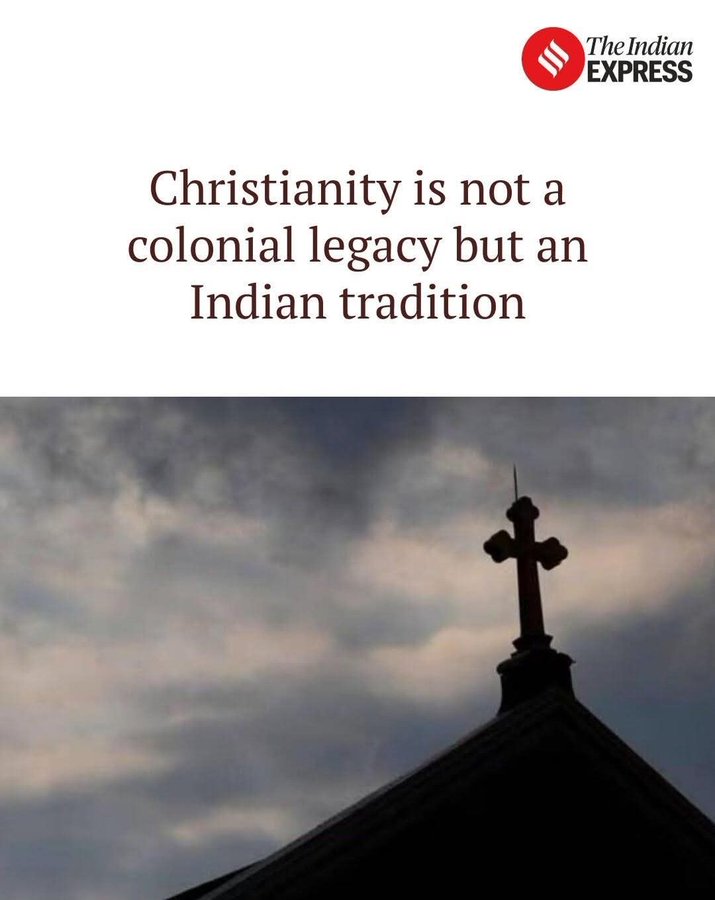

The claim that Christianity is not a colonial legacy, but an indigenous Indian tradition is not merely debatable, it collapses under basic historical scrutiny. What follows is not disagreement but a necessary correction of a narrative that replaces evidence with ecclesiastical mythology.
Let us dismantle the lies in the piece one by one.
The St. Thomas Claim: Theology Posing as History
The central pillar of the op-ed is the familiar St. Thomas story, that the Apostle reached India in the 1st century AD and established Christianity on the Malabar Coast. This is just a belief (a narrative rather) and not history.
The Acts of Thomas, repeatedly cited by missionaries, is a 3rd-century Syriac text, written nearly 200 years after the supposed events. It is theological literature, not a historical chronicle. Crucially, no Indian source corroborates it, not Sangam literature, not Ashokan inscriptions, not Tamil-Brahmi records, not Buddhist chronicles, not foreign travelogues that otherwise meticulously documented India.
Even the term “India” in early Church writings is notoriously vague. For writers like Eusebius and Origen, “India” often meant any land east of the Roman Empire from Arabia to Ethiopia. Eusebius himself conflates India with Socotra. Recycling legend is not evidence.
The Persian crosses in Kerala and at St. Thomas Mount date between the 7th and 9th centuries, and are associated with Nestorian Christian traders from Persia, post-Sassanid period, not the 1st century. Syriac inscriptions confirm medieval trade Christianity, not apostolic origins. Calling this “indigenous” stretches credibility beyond breaking point.
Missionary Institutions: Colonial Infrastructure, Not Civilisational Service
The op-ed celebrates 55,000 Christian schools and 4,000 hospitals as proof of selfless service. What it omits is how and why these institutions emerged.
Most major missionary institutions were established during colonial rule, funded through:
- Portuguese Padroado privileges
- British East India Company land grants
- Crown-endorsed missionary expansion
Institutions like St. Xavier’s, Loyola, CMC hospitals were explicitly dual-purpose: education/healthcare and evangelism. This is not conjecture. Madras High Court records, colonial correspondence, and missionary manuals openly acknowledge conversion as an objective.
The claim that service is “untainted” ignores decades of documentation on incentivised conversions, popularly called “rice Christianity.” Multiple state inquiry reports (including Madhya Pradesh and Odisha) recorded material inducements ranging from ration benefits to land access post-conversion. The 2008 Kandhamal violence exposed not just communal tensions, but large-scale land disputes following conversions – a fact carefully erased from missionary narratives.
Dalits and Tribals: Uplift or Extortion?
The Church presents itself as a champion of Dalits and tribals. Yet conversion has rarely translated into liberation.
Converted Dalits remain socially marginalised, and are often reclassified as “Christian Dalits” – now our courts have ordered that one cannot claim benefits if they have converted.
Empowerment that demands religious erasure as entry fee is not social justice; it is extortion with moral cover.
Supreme Court Judgment: A Legal Finding Twisted Into Vindication
The op-ed cites an October 17 Supreme Court ruling as proof that “forced conversion allegations are false.” This is legally dishonest.
The bench of Justices J B Pardiwala and Manoj Misra quashed FIRs from Fatehpur on procedural grounds – lack of magistrate inquiry, defective investigation, and absence of prima facie material.
The Court did not endorse missionary activity, validate conversion practices or declare allegations baseless in substance.
Justice Pardiwala’s remark that criminal law must not harass innocents was a rebuke to police procedure, not a sanctification of evangelical conduct. Conflating the two is either incompetence or deliberate misrepresentation.
Structural Privilege and Selective Victimhood
While temples are state-controlled, audited, and their revenues diverted, over ₹1 lakh crore annually nationwide, churches enjoy Article 30 minority exemptions, foreign funding under FCRA (₹20,000+ crore between 2011–2021), as well as near-total autonomy over assets.
In Tamil Nadu alone, temple land recoveries run into thousands of acres, while church land encroachments in Kerala exceed 20,000 acres by official estimates. In Manipur, church-aligned Kuki militias and evangelical mobilisation have played a documented role in ethnic violence, yet this is airbrushed into silence.
The Ultimate Logical Collapse
If Christianity is “as indigenous as India’s spiritual paths,” then will they next claim Jesus as a Rama avatar, Muhammad as a Bodhisattva and the Bible as an Upanishad appendix?
Civilisations are not built on such intellectual fraud.
Christianity is a Middle Eastern religion that entered India through trade, colonial power, and missionary expansion, sometimes peaceful, often coercive, always asymmetrical. There is no shame in that truth. The shame lies in rewriting history to launder power.
That The Indian Express chose to platform clerical propaganda as historical fact, while routinely downplaying temple destruction, demographic engineering, and legal asymmetry, is not journalism. It is ideological advocacy wearing a secular mask.
India does not need myth-making sermons. It needs honesty.
And history, inconvenient as it may be, still matters.
Subscribe to our channels on Telegram, WhatsApp, and Instagram and get the best stories of the day delivered to you personally.