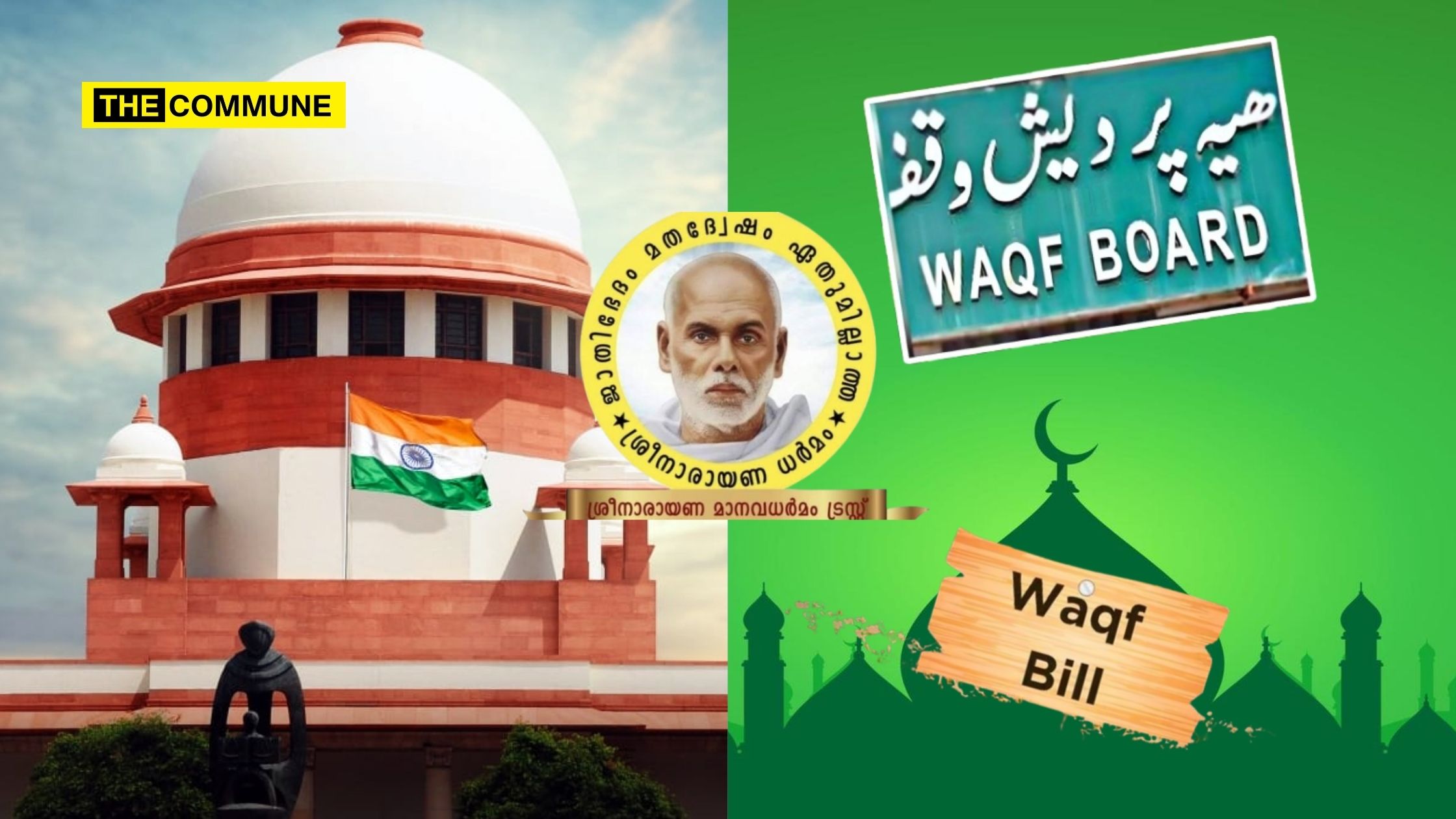
The Sree Narayana Manava Dharmam Trust has filed an intervention application in the Supreme Court, backing a batch of petitions that challenge the constitutionality of the Waqf (Amendment) Act, 2025. Founded in 2023, the Trust is dedicated to promoting the ideals of Sree Narayana Guru, a Hindu sage and social reformer from Kerala known for championing social equality and opposing caste discrimination.
The trust submitted its plea on 3 May 2025, stating that it could not remain an “idle spectator” to what it called the “devastating impact” of the new law on the Muslim community and social justice in India.
The plea argues that the 2025 amendment constitutes a “fraud on the Constitution” and effectively abolishes the traditional Islamic practice of Waqf. According to the Trust, the amended law replaces the religious institution of Waqf with a “state-designed mechanism” that undermines its theological and legal foundations.
“The arrangement for charity by Muslims created by the Impugned Act is not Waqf by any stretch of the imagination,” the petition states. “What is left after the enactment of the Impugned Act is, in law and in reality, not a Waqf institution at all—from a legal or theological point of view.”
The Trust contends that Parliament has no authority to abolish an ancient religious practice such as Waqf, which Muslims consider an act of worship. It argues that the Act violates protections guaranteed under Articles 13 and 29(1) of the Constitution.
Further, the application highlights that the amendment imposes an unconstitutional, “sui generis state-designed” scheme to control Muslim charitable donations, masquerading them as waqf while stripping them of their religious character. The removal of key provisions, such as the ‘waqf by user’ clause, and the reclassification of waqf as a non-religious institution, have also been challenged.
The Trust warns that the Act “deletes in its entirety the body of Islamic law as the basic governing law of waqf” and “fatally breaches the religious requirement that waqf must be administered strictly in accordance with democratic norms.” It alleges that the replacement of elections with appointments for Waqf Board members amounts to imposing “the non-democratic norms of Brahmanism” on an Islamic institution.
The matter is being heard by a bench comprising Chief Justice of India Sanjiv Khanna, Justice KV Viswanathan, and Justice Sanjay Kumar. The court is expected to resume hearing on preliminary objections and potential interim directions on 5 May 2025 at 2 PM.
It is noteworthy that the Sree Narayana Manava Dharmam Trust had criticized SNDP Yogam general secretary Vellapally Natesan for urging people to light lamps on 22 January 2024, the day of the Ayodhya Ram Temple consecration, calling it contrary to Sree Narayana Guru’s ideals of communal harmony. The Trust cited the Supreme Court’s acknowledgment that the Babri Masjid was illegally demolished and that the temple’s construction violates secular principles. In a statement, G. Mohan Gopal and V.R. Joshy accused Natesan of aligning with the RSS and attempting to misrepresent Guru’s teachings. They also noted the temple’s ₹18,000 crore cost equals Kerala’s education budget for 18 years.
(With inputs from Live Law)
Subscribe to our channels on Telegram, WhatsApp, and Instagram and get the best stories of the day delivered to you personally.