


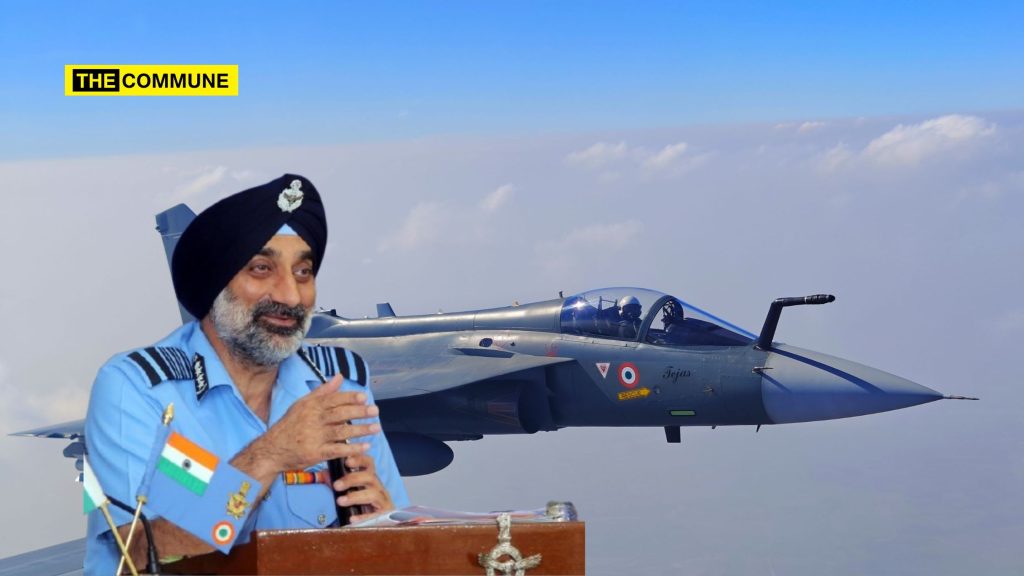
At the CII Annual Business Summit on 29 May 2025, Indian Air Force Chief, Air Chief Marshal Amar Preet Singh highlighted serious delays in defence procurement, particularly in indigenous projects. He expressed concern that most contracts have stalled due to slow production of critical weapon systems.
Singh specifically pointed to the delayed delivery of the 83 Tejas Mk1A Light Combat Aircraft (LCA) ordered from Hindustan Aeronautics Limited (HAL) in February 2021 for ₹48,000 crore. Deliveries were scheduled to start by March 2024 but have yet to begin, mainly due to delays in engine supplies from US-based General Electric, which is facing supply chain issues.
The IAF chief also noted that the prototype for the next-generation Tejas Mk2 has not yet been rolled out, and the Advanced Medium Combat Aircraft (AMCA), India’s stealth fighter project, is still without a prototype.
Emphasizing the importance of self-reliance, Singh urged stronger trust and transparency between the armed forces and domestic defence industry. He stressed that India must focus not only on producing but also designing weapon systems locally to meet urgent operational needs.
“Production capacity may increase over the next decade, but what we need today, we need now. We must get our act together quickly because wars are won by empowering our forces,” he said.
The remarks come weeks after India’s military action against Pakistan under “Operation Sindoor.” Meanwhile, the government recently approved a framework to accelerate development of the indigenous fifth-generation stealth fighter jet, the AMCA.
Why Is the IAF Chief Angry Over Delayed Jet Deliveries?
Air Chief Marshal Amar Preet Singh recently expressed strong dissatisfaction over persistent delays in India’s defence procurement timeline—especially regarding the Tejas Mk1A fighter jets. He emphasized that if a timeline is committed, it must be honoured. His frustration is rooted in a series of delays that have critically affected the Indian Air Force’s operational readiness.
The issue traces back to 2021, when Hindustan Aeronautics Limited (HAL) signed a $716 million deal with General Electric (GE) of the United States for 99 F404-IN20 jet engines. These engines were crucial for powering the indigenous Tejas Mk1A aircraft. According to the contract, initial deliveries were expected by March 2023.
However, as of 29 May 2025, only one engine has been delivered. GE, which committed to supplying all engines by now, has shared a revised timeline: 11 more engines in 2025, followed by 20 engines annually from 2026 to 2029, and the final 8 in 2030. This enormous delay has completely disrupted India’s indigenous fighter production schedule.
On the strength of GE’s original commitment, the Indian Air Force had placed a ₹48,000 crore order with HAL in February 2021 for 83 Tejas Mk1A jets (including 73 single-seaters and 10 trainer variants). HAL, in turn, committed to begin jet deliveries by March 2024. However, due to GE’s engine supply failure, HAL has been unable to deliver even a single aircraft to the IAF.
This delay comes at a time when the Indian Air Force is facing an acute shortage of fighter aircraft. India requires a minimum of 42 squadrons—each consisting of 18 fighter jets—to maintain credible deterrence and readiness. In reality, the IAF is operating with just 31 squadrons, the lowest level since the 1965 war. For context, the IAF had 42 squadrons in 1996, and 35 squadrons in 2013.
The shortage is not due to a lack of aircraft from HAL—many of the jets are reportedly ready, awaiting only the engine installations. The core bottleneck remains GE’s inability to deliver, which has sparked speculation about whether these delays are deliberate. Some observers suggest this may be a strategic move by elements within the US military-industrial complex, possibly to pressure India into purchasing American fighter jets like the F-35, instead of developing its own.
Timeline is a big issue. If you have committed a timeline to deliver then deliver at timeline
– Air Chief MarshalWhy is the Air Chief angry over deliveries ?
How US military industrial complex betrayed India?
Why they did this?The story started in 2021🧵
1/8 pic.twitter.com/oiLgJ3QkGM
— STAR Boy TARUN (@Starboy2079) May 29, 2025
The Air Chief’s anger reflects a broader concern: India’s ability to maintain independent defence capability is being undermined, not by its technological limits, but by external dependency on critical components like jet engines. The crisis highlights an urgent need to design and produce complete weapon systems within India, reducing reliance on foreign partners who may not always share India’s strategic timelines or priorities.
(With inputs from Hindustan Times)
Subscribe to our channels on Telegram, WhatsApp, and Instagram and get the best stories of the day delivered to you personally.