


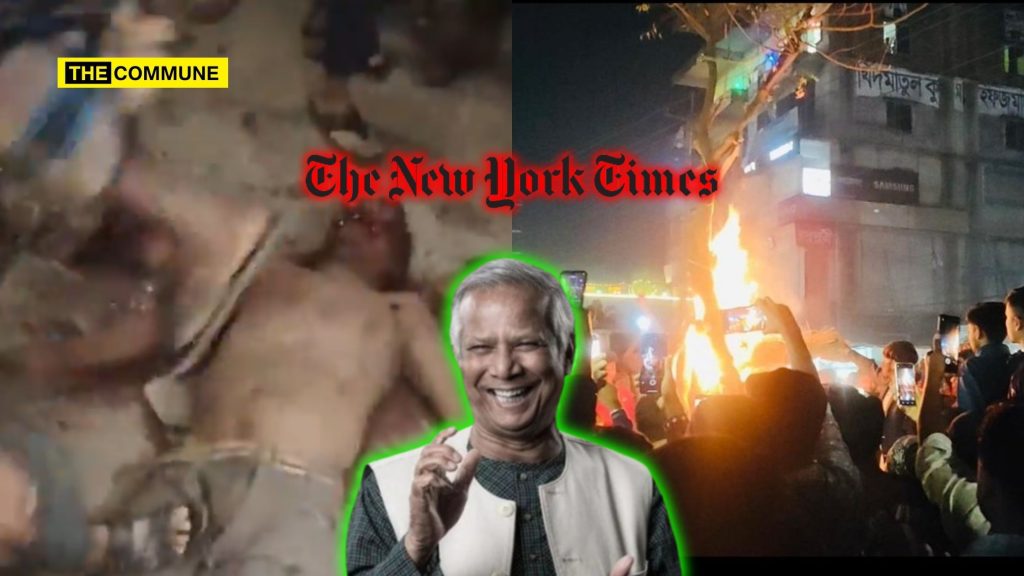
A report published by the The New York Times on 22 December 2025, detailing the lynching of a Hindu garment worker in Bangladesh, has come under sharp criticism from commentators and readers who accuse the newspaper of ideological bias, selective context, and narrative dilution in its coverage of the crime.
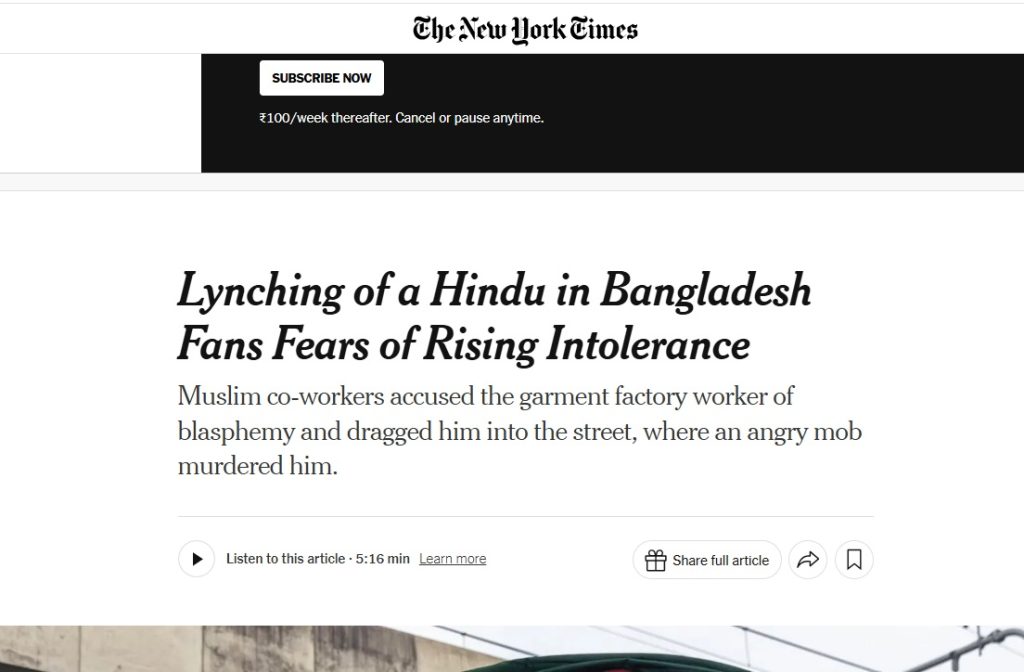

The New York Times article reported the killing of Dipu Chandra Das, a 27-year-old Hindu employee at a garment factory near Dhaka, who was accused by Muslim co-workers of blasphemy following a workplace discussion. According to the report, Das was dragged into the street by colleagues, where an angry mob lynched him, tied his body to a tree, and set it on fire. Bangladeshi authorities later arrested 12 people in connection with the killing, while police said they were unable to verify any statement made by Das that could substantiate the blasphemy allegation.
While acknowledging the brutality of the incident, critics argue that the newspaper’s framing diluted the specific religious nature of the crime by placing it within what it described as a “wider pattern of religious intolerance in South Asia.”
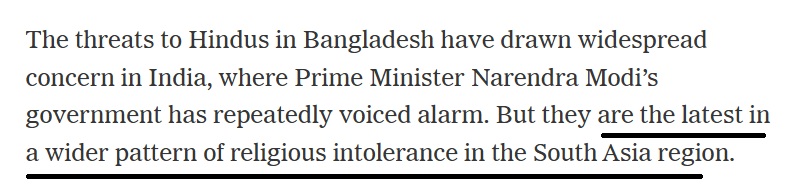

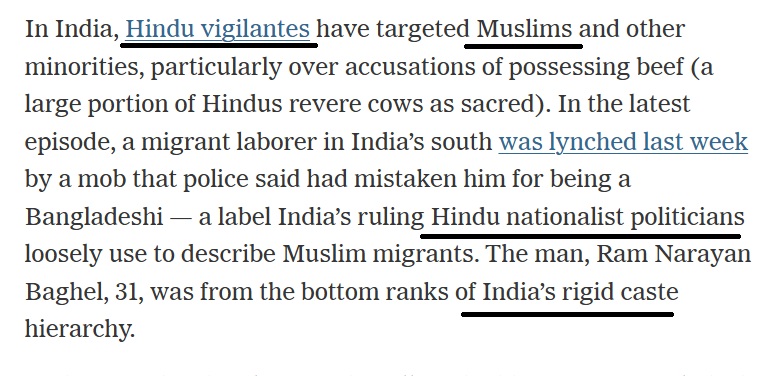
They point out that the article juxtaposed the lynching of a Hindu in Bangladesh with references to unrelated incidents in India, including violence by “Hindu vigilantes” against Muslims, thereby shifting focus away from the crime at hand.

Observers have also recalled that, just days earlier, an Indian court had convicted 10 Muslim men for the lynching of Ram Gopal Mishra, a Hindu, a fact not referenced in the New York Times report. Critics contend that such omissions contribute to an unbalanced portrayal in which violence against Hindus in Muslim-majority contexts is relativised, while unrelated incidents elsewhere are inserted to maintain a preconceived regional narrative.
Another point of contention has been the language used to describe the perpetrators. While the article noted that Das’s co-workers accused him of blasphemy, critics argue that the report avoided identifying the attackers as part of a broader pattern of Islamist or religiously motivated violence. Instead, they were largely described as “co-workers” or members of an angry mob, despite the killing being triggered by an accusation of insulting Islam’s Prophet Muhammad – a pattern seen in multiple blasphemy-related lynchings in the region.
The New York Times article also linked the incident to political instability in Bangladesh following the fall of former Prime Minister Sheikh Hasina and the interim leadership of Nobel laureate Muhammad Yunus. While human rights groups cited in the report expressed concern about the safety of religious minorities, critics say the emphasis on governance challenges further softened accountability for religious extremism by framing the murder as a symptom of disorder rather than a targeted act of communal violence.
Several commentators have accused the report’s authors, Saif Hasnat, Mujib Mashal, and contributor Suhasini Raj, of employing what they describe as a familiar editorial template: contextualising violence against Hindus within a broader regional comparison that prominently features alleged Hindu extremism in India, even when the primary incident occurs outside India and involves Muslim perpetrators.
This is exactly the same template that Western media employs to cover religious violence in the region which they prefer calling South Asia rather than the Indian sub-continent; particularly allegations that crimes against Hindus in Muslim-majority countries are frequently reframed to avoid direct attribution of religious motivation, while violence involving Hindus elsewhere is foregrounded as ideological or majoritarian.
Subscribe to our channels on WhatsApp, Telegram, Instagram and YouTube to get the best stories of the day delivered to you personally.