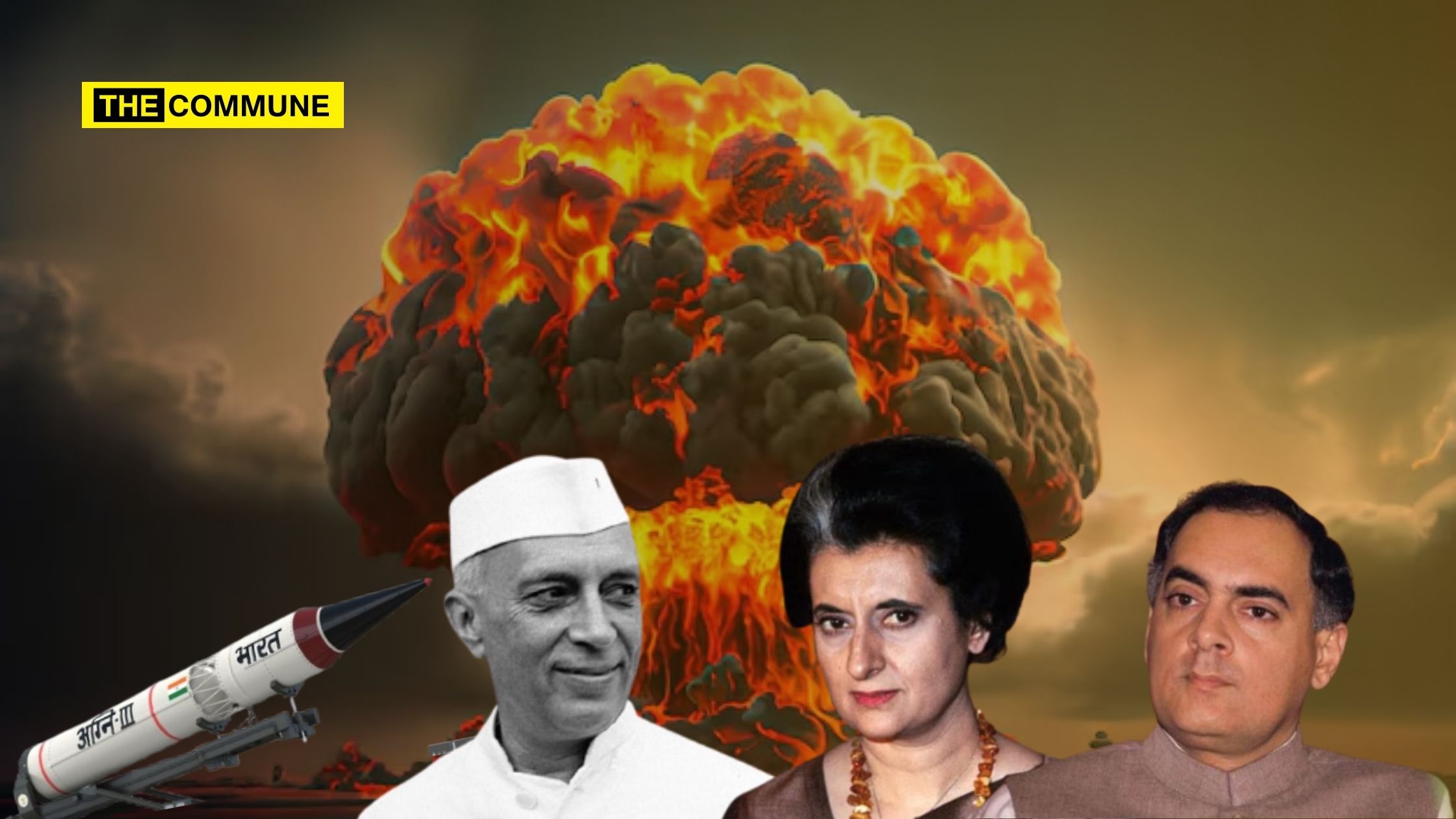
Over the decades, the Nehru-Gandhi political dynasty, long positioned at the helm of Indian governance, has repeatedly made decisions that, critics argue, compromised India’s national security. From missed strategic opportunities in the nuclear realm to restrained responses in the face of terror, a pattern of indecision and idealism over hard realism seems to have defined their approach to safeguarding the nation.
Nehru’s Nuclear Blunder: Rejecting Kennedy’s Offer, Ceding Advantage to China
India’s first Prime Minister, Jawaharlal Nehru, turned down a significant strategic opportunity that could have changed the subcontinent’s nuclear trajectory. Former Foreign Secretary Maharajakrishna Rasgotra revealed in his memoir ‘A Life in Diplomacy’ that in the early 1960s, US President John F. Kennedy offered to help India conduct a nuclear test — an offer made to ensure democratic India, not communist China, became the first Asian nuclear power.
“Kennedy, who was an admirer of India’s democracy and held its leader Jawaharlal Nehru in very high esteem, felt that democratic India, not Communist China, should be the first Asian country to conduct a nuclear test,” Rasgotra writes. Despite initial interest, Nehru rejected the proposal after consultations with Dr. Homi Bhabha and G.P. Parthasarathy. According to Rasgotra, had Nehru accepted the offer, “India would have tested the nuclear device first in Asia, before China, and it would have deterred China from launching its war of 1962 and even imparted a note of caution to Pakistan’s Field Marshal Ayub Khan’s plans for war in 1965.”
This only blocked India’s entry into the NSG (Nuclear Suppliers Group) and had Nehru chosen otherwise, that decision could have positioned India as a founding member of the NSG, rather than leaving it to seek entry as a supplicant in later decades.
This single decision arguably delayed India’s emergence as a nuclear power and gave China a strategic upper hand, which continues to influence geopolitical dynamics today.
Indira Gandhi’s Offer To Share Nuclear Technology With Pakistan
In a move that stunned even diplomatic circles, Indira Gandhi offered to share nuclear technology with Pakistan just two months after India’s first nuclear test — the 1974 “Smiling Buddha.” According to US embassy cables released by Wikileaks in 2013, Indira Gandhi sent a letter to Pakistan’s Prime Minister Zulfikar Ali Bhutto offering peaceful nuclear cooperation.
“I have explained in my letter to Prime Minister Bhutto the peaceful nature and the economic purposes of this experiment and have also stated that India is willing to share her nuclear technology with Pakistan in the same way she is willing to share it with other countries, provided proper conditions for understanding and trust are created. I once again repeat this assurance,” Gandhi reportedly stated in Parliament on 22 July 1974.
This outreach came shortly after the 1971 Bangladesh Liberation War, during which India held nearly 93,000 Pakistani prisoners of war.
The offer, framed as “peaceful cooperation,” came despite Pakistan’s open hostility post-1971 war. Bhutto rejected it, but the ideological folly was clear: empowering a rogue state with WMD capabilities. Meanwhile, India faced global sanctions, while Pakistan accelerated its nuclear program with Chinese aid.
Critics continue to argue that the decision to return the POWs without extracting substantial strategic guarantees was itself a grave diplomatic blunder — one that was compounded by this gesture of nuclear magnanimity to a state that would soon become a global hub of terror networks.
Rajiv Gandhi’s Nuclear Disarmament Idealism
At a time when China had become a nuclear power and Pakistan was stealthily advancing its nuclear weapons programme with covert international support, Rajiv Gandhi chose to champion global nuclear disarmament.
In 1988, he presented an Action Plan for a Nuclear-Weapons-Free and Non-Violent World Order at the United Nations General Assembly. While idealistic in tone, the plan was seen by many as disconnected from India’s strategic necessities amid an increasingly hostile neighborhood.
“India remains convinced that its security would be strengthened in a nuclear weapon free and non-violent world order,” the plan stated. “We are prepared to negotiate a global No-First-Use treaty… Our proposal for a Convention banning the use of nuclear weapons remains on the table.”
While India’s moral commitment to non-proliferation was commendable, this disarmament push during an era of nuclear arms build-up in both China and Pakistan signaled strategic naïveté rather than pragmatic leadership. Critics say such posturing weakened India’s bargaining position and gave adversaries room to maneuver. Critics argue this emboldened Islamabad’s asymmetric warfare, culminating in Kargil (1999) and 26/11 (2008).
UPA’s Cowardice After 26/11: Refusing To Strike Back
Perhaps the most striking example of compromised national security came under the United Progressive Alliance (UPA) government led by Prime Minister Manmohan Singh, with Sonia Gandhi and Rahul Gandhi at the political helm. The most damning indictment comes from Shivshankar Menon, former Foreign Secretary and NSA, in his book Choices: Inside the Making of Indian Foreign Policy.
In the book, Menon reveals that in the immediate aftermath of the 26/11 Mumbai terror attacks, Indian security and intelligence agencies had strongly recommended a military response — including strikes on Lashkar-e-Taiba (LeT) headquarters in Muridke and camps in Pakistan-occupied Kashmir.
He writes in the chapter titled “Restraint or Riposte?”, “I am often asked, “Why did India not attack Pakistan after the 26/11 attack on Mumbai?” Why did India not use overt force against Pakistan for its support of terrorism? I myself pressed at that time for immediate visible retaliation of some sort, either against the LeT in Muridke, in Pakistan’s Punjab province, or their camps in Pakistan-occupied Kashmir, or against the ISI, which was clearly complicit. To have done so would have been emotionally satisfying and gone some way toward erasing the shame of the incompetence that India’s police and security agencies displayed in the glare of the world’s television lights for three full days.
During and after the attack, a series of informal discussions and meetings in government took place that considered our responses. The then national security adviser, M. K. Narayanan, organized the review of our military and other kinetic options with the political leadership, and the military chiefs outlined their views to the prime minister. As foreign secretary, I saw my task as one of assessing the external and other implications and urged both External Affairs Minister Pranab Mukherjee and Prime Minister Manmohan Singh that we should retaliate, and be seen to retaliate, to deter further attacks, for reasons international credibility and to assuage public sentiment.
For me, Pakistan had crossed a line, and that action demanded more than a standard response. My preference was for overt action against LeT headquarters in Muridke or the LeT camps in Pakistan-occupied Kashmir and covert action against their sponsors, the ISI. Mukherjee seemed to agree publicly of all our options being open. In these discussions we considered our options, the likely Pakistani response, and the escalation that could occur.”
Despite military readiness and public outrage, Sonia Gandhi and Manmohan Singh’s government opted for inaction—a decision Menon calls a “betrayal of national sentiment.” Pakistan, sensing impunity, escalated terrorism in Kashmir.
The Gandhi-Vadra family’s legacy is one of serial compromises on India’s national security.
🔴 After 26/11, intelligence agencies recommended striking the Lashkar-e-Taiba (LeT) headquarters in Muridke.
Despite Pranab Mukherjee’s insistence, Sonia Gandhi and Rahul Gandhi’s UPA… pic.twitter.com/kgr4P0wQNK— Pradeep Bhandari(प्रदीप भंडारी)🇮🇳 (@pradip103) May 29, 2025
A Pattern Of Strategic Compromise
From Nehru’s rejection of pre-emptive nuclear capability, Indira Gandhi’s nuclear olive branch to Pakistan, Rajiv Gandhi’s disarmament idealism during regional proliferation, to the UPA’s muted response to cross-border terror — the Nehru-Gandhi family’s foreign and security policies reveal a recurring pattern: prioritizing abstract principles over pragmatic national interest. These decisions have consistently left India vulnerable — strategically outpaced, diplomatically constrained, and frequently reactive in the face of aggression.
Subscribe to our channels on Telegram, WhatsApp, and Instagram and get the best stories of the day delivered to you personally.