


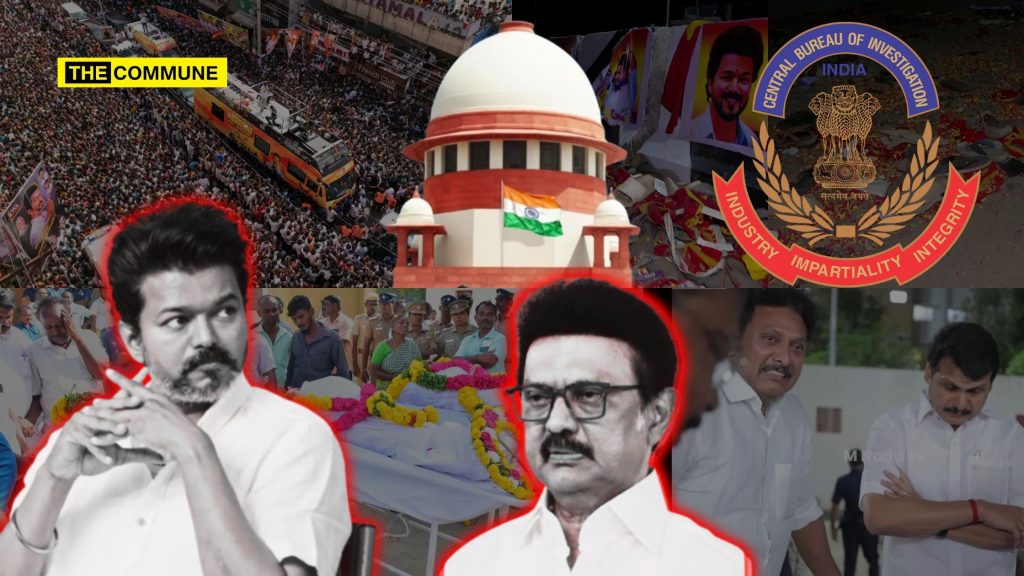
In an unprecedented and sharply worded order, the Supreme Court of India today delivered a severe indictment of the Tamil Nadu government led by the DMK and the functioning of the Madras High Court in handling the aftermath of the tragic Karur stampede. The court, citing a crisis of confidence, “political undertones,” and a complete systemic failure, not only transferred the investigation to the Central Bureau of Investigation (CBI) but also suspended the state’s own probes and established a high-powered supervisory committee to oversee the case.
The bench of Justices J.K. Maheshwari and N.V. Anjaria, while hearing a cluster of petitions related to the September 27 stampede that killed 41 people, expressed deep dismay at the actions of both the state administration and the judiciary, leading to a “multiplicity of proceedings” and a “lack of sensitivity and propriety.”
Supreme Court Cooks DMK
The Supreme Court’s order points out how the DMK government’s actions have eroded public trust to a point where none of its institutions were deemed fit to handle the investigation.
The court took serious note that top officials of the Tamil Nadu Police “have taken to press conferences to abjure the fault of the sub-ordinate officials.” It observed that these officials mounted a “robust defense” claiming their officers were prompt, even before the investigation could be completed.
The court stated, “Prima facie, this fact in itself creates a doubt in the minds of the general public about the independence and impartiality of the investigation.” The court questioned how a fair probe could be conducted by the same police force whose highest echelons had already publicly exonerated their subordinates.
In a move that seems to be a total vote of no confidence, the Supreme Court explicitly suspended the operations of both the one-man Enquiry Commission appointed by Chief Minister M.K. Stalin and the Special Investigation Team (SIT) formed by the Madras High Court. This signifies that neither the executive (State Government) nor the judiciary (State High Court) of Tamil Nadu was deemed capable of conducting a credible inquiry.
The order points to what can be seen as a discriminatory practice in granting permissions for political rallies. It pointedly mentioned that while the TVK party was granted permission for the fatal rally on a route connecting to a National Highway, “in January, 2025 permission sought by a different political party was refused.” This observation implicitly suggests a possible bias in the state’s administration of permissions, glaringly pointing to the “political undertone” that the Court noted.
The court highlighted that the “ruling dispensation” controls the “immense machinery of the State,” against whom serious allegations have been made for not discharging their functions properly. It lamented that the families of the victims are caught in the “political tussle between the two sides,” with little solace for their loss.
A Stunning Rebuke of the Madras High Court’s “Chaotic” Conduct
The Supreme Court’s harshest language was arguably reserved for the Madras High Court, whose handling of multiple petitions was described as “strange,” creating confusion and overstepping judicial boundaries.
The bench strongly criticized the learned Single Judges of the High Court’s Main Seat in Chennai for “entertaining the writ petition for the prayers which were not made” and “expanding the scope without any foundation in pleadings.”
In the case of WP Crl. No. 1000 of 2025, the court found it “completely strange” that the judge suo moto decided to order an SIT. The Supreme Court noted, “The judgement is completely silent about how learned Single Judge arrived at such a conclusion and what material was perused by the Court.”
The Supreme Court expressed its bewilderment at the “need to increase the multiplicity of proceedings” when petitions concerning the same incident, specifically those demanding a CBI probe or SIT, were already being heard comprehensively by a Division Bench of the Madurai Bench, which has territorial jurisdiction over Karur.
The court stated, “Such recourse prima facie indicates the lack of sensitivity and propriety to deal with such a matter… for the reasons best known to the Hon’ble Judges.” This is an exceptionally rare and direct criticism of the conduct of fellow judges.
The order questioned how a petition concerning the Karur stampede was entertained by the Chennai Main Seat, stating there was “no occasion” for it without the Chief Justice’s order. This chaos culminated in a “stark contradiction”: the Madurai Division Bench found no flaw in the police probe, while the Chennai Single Judge, without citing evidence, expressed dissatisfaction and formed an SIT. This judicial incoherence severely undermined the High Court’s credibility.
The Supreme Court’s Decisive Intervention
Citing the “national ramifications” of the incident and the need to enforce the fundamental rights of the victims’ families, the Supreme Court invoked its extraordinary powers to ensure “complete justice,” effectively creating a parallel investigative structure outside the Tamil Nadu government’s influence.
The investigation of FIR No. 855/2025 has been immediately transferred to the CBI. The state police, the High Court’s SIT, and the Chief Minister’s Enquiry Commission have been directed to hand over all evidence to the central agency.
In a move that highlights its lack of trust in the existing systems, the court has constituted a three-member Supervisory Committee headed by former Supreme Court Justice Ajay Rastogi. The committee, which will include two senior IPS officers from outside Tamil Nadu, is empowered to:
- Monitor and supervise the CBI investigation.
- Review evidence and direct the areas of probe.
- Undertake any ancillary inquiries it deems fit.
This ensures the investigation is insulated from the “political undertone” and potential local influence.
The Supreme Court also intervened in the pending matter concerning the formulation of Safety Protocols for public rallies. It directed the Chief Justice of the Madras High Court to assign this case to a Division Bench, implicitly criticizing its handling by a Single Judge.
The Unspoken Message: How Court Pointed To Systemic Failure Of Govt Without Saying It
The order systematically shows how the court cooked the DMK government by exposing their incompetence and a crisis of credibility.
The Court methodically established a clear legal basis for its intervention. It first identified a probable administrative failure in crowd management. It then documented specific actions such as public statements by senior police officials pre-emptively defending the force that created a reasonable apprehension of bias. The Court rightly concluded that this combination fundamentally compromised the possibility of a fair and impartial investigation under the state apparatus, thereby justifying the transfer of the probe to the CBI to uphold the integrity of the judicial process.
By ruling that the tragedy had ‘shaken the national conscience,’ the Supreme Court invoked a well-established legal doctrine from its own jurisprudence. This principle allows it to exercise its extraordinary powers under Article 142 of the Constitution to ensure ‘complete justice,’ particularly in cases involving egregious violations of fundamental rights that transcend state boundaries. This legal action was taken solely to restore public confidence in the justice system and to guarantee an unbiased investigation for the victims, not as a commentary on any political entity.
Conclusion: A Comprehensive Indictment
This order is more than a routine transfer; it is a comprehensive judicial indictment. By taking the probe out of the state’s hands and placing it under the dual oversight of the CBI and a retired Supreme Court judge, the apex court has unequivocally signaled that it believes only a fully independent, centrally monitored investigation can deliver justice. The ruling represents a total loss of confidence in the DMK government’s authority and a stinging rebuke of the state’s highest court, leaving the Tamil Nadu administration politically and administratively isolated in one of the gravest tragedies of its tenure.
Subscribe to our channels on Telegram, WhatsApp, and Instagram and get the best stories of the day delivered to you personally.