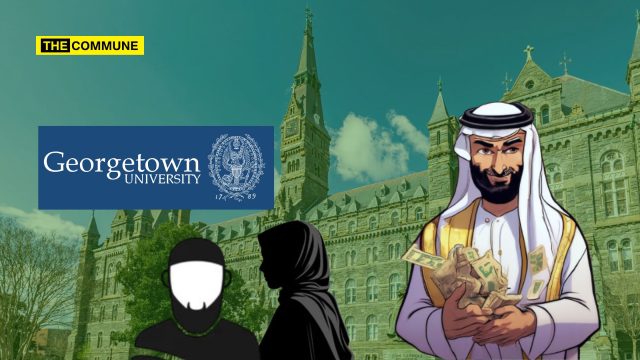
Georgetown University (GU), a leading Catholic institution in the United States, is facing mounting criticism following the release of two reports alleging that it has become a hub for radical Islamist influence due to extensive foreign funding, particularly from Qatar and other Middle Eastern regimes.
The Middle East Forum (MEF), in a report titled Beachhead: Georgetown University, accuses the Jesuit university of partnering with foreign entities linked to extremist ideologies. The report claims that GU has received more than $1 billion from nations including Qatar, Turkey, and Malaysia over the past two decades, enabling what it calls “a fundamental reshaping of Middle East and Islamic studies in the U.S.”
Central to these allegations is Georgetown’s Alwaleed Bin Talal Center for Muslim-Christian Understanding (ACMCU), which was established in 2005 with a $20 million gift from a Saudi royal. MEF claims the center functions as an ideological stronghold promoting views sympathetic to America’s adversaries and hostile to U.S. interests, and that many of its faculty have links to the Safa Network, a Virginia-based group previously investigated by U.S. federal agencies for alleged ties to Hamas and Palestinian Islamic Jihad.
The report alleges that 40 of ACMCU’s faculty and advisers over the past 30 years have had affiliations with the Safa Network, which has been accused of pushing Islamist ideology, suppressing intellectual diversity, and theocratizing education.
A second investigation, published in June by the Institute for the Study of Global Antisemitism and Policy (ISGAP), raises additional concerns. Titled Foreign Infiltration: Georgetown University, Qatar, and the Muslim Brotherhood, the 135-page report accuses GU of underreporting $146 million in funding from Qatar to the U.S. Department of Education in violation of disclosure laws. ISGAP estimates that undisclosed Qatari scholarships and grants could total over $102 million, with millions more allegedly omitted in reporting donations from the Qatar Foundation.
According to ISGAP, foreign funding has led to “a dilution of Georgetown’s foundational Jesuit principles,” claiming that the university’s culture has shifted toward a “pro-Islamist and anti-Israel orientation.” The report warns that this ideological realignment has contributed to increased hostility toward Western values, the normalization of Hamas-linked rhetoric, and the growth of antisemitic activism on campus.
The MEF further links Georgetown to a broader Sunni Islamist alliance involving Qatar, Turkey, and Malaysia, describing these nations as ideological and logistical supporters of extremist movements. Qatar, in particular, has been labeled a principal sponsor of the Muslim Brotherhood and its affiliates, including Hamas.
Critics argue that allowing the Qatari regime such deep involvement in an American academic institution poses a threat to national interests. “How can the Qatari regime be permitted to fund one of the most important and sensitive universities in the United States?” the MEF report asks.
The ISGAP report notes a growing trend of Georgetown graduates expressing sympathy for extremist ideologies and hostility toward Israel, a shift it attributes to the university’s evolving academic climate. Medical students and faculty have reportedly made public statements justifying Hamas violence, and the university has hosted pro-Hamas speakers as part of lecture series such as “Anatomy of Genocide in Gaza.”
In 2023, Georgetown drew criticism for inviting UN Special Rapporteur Francesca Albanese, widely criticized for anti-Israel bias, to deliver a lecture under its Gaza series. Israeli officials condemned the university’s platforming of what they viewed as pro-Hamas propaganda.
Despite being founded by the Society of Jesus and ranking as the top Catholic college in America, Georgetown has received significant financial support from multiple Arab nations, including Oman, Saudi Arabia, Kuwait, Egypt, and Jordan. It ranks second nationally, behind Cornell University, for total funding from Arab Muslim donors, with Qatar alone providing the majority.
In 2023, GU unveiled the Yarrow Mamout Masjid, describing it as the first mosque on an American college campus to feature ablution stations, a halal kitchen, and a spirituality hall. The university has also boasted of being the first U.S. school to appoint a full-time Muslim chaplain.
The U.S. Department of Education previously warned in 2020 that ACMCU had drawn criticism for misrepresenting its pluralistic mission, with observers noting the absence of meaningful Christian representation at the center.
Georgetown University has not responded to recent media inquiries regarding the allegations outlined in the MEF and ISGAP reports.
(With inputs from Stream)
Subscribe to our channels on Telegram, WhatsApp, and Instagram and get the best stories of the day delivered to you personally.