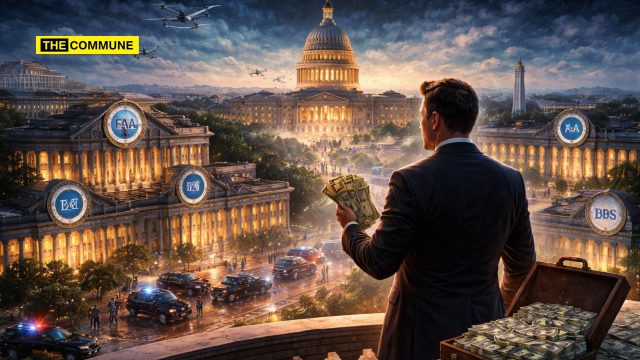
The proposition of a private billionaire, specifically Elon Musk, funding federal agency operations or paying federal employee salaries during a government shutdown is not a logistical workaround. It is a constitutional, legal, and democratic catastrophe waiting to materialize. This report expands upon foundational dangers: regulatory capture, congressional power subversion, Anti-Deficiency Act violations, economic fragility, and shifting allegiances and further identifies additional crisis vectors that the United States would face in both the near and long term. Backed by legislative history, financial data, and institutional analysis, this piece argues that permitting private funding of public employees would set the United States on an irreversible path toward neofeudal governance.
The Death of Regulatory Independence: When the Regulator Owes the Regulated
Regulatory independence is the cornerstone of a functioning market economy. Agencies such as the FAA, EPA, FCC, DOJ, and DHS are designed to enforce rules without fear or favor. This independence is not merely a procedural nicety – it is the mechanism through which consumer safety, environmental protection, and market competition are upheld.
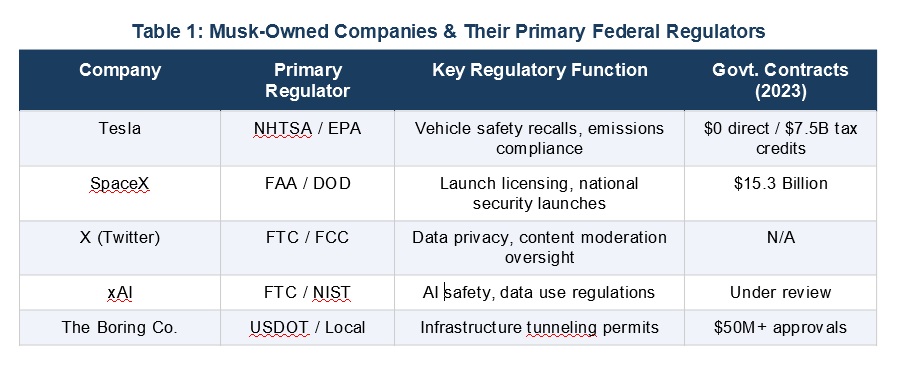
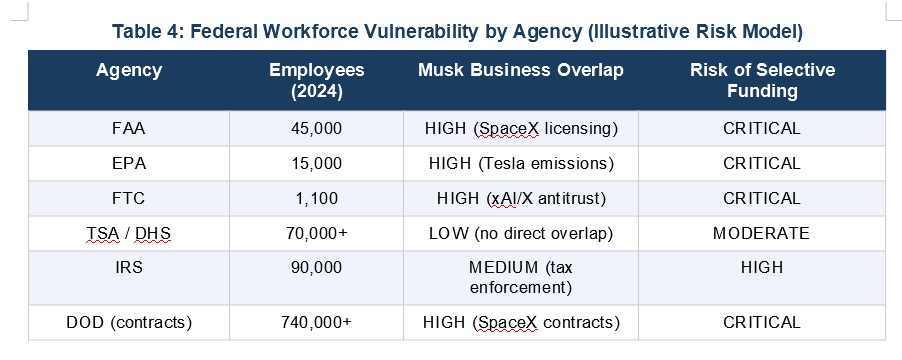
Elon Musk is not a passive actor in this ecosystem. He is the CEO of Tesla (subject to NHTSA and EPA oversight), SpaceX (subject to FAA licensing), xAI and X/Twitter (under scrutiny from the FTC and FCC), and has previously been investigated by the SEC. As of 2024, SpaceX alone had received over $15.3 billion in government contracts, according to USASpending.gov. His companies collectively employ over 140,000 workers directly regulated by federal agencies.
If Musk were to fund TSA agents, DHS personnel, or FAA employees, a structural conflict of interest of unprecedented scale is created. Even if explicit favoritism never occurs, the mere perception of dependence on a private benefactor compromises institutional integrity. Research in organizational psychology consistently shows that “benefactor bias” – an unconscious preference for the interests of financial supporters occurs even in rigorous professional contexts.
The stakes are staggering. The FAA approved SpaceX’s Starship launch licenses following extensive regulatory delays. The EPA has been scrutinized over Tesla’s manufacturing emissions waivers. A captured FAA could green-light unsafe launches. A captured EPA could ignore pollution violations. A captured SEC could overlook market manipulation. Each agency “sponsored” by Musk becomes, in effect, a subsidiary of his business empire.
Violating the Power of the Purse: The Collapse of Constitutional Checks
Article I, Section 9, Clause 7 of the U.S. Constitution is explicit: “No Money shall be drawn from the Treasury, but in Consequence of Appropriations made by Law.” The Framers did not include this clause as a technicality – it was the primary safeguard against executive tyranny. The power to fund government was deliberately placed in the hands of the elected legislature, not the executive and certainly not private citizens.
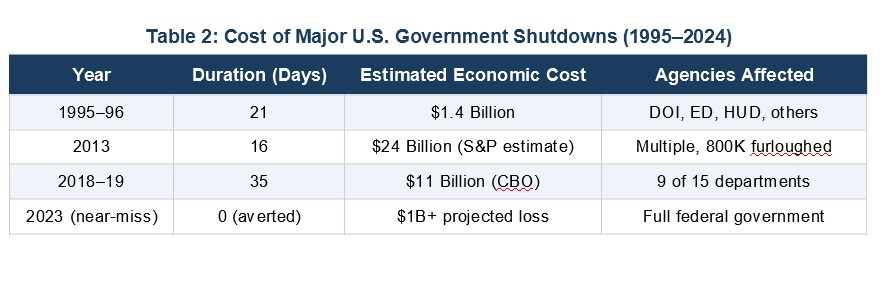
Government shutdowns, despite their economic pain, serve a democratic function. They are the fiscal pressure valve that forces legislative negotiation. Since 1976, the United States has experienced 22 government funding gaps. The 2018-2019 shutdown, the longest in U.S. history at 35 days, cost the economy an estimated $11 billion, according to the Congressional Budget Office (CBO). Yet it also produced a negotiated resolution and a temporary funding bill.
If a private billionaire can simply bypass this mechanism by writing personal checks to federal employees, Congress loses its only financial leverage. The incentive for lawmakers to negotiate, compromise, and represent constituents on budget issues evaporates entirely. Future shutdowns could be selectively “solved” by whichever billionaire has the most interest in keeping a particular agency running – not the one most essential to the public good.
This has a name in political science: the “fiscal hostage” problem in reverse. Instead of Congress using the budget as leverage against the executive, private wealth becomes leverage against democracy itself. A billionaire who keeps the TSA funded but lets the IRS starve is effectively setting fiscal priorities for the world’s largest economy.
The Anti-Deficiency Act: A Legal Minefield with No Exit
The Anti-Deficiency Act (ADA), codified at 31 U.S.C. §§ 1341–1342, prohibits federal agencies from accepting voluntary services or incurring obligations exceeding appropriated funds. It was first enacted in 1870 and has been strengthened through subsequent legislation, precisely because Congress recognized the danger of executive agencies becoming financially entangled with private interests.
Any attempt to have a private billionaire fund federal salaries would trigger immediate violations of the ADA. This is not a grey area. The Government Accountability Office (GAO) has issued multiple opinions affirming that federal agencies cannot accept gifts of services or funds that substitute for Congressional appropriations, even during shutdowns. The sole exception, accepting “emergency” services, is narrowly confined to immediate threats to life or property.
The legal chaos that would follow is multidimensional. First, the choice of which employees or agencies get funded by private money is itself a legally perilous act – it could constitute unlawful discrimination among federal workers. Second, employees who accept private compensation during a shutdown may forfeit back-pay entitlements normally guaranteed by the Government Employee Fair Treatment Act of 2019. Third, any contracts awarded during a period when an agency was privately funded could be legally challenged as tainted by conflicts of interest, potentially unraveling billions of dollars in federal procurement.
Legal scholars at Harvard Law’s Federal Budget Policy Seminar have noted that “a scenario in which a private citizen funds agency operations creates a constitutional void that existing statutes were never designed to address.” The resulting litigation could clog the federal courts for years, delay critical government functions, and cost taxpayers far more than the shutdown itself ever would.
Economic Fragility: Sovereign Risk and Market Destabilization
The United States dollar is the world’s primary reserve currency. As of Q1 2025, the dollar accounts for approximately 58.4% of global foreign exchange reserves, according to IMF COFER data. U.S. Treasury bonds are the benchmark for the global risk-free rate – the foundation upon which trillions of dollars in financial instruments are priced. This position rests entirely on the perception of the United States as a stable, sovereign, and predictable borrower.
The moment a private individual begins funding federal government operations, that perception fractures. Bond markets are acutely sensitive to sovereign governance risks. A scenario in which a billionaire’s personal wealth, which can fluctuate by tens of billions of dollars in a single day, becomes part of the formula for federal operations creates unprecedented volatility pricing into U.S. Treasuries.
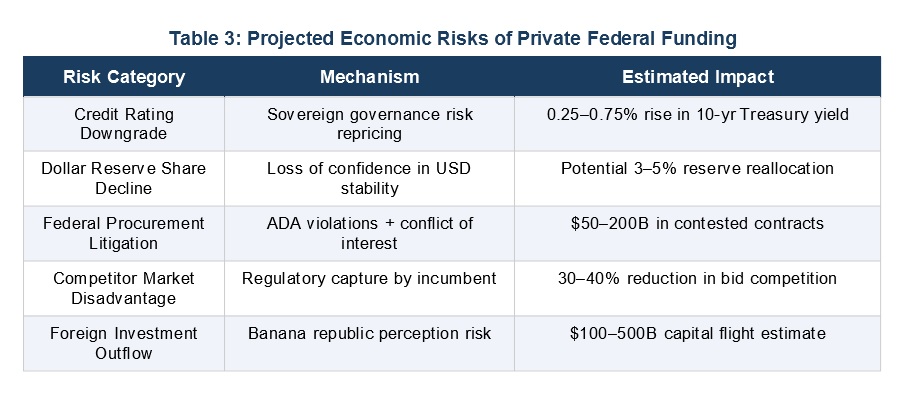
Consider the market implications: Musk’s net worth dropped by approximately $200 billion between November 2021 and December 2022 due to Tesla stock declines. If federal operations were partially dependent on his financial capacity during this period, the implication for government stability is catastrophic. Credit rating agencies such as Moody’s and S&P, which already downgraded U.S. debt in 2023, would likely respond to such a development with further downgrades, pushing borrowing costs higher.
The competitive distortion effects are equally severe. Federal agencies that award contracts to aerospace, technology, automotive, or AI companies would be scrutinized as structurally compromised. Musk competitors: Boeing, Lockheed Martin, Rivian, Google DeepMind, and others would face a procurement process where the funding source of the evaluating agency is their direct rival. This would trigger immediate legal challenges, reduce competition for government contracts, inflate procurement costs, and ultimately burden taxpayers.
The Security Risk: Loyalty, Allegiance, and the Hollow Oath
Every federal employee, from the most junior TSA screener to the Director of the FBI, takes an oath to “support and defend the Constitution of the United States.” This oath is not ceremonial. It is the legal and moral foundation of a civil service that serves the public, not any individual. The Pendleton Civil Service Reform Act of 1883 was enacted precisely to break the “spoils system,” where government employment was tied to personal loyalty to political patrons.
Human psychology operates on the principle of reciprocity. Decades of social psychology research, from Robert Cialdini’s foundational work on influence to more recent studies in organizational behavior, confirm that individuals who receive material help from a benefactor develop measurable loyalties that influence their professional decision-making. When federal employees know that their mortgage was paid, their children were fed, and their retirement is secure because of Elon Musk’s personal largesse rather than the U.S. Treasury, the oath to the Constitution becomes a theoretical abstraction.
The national security implications are severe. During a contested election, a constitutional crisis, or a moment of conflict between a private billionaire’s interests and the public good, whose orders would agency employees follow? The agency head appointed by law? Or the man whose paycheck kept their family afloat? History offers grim precedents: in Weimar Germany, the erosion of loyalty to state institutions in favor of private patrons was a precursor to institutional collapse. In contemporary Venezuela and Hungary, the capture of civil service loyalties by executive-aligned private interests preceded democratic backsliding.
The Precedent Problem: Every Billionaire Gets a Turn
Perhaps the most underappreciated danger is the precedent. Once it is established that a private individual can fund federal operations during a shutdown, the principle cannot be restricted to one person. Jeff Bezos could fund the U.S. Postal Service and the FTC which regulates Amazon’s competitors. Larry Ellison could fund the Department of Defense’s technology divisions, where Oracle competes for contracts. The Koch Industries network could fund the EPA which regulates fossil fuel operations.
This is not hypothetical alarmism. It is the logical extension of the principle. In Citizens United v. FEC (2010), the Supreme Court’s ruling that political spending constitutes free speech opened floodgates that transformed U.S. campaign finance. A precedent permitting private funding of federal operations would dwarf the Citizens United impact in its consequences, converting entire government agencies into instruments of competitive private strategy.
The United States would effectively transform from a constitutional republic into a competitive oligarchy, where the wealthiest individuals vie to “sponsor” the agencies most strategically valuable to their empires. Public policy would no longer be determined by democratic deliberation but by the financial capacity and strategic interest of private wealth. The 2024 Forbes 400 list identifies 400 individuals with a combined net worth exceeding $5 trillion – more than enough to fund the entire discretionary federal budget of $1.7 trillion multiple times over.
Workforce Demoralization and the Collapse of the Civil Service
The federal government employs approximately 2.9 million civilian workers as of 2024, according to the Office of Personnel Management (OPM). These employees are compensated through a structured system governed by the General Schedule (GS) pay scale, a merit-based framework designed to ensure equal treatment, professional development, and non-partisan service. This system has been refined over 140 years since the Pendleton Act.
A tiered system in which some federal employees receive private funding while others do not would create catastrophic morale and equity crises. If Musk chooses to fund TSA and DHS but not the IRS or the EPA – agencies that directly regulate his businesses – the message to EPA scientists and IRS auditors is explicit: your work is less valued because it inconveniences the benefactor. Skilled professionals would exit the agencies starved of private support, resulting in a brain drain in the very departments most critical to regulatory enforcement.
Retention data already shows the civil service is under stress. A 2023 Partnership for Public Service survey found that 42% of federal employees under age 40 were considering leaving government service within three years, citing pay, flexibility, and perceived lack of institutional support. Introduction of private salary subsidies for select agencies would exacerbate this disparity, creating a two-tiered civil service, a “sponsored” class and an “abandoned” class with devastating effects on institutional cohesion.
International Perception and the Erosion of U.S. Soft Power
The United States has long derived geopolitical authority from the perception of stable, rule-based governance. The U.S. model of constitutional democracy has been exported, emulated, and advocated for globally – serving as the philosophical foundation for American foreign policy from the Marshall Plan to the post-Cold War order. That credibility rests on the assumption that U.S. institutions are funded by public taxation, governed by law, and answerable to elected representatives.
The revelation that a single private individual is paying the salaries of federal employees would reverberate in diplomatic, economic, and security arenas worldwide. U.S. allies in NATO, the EU, Japan, South Korea, and Australia who integrate defense, intelligence, and trade infrastructure with American federal agencies would face legitimate questions about the reliability and neutrality of U.S. government counterparts. Is an FAA safety certification credible if the FAA was funded by the CEO of a competing aerospace company? Is a DOJ antitrust decision trustworthy if the DOJ payroll was partially sustained by a technology oligarch?
Adversaries, particularly China and Russia, would exploit this narrative aggressively. Chinese state media would amplify the story as proof of “American plutocracy.” Russian information operations would use it to undermine confidence in U.S. democratic institutions among allied populations. The damage to U.S. soft power would be immeasurable and long-lasting, weakening America’s ability to lead coalitions, negotiate trade agreements, and set global governance norms.
The Structural Dismantling of Democratic Accountability
At its deepest level, the privatization of federal salary funding represents an attack on the concept of democratic accountability itself. In a democracy, citizens hold their government accountable through elections, taxation, and the rule of law. Citizens pay taxes; taxes fund the government; the government serves the citizenry. This cycle of accountability, money flows from the people to their representatives, then to the state is the operating system of democracy.
When a private actor inserts himself into this cycle, the loop breaks. Federal employees are no longer accountable to taxpayers through the chain of command. They are accountable, at least partially, to the private donor. Citizens who did not choose, elect, or consent to Elon Musk’s role in their governance have no mechanism to hold him accountable. He faces no ballot, no oversight committee, no electoral consequence for his choices about which agencies to fund and which to abandon.
The Anti-Corruption Index by Transparency International consistently identifies the independence of public institutions from private financial influence as the primary variable distinguishing high-trust from low-trust governance systems. Nations where private money flows directly into government operations such as certain Latin American and African states consistently rank among the most corrupt. The United States currently ranks 24th globally, a position that would be imperiled by formalizing private funding of public servants.
Conclusion: A Precedent the Republic Cannot Survive
The argument for allowing Elon Musk or any billionaire to fund federal salaries during a government shutdown is seductively simple: workers suffer, a wealthy person wants to help, why not? But this framing obscures the systemic devastation that would follow.
This analysis has identified nine distinct vectors of crisis: the capture of regulatory agencies that oversee the benefactor’s businesses; the subversion of Congress’s constitutionally mandated Power of the Purse; violations of the Anti-Deficiency Act that would trigger cascading litigation; economic destabilization of Treasury markets and U.S. sovereign credit ratings; the erosion of civil servant loyalty to the Constitution; the establishment of a precedent that invites every billionaire to sponsor their preferred agencies; the demoralization and stratification of the 2.9-million-person federal workforce; the corrosion of U.S. soft power and diplomatic credibility; and the fundamental dismantling of democratic accountability.
In aggregate, these outcomes constitute not a temporary administrative workaround but a structural transformation of the United States from a constitutional republic into a privatized oligarchy. The government shutdown mechanism despite its real and painful costs to workers is a democratic pressure valve. Its resolution must come through democratic means: negotiation, legislation, and accountability.
A government that cannot fund itself through the consent and taxation of its people has a political problem that demands a political solution. Replacing that political solution with the financial patronage of an unelected billionaire does not fix the problem – it destroys the system designed to solve it.
The United States was founded in explicit rejection of a system where wealth conferred governance rights. The very Declaration of Independence was a repudiation of a monarch whose authority derived from personal power rather than popular consent. To permit a 21st-century equivalent – a techno-feudal lord whose wealth buys him de facto control over the agencies that govern his competitors would be to betray that founding principle in the most consequential way possible.
The public funding of public servants is not a bureaucratic formality. It is the material expression of sovereignty. The moment it is surrendered to private wealth, sovereignty itself is surrendered and with it, the republic.
Ganesh Kumar is a geo-political analyst.
Subscribe to our channels on WhatsApp, Telegram, Instagram and YouTube to get the best stories of the day delivered to you personally.