


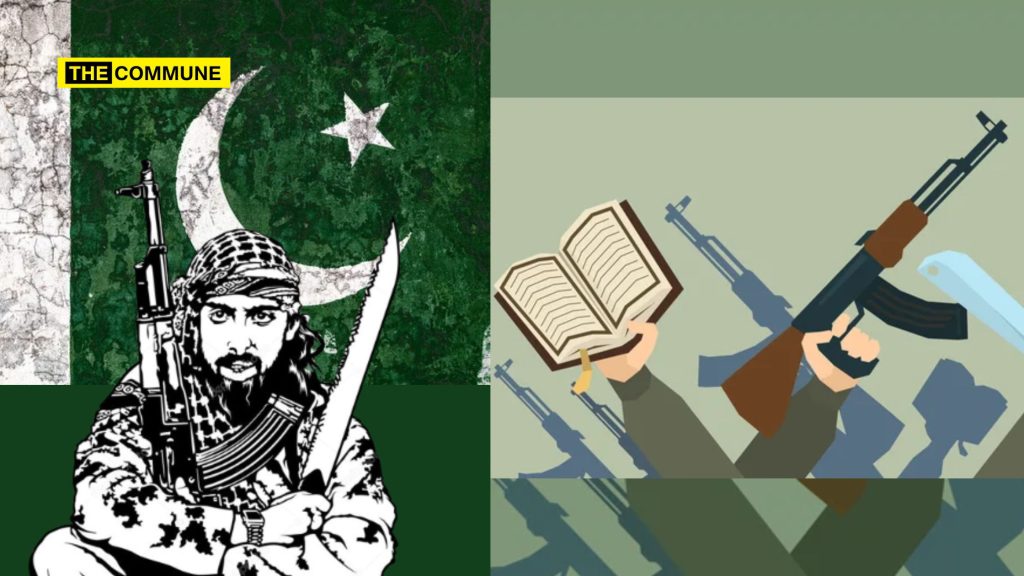
Consider the immediate aftermath of any terror attack in India. A bomb rips through a market in Jaipur. A train is blasted in Mumbai. Gunmen lay siege to a temple. Before the smoke has cleared, before the last victim has been identified, the machinery of our national consensus whirs into motion. The script is as predictable as it is comforting. Within an hour, television anchors, their faces grim, will speculate about the “masterminds across the border.”
Government spokesmen will release identical statements: “We condemn this cowardly act” and “We will give a fitting reply.” The conversation is now firmly, and exclusively, about Pakistan. The purpose of this ritual is not to find the truth. The purpose is to pre-empt the truth. The purpose is to ensure that the one set of questions that truly matters is never asked. Who is the man who lives in that Pune colony who surveyed the German Bakery? Who is the “student” in Jaipur who procured the bicycles? Who is the “local businessman” in Mumbai who provided the safe house? These are uncomfortable questions. They are inconvenient questions.
The official narrative, the one taught in our textbooks and repeated by our public intellectuals, is that the ideology which created Pakistan left India with the new border. That the Muslims who “chose” India were, by definition, secular, moderate, and committed to the new republic. But let us put these assumptions to the stress test. The demand for Partition was the political culmination of an ideological assertion: that a separate Muslim identity, law, and society (the “Ummah”) could not be submerged into a composite, non-sectarian, democratic state. This ideology did not evaporate on August 15, 1947. It simply changed its tactics. It burrowed. It waited. It presented itself not as a demand for a separate state, but as a demand for special status within the Indian state. Every time the state has been confronted with this obstinacy, it has buckled. This is the “secularism” we have practiced. When the Supreme Court granted a pittance to an elderly woman, Shah Bano, the entire clerical establishment rose as one. The “liberals” who now lecture us on television were silent. The state, led by a Prime Minister with a brute majority, overturned the court’s judgment. This is of a piece with the insistence on separate personal laws, the riots over cartoons in a distant country, the organized opposition to Vande Mataram, the refusal to allow reform. This is a relentless political project. It is the assertion of a parallel sovereignty. And this is the very history that the “Blame Pakistan” reflex is designed to make us forget.
The great truth of our age is this: the single-minded focus on Pakistan is an analytical error. One can even go as far as to say that it is a sophisticated, multi-layered, and wholly deliberate act of intellectual and political evasion. It is the shield which our entire establishment, new and old, from South Block to the newsrooms of Delhi, holds up to protect itself from a reality it dares not name. That reality is the history, and the continuing present, of Islamic obstinacy and radicalism within India.
Now, see how this evasion connects directly to terror. A module cannot function on air. A Pakistani agent, no matter how skilled, cannot simply walk into a sensitive area and plant a bomb. He needs a network. He needs a local guide, a translator, someone to rent a flat, to buy a SIM card, to procure the chemicals, to weld the containers. He needs, in short, a domestic support system. And what has our own investigative history shown? Time and again, after the media’s focus has moved on, the charge sheets are filed. And who are the names? They are not phantoms from Islamabad. They are the members of the Students Islamic Movement of India (SIMI). They are the founders of the “Indian” Mujahideen. They are local clerics, university students, and software engineers from Azamgarh, from Bhatkal, from Kerala. They are Indians. Their motive is not Pakistani nationalism. Their motive is the same ideology that our establishment has refused to confront for seventy years. They are fighting for that same parallel sovereignty. They see the Indian state, its constitution, and its “kafir” society as the enemy.
But the “Blame Pakistan” narrative performs a vital service. For the ‘secular’ establishment of old, it was a tool to appease a vote-bank. But for the new ‘pro-Hindutva’ establishment, this evasion is more profound. Why? Because blaming Pakistan is easy. It is the perfect performance of nationalism. It allows for a muscular, theatrical display which electrifies the base and consumes the news cycle. It requires no hard choices, no messy internal reforms. The alternative, confronting the domestic fifth column, is the hornet’s nest that they choose not to confront. To do so would be to admit that the problem is not a simple foreign policy dispute but a deep-fanged societal rot. It would mean undertaking the hard, grinding, unpopular work of statecraft: genuine police reform, the modernization of madrasas, the enforcement of a uniform civil code against all opposition, and the patient, thankless task of intelligence gathering in hostile domestic localities. Why bother with this difficult, protracted war at home when a spectacular, prime-time “fitting reply” to Pakistan gives you all the political capital at a fraction of the cost? The “nationalist” establishment has discovered that the rhetoric of strength is a perfect substitute for the creation of a hard state.
The result of this grand, collusive deception is that the problem is never solved. It only festers. By attributing every attack to an external enemy, we give a free pass, a complete immunity, to the internal, ideological fifth column that sustains it. We are, in effect, pruning the weed while carefully watering its roots. The 26/11 Mumbai attack was the perfect example. It was a Pakistani plot. But it could not have been executed without the maps and surveillance provided by domestic facilitators. Yet, even in that case, which part of the story was quietly buried? The hunt for the Indian helpers. We have chosen a comfortable lie over an inconvenient truth. The ‘secularists’ traded national security for the applause of a moribund intellectual class. The ‘nationalists’, more cynically, trade it for the roar of the crowd, for the tactical convenience of an external enemy. The result is the same. This shared delusion will not last. The nature of reality is that it does not care for our narratives. It has a way of asserting itself, often in the most brutal fashion. By refusing to name the enemy within our gates, by all sides shielding themselves with the “foreign hand” theory, we are not displaying secular tolerance or nationalist strength. We are committing national suicide.
Postscript
Let us be unambiguous. The case against Pakistan is settled. It is an irredeemable state dedicated to our destruction, and it must be treated as such. The question is not whether to confront Pakistan, but what else we are failing to do while we are so consumed. The obsessive focus on Pakistan is not a lie, but it is a half-truth so vast it functions as a lie. It is the ‘nationalist’ establishment’s great alibi. It is the single, deafening drumbeat they use to drown out the sounds of the enemy already inside the gates. An enemy they perhaps find politically inconvenient, and therefore terrifying, to name.
Yours truthfully,
Nishkala
Subscribe to our channels on WhatsApp, Telegram, Instagram and YouTube to get the best stories of the day delivered to you personally.