


In the race for who breaks the news first, several end up posting fake news without basic verification. But in what was seen as a calculated attempt at defaming a Hindu religious institution, The News Minute played a major role in amplifying the fake claims. Its sister organisation Newslaundry also did the same – while they simply reposted TNM’s videos, there was one video (which seems to be deleted now) sometime when the Parliament was in session (as mentioned in the video) defaming the temple and the Dharmadhikari. The now-debunked Dharmasthala “mass burial” saga stands as a stark lesson in journalistic malpractice. But will they learn?
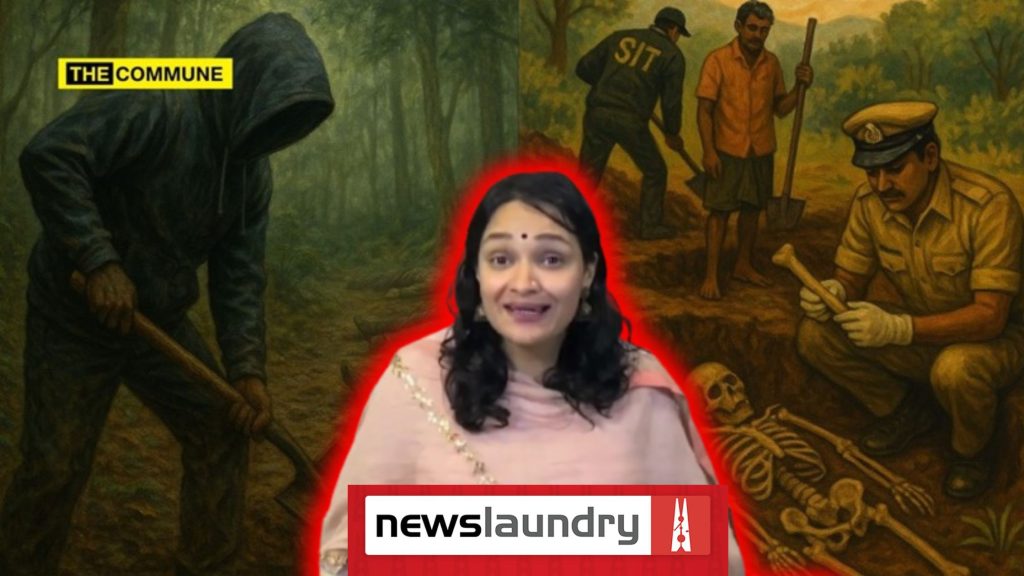
Coming back to the article, Newslaundry’s Manisha Pande, in what seems to be a now-deleted video, became a prime example of how activism can be disguised as reporting, meticulously constructing a narrative to implicate the Dharmadhikari of Dharmasthala, Veerendra Heggade, based on nothing but a fabricated story.
Pande’s report, framed as an issue that “hasn’t got the attention it deserves,” did not seek to investigate the claim but to legitimize it through emotional manipulation and selective omission of facts. Her approach followed a well-worn leftist playbook: amplify the allegation, ignore countervailing evidence, and frame any attempt at legal defense as the action of a powerful, guilty party silencing the truth.
Pande’s segment was all about persuasive storytelling, not objective journalism. She begins by lending credibility to the “chilling report” from publications like Deccan Herald and The Hindu.
She then meticulously details the masked man’s “gory claim,” sharing TNM’s video which repeats every horrific detail – bodies with acid attack marks, girls in school uniforms, signs of sexual assault, and death threats. This served to horrify and provoke outrage, making the audience emotionally invested in the allegation itself rather than its validity.
The most glaring failure of Pande’s reporting was her portrayal of the judicial response. She framed the ex-parte injunction secured by Harshendra Kumar Heggade purely as “censorship” by a “powerful political figure” to silence the truth.
She deliberately omitted the fundamental legal principle behind such injunctions: the protection of reputation from unproven and potentially defamatory allegations. The court’s action was a standard legal remedy available to any individual or institution facing what appears to be a baseless, public, and damaging smear campaign. By not explaining this context, Pande painted a picture of a guilty man using his influence to hide his crimes, effectively pre-judging the case and poisoning the well for her audience.
Just watch how Manisha Pandey of NewsLaundry spreads innuendos and insinuations against Dharmasthala Administration Head Veerendra Hegde for pursuing a legal injunction to remove all content about a case THAT IS UNDER INVESTIGATION!
What garbage journalism is this? https://t.co/11yvpSabHO pic.twitter.com/3qqpWq1pim
— Sensei Kraken Zero (@YearOfTheKraken) August 24, 2025
The media outlet’s role shifted from verifying facts to acting as a megaphone for an allegation, demanding that the accused prove a negative.
As we now know, these questions would have revealed the truth far sooner. The entire narrative collapsed under the slightest scrutiny:
- The SIT found no evidence in the locations identified.
- The skull presented as evidence was found to be decades old and belonging to a male.
- The “masked man,” identified as Chinnayya, confessed to being trained by a gang in Chennai to spread the lie.
- Key “witnesses” like Sujatha Bhat (the alleged mother of one victim) publicly admitted on camera that their entire story was fabricated.
Manisha Pande’s report for Newslaundry was not an isolated error but a calculated piece of narrative-building. It amplifies a lie with sensationalist detail, frame the legal self-defense of the accused as an admission of guilt, and then quietly disappear or memory-hole the content when the fabrication is exposed, offering no apology or correction.
The target was not just Veerendra Heggade but the very institution he represents. The objective was to “sow a seed of doubt in the minds of the public,” to question the credibility of a revered Hindu temple, and to portray it as a suspicious institution rather than a center of faith and social service.
If the video has indeed been deleted, the deletion from YouTube is a silent admission of its falsehood. However, the damage inflicted by this propaganda on the reputation of a sacred institution and a respected individual is a testament to the perils of activist journalism, where the agenda to “question” Hindu institutions outweighs the duty to report the truth.
Subscribe to our channels on Telegram, WhatsApp, and Instagram and get the best stories of the day delivered to you personally.