


In what can only be described as a disturbing snapshot of India’s elite technical institutions being hijacked by ideological forces, a recent controversy at IIT Gandhinagar (IITGN) has exposed the extent to which the Humanities departments have become breeding grounds for secrecy, intimidation, and even potential exploitation.
At the center of this storm is Nishaant Choksi, an Associate Professor at IITGN, whose email threatening disciplinary action against students has now gone public. His reaction followed the exposure of several thesis topics in the Humanities and Social Sciences (HSS) department, many of which are steeped in Islamic theological themes — presented not critically or historically, but with ideological approval masked as academic inquiry.
Among the research topics that have drawn concern:
- “Fishing With Faith: Islam, Indigenous Knowledge, and Ecological Sustainability in Lakshadweep“,
- “Robes of Authority: Sunni Ulama, Sartorial Tradition and Embodied Piety in Malabar“,
- “From Gods to Jinn: Ontological Rewriting and the Islamization of Spirits in Kerala“,
- “Beyond Cultural Brokers: Speech Mediation and Ritual Efficacy in Mosque Speeches in Kozhikode“.
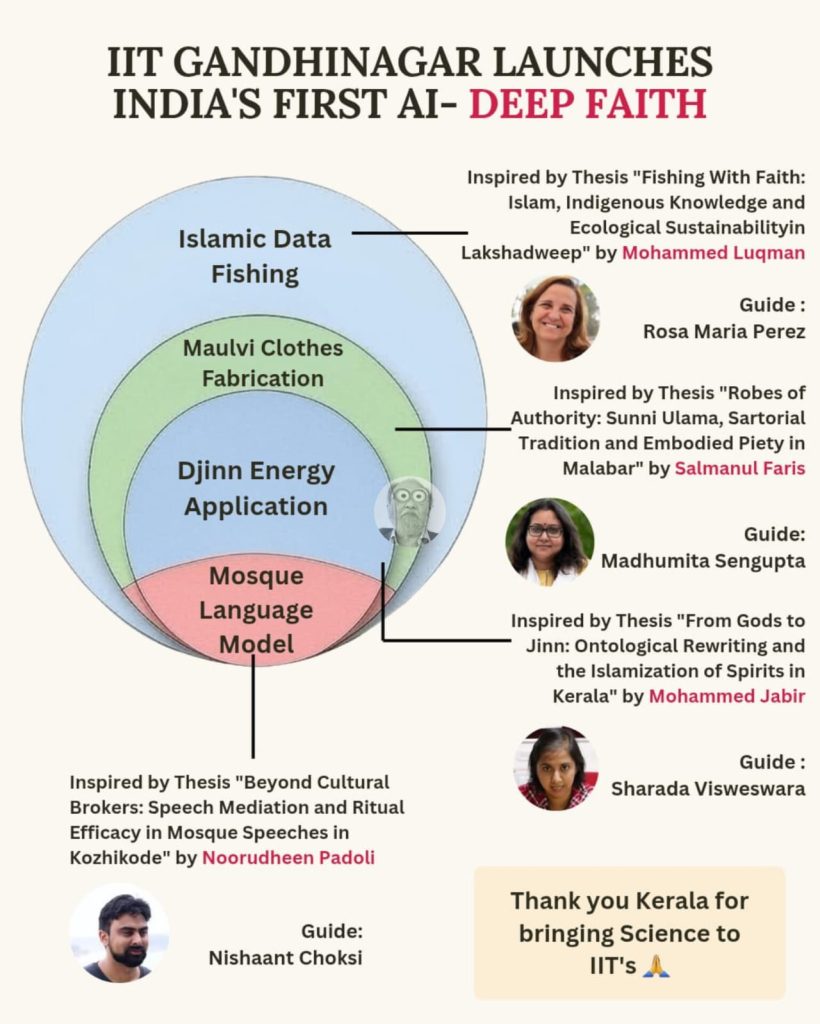

Many of these theses appear less like neutral studies and more like glorified endorsements of religious dogma, funded by taxpayer money under the guise of social science. That this is happening in a premier science and technology institution is a scandal in itself.
This is what the research theses abstracts look like:
Title: Robes of Authority: Sunni Ulama, Sartorial Tradition, and Embodied Piety in Malabar
Supervisors: Madhumita Sengupta & Rosa Maria Perez
Summary: This thesis examines how Sunni Islamic scholars (ulama) in Malabar, Kerala, assert religious authority not only through knowledge and teachings but also through their clothing and behavior. It explores how their attire and bodily presentation serve as symbols of moral and religious authority, deeply tied to regional Islamic traditions and cultural continuity.
Title: Fishing With Faith: Islam, Indigenous Knowledge and Ecological Sustainability in Lakshadweep
Supervisor: Rosa Maria Perez
Summary: This work explores how Islamic faith practices integrate with traditional ecological knowledge in Lakshadweep. It suggests that religious beliefs influence sustainable fishing practices among the island’s Muslim communities, merging spiritual life with environmental conservation.
Title: From Gods to Jinn: Ontological Rewriting and the Islamization of Spirits in Kerala
Supervisor: Sharada Visweswara
Summary: This thesis investigates how indigenous spiritual beliefs in Kerala are reinterpreted and transformed under Islamic influence. It focuses on how traditional spirit entities are being recast as Islamic jinns, altering local ontologies and spiritual landscapes.
Title: Beyond Cultural Brokers: Speech Mediation and Ritual Efficacy in Mosque Speeches in Kozhikode
Supervisor: Nishaant Choksi
Summary: This research examines how speech acts in mosques in Kozhikode function beyond just translation or communication. It argues that imams and speakers play key roles in shaping ritual experiences and religious meanings, emphasizing their performative and mediating functions in the community.
Collectively, these theses reveal an academic trend that embeds Islamic theology and ethnography within state-funded institutional research under the guise of cultural studies.
Here is the original research that has gone into this great Islamic study. I request IIT Gandhinagar to take up a new project that will help identity Kafirs through the fear in their voice even if they memorize kalma. Let's create more application oriented research shall we? pic.twitter.com/LNNTgQm1J3
— Eminent Intellectual (@total_woke_) April 28, 2025
But what is more disturbing than the ideological bent is the environment of fear and control being imposed by faculty. In his email, Choksi refers to an “honor code” and decries the sharing of internal academic information as a “serious breach.” One wonders: what is being hidden that the public — or even other departments — should not see?
🚨 This is scary. Our students are not safe in an environment of academic intimidation, secrecy & sexual exploitation.
After I exposed Islamic idiocy being studied in @iitgn, this is the mail one of the professors Nishaant Choksi sent.
He talks about an "Honor code" as if they… https://t.co/2XP4hWvNhc pic.twitter.com/PJIjvRX8KK
— Eminent Intellectual (@total_woke_) April 30, 2025
The problem is not just ideological. Humanities departments in IITs have, for years now, operated with little scrutiny. There is growing anecdotal evidence of harassment, especially of Hindu and female students, in environments where professors are granted unchecked authority under vague principles of academic freedom.
Let’s also be clear: these are not fringe electives. These are Masters-level dissertations with official guides and academic backing. Students are not simply exploring topics — they are being inducted into an ideological pipeline. And when concerns are raised, instead of transparency, the response is threats, committees, and “honor codes” that resemble the coercive codes of closed cults more than scholarly institutions.
The truth is stark: IITs were never meant to become echo chambers for unscientific ideologies dressed up in postmodern academic lingo. Their purpose is to advance technology and science, not to become satellite departments for ideological indoctrination.
This entire episode demonstrates why Humanities departments — as they currently function — must be removed from IITs. Or at the very least, subject to the same transparency and accountability that technical departments are. If a department cannot withstand public scrutiny, then it does not belong in a public institution.
For now, the Ministry of Education and the IIT Council must step in. This is about preserving the sanctity of institutions funded by the Indian public, meant to serve the Indian public, not manipulate them.
Subscribe to our channels on Telegram, WhatsApp, and Instagram and get the best stories of the day delivered to you personally.