


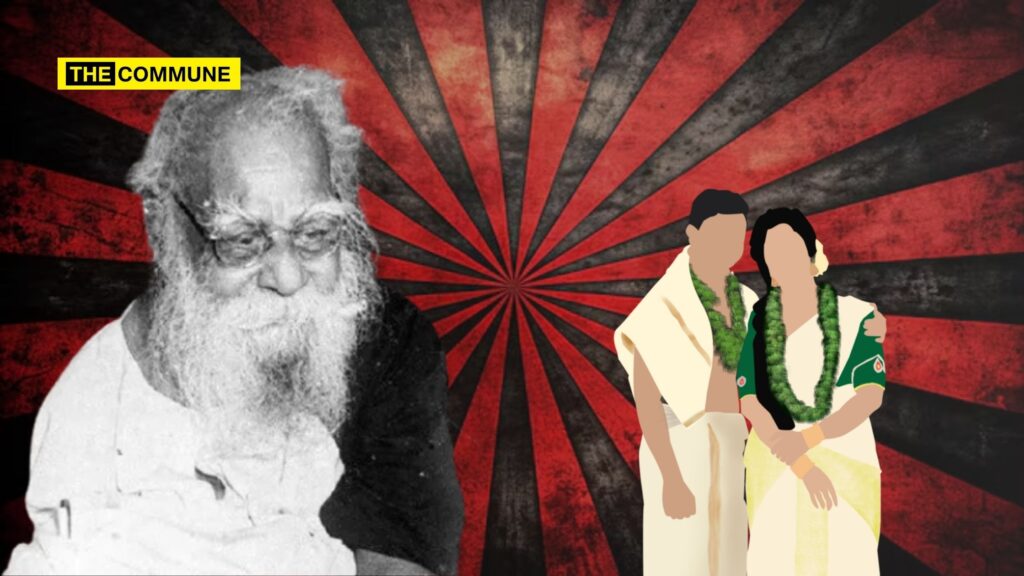
The most disgusting, sadistic and misogynistic ideologues in recent history seem to be the followers of the Dravidianist ideology aka the followers of EV Ramasamy Naicker, whom they hail as ‘Periyar’. Why is that? Because under the pretense of historical critique, they’ve constantly pushed revolting opinions about women—often shaped by their own bizarre fetishes. Their narratives weaken men, strip husbands of dignity, and reduce women to mere flesh to be consumed by men of their ilk. And the worst part? These aren’t accounts backed by real history—they’re made-up tales driven by nothing but their own sick sexual fantasies. And who was the man behind many of these pathetic cucked-up stories? None other than E.V. Ramasamy Naicker himself. He wrote such content under the pseudonym “Chithiraputhiran” in the Kudiyarasu magazine.
In one such article, titled “Malayala Samudhayam” (“Malayalam Tradition”), dated on 2 August 1925, he goes on to paint a grotesque picture of Kerala society. He casually claims that women don’t cover their chests, that men share wives like it’s some economic strategy, and glorifies Nambudiri Brahmins having access to multiple Nair women—comparing the women’s supposed devotion to them with that of Gopis pining for Krishna. He even says families would be overjoyed if a Nambudiri expressed interest in their daughter, treating it like a divine blessing.
Here’s a disturbing glimpse:
“There is a derogatory term in this country called “Keralam Valara Vasaram.” I had the opportunity to see Kerala firsthand last year. I would like to mention some of the things I observed and heard below. Malayalam (Kerala) is among the first in the world in terms of rich water resources. The region is abundant in coconut, kamuku, mango, jackfruit, cashew, and banana, along with cassava tubers and paddy. It experiences significant rainfall for six months of the year. The goddess of nature can be seen only in that country. Both men and women are very beautiful. In both cities and villages, the houses are spacious and have gaps. The Malayalis are very frugal and do not lead a luxurious life. Men and women wear only a piece of clothing around their waists. Women do not consider it fashionable to cover their breasts. Their food is also very frugal; they do not need many sambar dishes or curries like the Tamils do.
They drink hot porridge with joy. Not only are they frugal in food and clothing, but they are also frugal in speech and do not waste words. They communicate many things to each other through finger gestures, eye movements, and the movement of their muzzles. This frugality does not stop there; they also demonstrate frugality in marriage. Two or three brothers marry one woman, similar to the Pandavas. If each man has his own wife, the offspring and expenses will increase, so they resort to this thrifty method. There are two types of marriage. One is a formal marriage. The other is an informal relationship. Nair women take pride in marrying Brahmins known as Namboothiris. The community of this Brahmin class is very small, while the community of Nair women who marry is large. For this reason, four or five women have to be married to each Namboothiri. The Namboothiris are fortunate. If one is to be born, it is best to be born in Kerala as a Namboodiri. Otherwise, one’s rebirth in this human life is not worthy. A Namboothiri embodies Satsat Sachidananda. No other human birth commands the respect and veneration that a Namboothiri does. Additionally, a Nair woman with a legitimate husband is often eager to be with a Namboodiri.
Just as the Gopis performed penance to see Krishna, as described in the Mahabharata and the Puranas, most of the Nair women are performing penance for the sake of the Namboothiris’ samantham (matrimonial alliance confirming marriage). Not only are Nair women attracted to this passion of the Namboothiri class. If a Namboodiri sees a Nair and says, “Your wife is very beautiful. I will come to your house tomorrow,” the Nair will be overjoyed. He will think that God Himself has appeared and spoken this message. He will run home and inform his wife about the marriage wish of Namboothiri Thambiran. The joy that will come to her will be immeasurable. She will immediately decorate the house, light it, clean it, and adorn herself with her jewels. She will eagerly anticipate the arrival of the Namboothiri.“
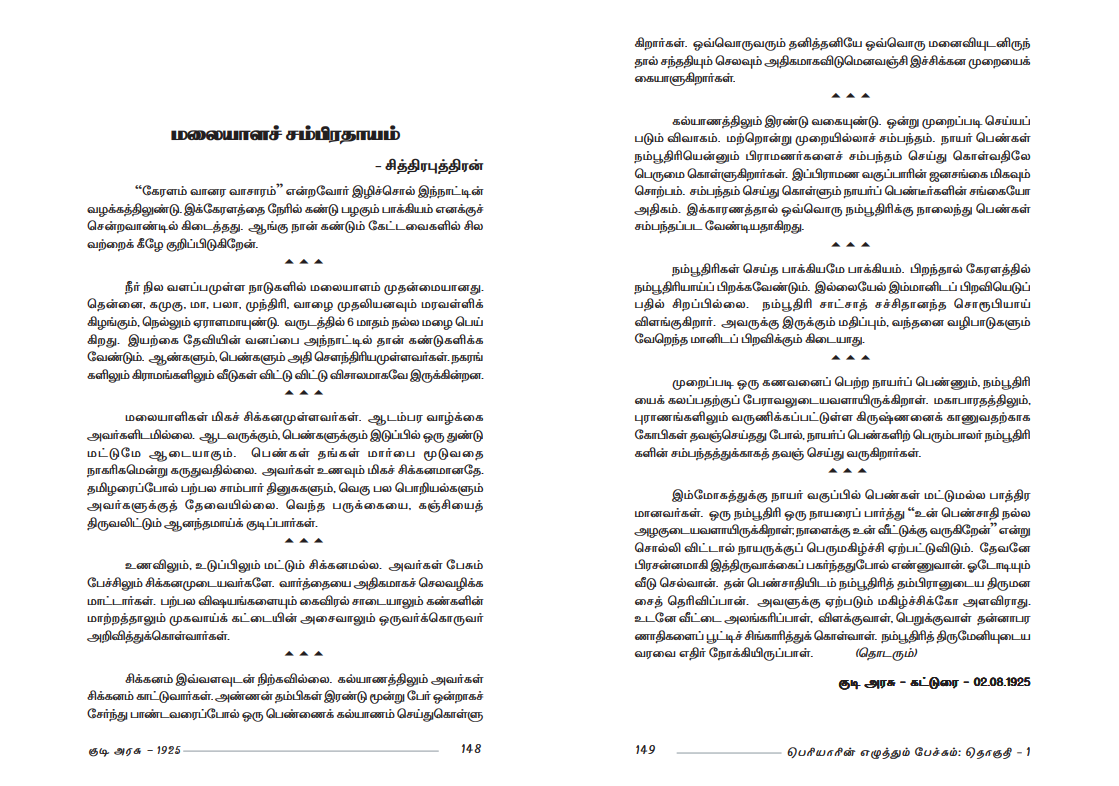

Let’s be absolutely clear—this wasn’t history. It wasn’t anthropology. And it certainly wasn’t satire. What EVR, under the alias Chithiraputhiran, penned in the Kudiyarasu on 2 August 1925, was a disturbing grotesque blend of fetish-laced fantasy and ideological spin, aimed at degrading women under the guise of cultural commentary.
EVR’s fascination with the Sambandham system—where Nambudiri Brahmins had alliances with multiple Nair women—was less about dismantling caste hierarchy and more about reimagining it to suit a Dravidianist reversal. His writings suggest a subconscious desire to replicate that structure, with Dravidian men taking the place of the Nambudiris, wielding similar power over upper-caste women, particularly Brahmins. This wasn’t a vision of egalitarianism, but rather one of revenge re-cast as sexual dominance. Instead of seeking liberation through equality, EVR’s rhetoric hints at a deep yearning to invert the caste pyramid by asserting masculine control in the most intimate domains—female bodies and sexuality—thus reducing social justice to a fantasy of conquest and humiliation.
Subscribe to our channels on Telegram, WhatsApp, and Instagram and get the best stories of the day delivered to you personally.