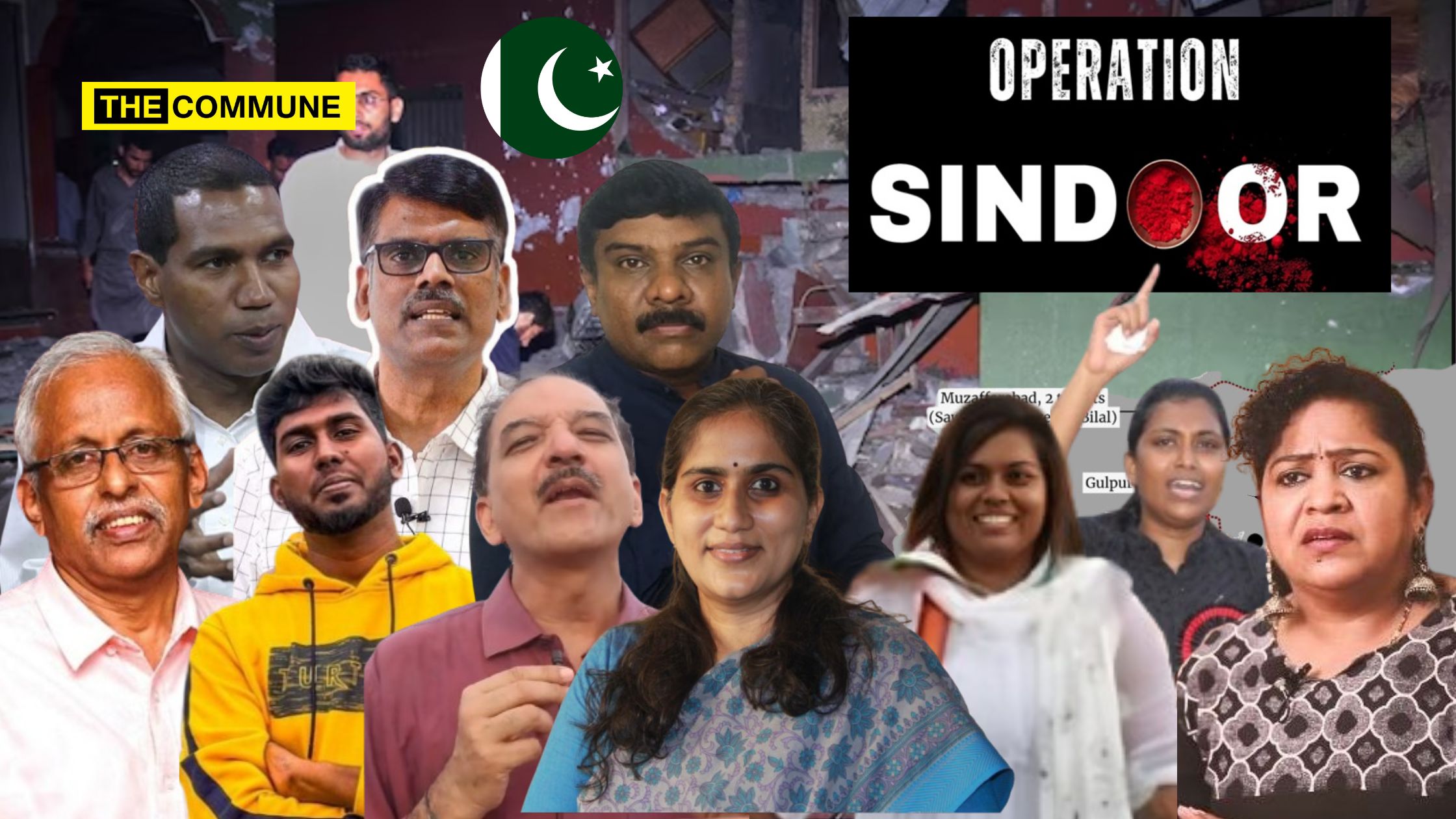
Immediately after India’s retaliation targeting a terror camp in Pakistan, the Dravidian and Periyar ecosystem, which has long been associated with anti-India narratives, went into a frenzy. This is the same faction that, when terrorists ruthlessly killed innocent tourists based on their religion, only Hindus were targeted, tried to downplay the religious motive, claiming there was no such basis for the attack. They crafted a narrative suggesting the incident would create disharmony in the nation. However, after India’s government launched a precise and strategic strike on terror camps, these groups shifted tactics, peddling fake news and echoing pro-Pakistan rhetoric—essentially amplifying the message Pakistan wanted to broadcast to the world after sheltering terrorists on its soil.
Below are some gems of how these influencers, using their popularity, preached peace to a sovereign government, but remained conspicuously silent when terrorism struck the nation.
All-in-All Commentator Sumanth Raman
In a time of national security triumph, Sumanth Raman—a perennial simp to the Congress narrative and someone who fashions himself as an expert on everything— chose to echo the talking points that could’ve come straight from Islamabad’s propaganda playbook. His latest commentary, questioning India’s military objectives and portraying the outcome of the current conflict with Pakistan as a strategic vacuum, is not just misinformed—it is deliberately defeatist.
On his X handle, he wrote, “The terrorists who carried out the Pahalgam massacre are still at large. Despite being hit, Pakistan was still able to mount some retaliation. Pakistan was not isolated diplomatically. They still got the IMF aid package. I’m trying to think of what we got out of all this, that we have paid for with more lives than the 26 we lost at Pahalgam and billions of dollars worth of defence equipment spent and the damage to some of our towns. Next time there is a terror attack how will it be any different even if we retaliate against Pakistan directly? I support the ceasefire but I’m confused about what the strategic objective of the larger military action beyond the strike on the terrorist hideouts was and what has been achieved. My impression is that our armed forces performed well but our diplomats and political leadership could have done much better. And the ceasefire was agreed to without any conditions imposed on Pakistan. The only positive I see is that Pakistan knows that the next time it stages a terror attack in India, there will be direct retaliation on Pakistani territory. For a rogue State like Pakistan is that enough of a deterrent? #IndiaPakistanConflict #Ceasefire”
The terrorists who carried out the Pahalgam massacre are still at large. Despite being hit, Pakistan was still able to mount some retaliation.
Pakistan was not isolated diplomatically. They still got the IMF aid package.I’m trying to think of what we got out of all this, that…
— Sumanth Raman (@sumanthraman) May 10, 2025
His post completely misrepresents the facts. India’s response to the Pahalgam massacre was both strong and precise. The Indian Air Force didn’t target empty buildings or make symbolic gestures. Instead, it carried out strikes on active terror camps based on real-time intelligence, dismantled crucial infrastructure deep within Pakistani territory, and delivered a direct blow to the Noor Khan Air Base near Rawalpindi—sending a clear and powerful message to Pakistan’s nuclear command. This wasn’t a symbolic act; it was a carefully calculated strategic move.
Despite Pakistan launching over 300 drones, many of which were hidden behind civilian air corridors, India’s air defense systems successfully intercepted every single one. This not only prevented further civilian casualties but also safeguarded critical infrastructure. This wasn’t a failure—it was a demonstration of India’s military capability.
Communist Maruthaiyan Peddles Pakistani & Chinese Propaganda About “Downed Rafale Jets”
In a recent interview on the Dravidianist propaganda YouTube channel ‘Aransei’, known for its ideological bias, communist sympathizer Maruthaiyan was invited to comment on Operation Sindoor. Instead of offering informed insight, Maruthaiyan went on a full-blown propaganda spree repeating baseless claims pushed by foreign anti-India media. Most notably, he declared that Indian Rafale jets were shot down by Pakistan’s military ironically, a claim even Pakistan’s Defence Minister Khawaja Muhammad Asif couldn’t confirm. Asif had merely told CNN that his sources were “Indian social media.“ Yet, Maruthaiyan went even further, spinning a web of unsupported claims as if he had access to intelligence the Pakistani government itself lacked.
From the very start of the interview, Maruthaiyan mocked the Indian armed forces and questioned the government’s announcement about neutralizing terror camps. Yet, in a hypocritical twist, he wholeheartedly embraced the narrative peddled by foreign propaganda outlets. He said, “When a war is going on, we can never find out immediately which side is telling the truth. Both sides will say that we won, we won, we are the ones who are winning. Now, they (Indian) are saying that we have killed 100 terrorists, isn’t it? Yes, when they have declared that we are going to fight a war and going to attack the terrorists, then the terrorists seem to have been sitting there, don’t they?”
He laughed mockingly and then launched into another attack on the Indian government, “If you kill the tribals, then the dead are Maoists, extremists and terrorists. Now, here you can say the same and account them as terrorists, that’s it. They claim that there were children among those killed. Let that be on one side. On the other side, Pakistan is saying that they shot down five fighter jets—three Rafales and two MiGs.”
After asserting these wild claims, Maruthaiyan then cited Global Times—the Chinese Communist Party’s propaganda mouthpiece as his primary source, stating, “This was first reported by Global Times, a Chinese newspaper. It came out on their website, and the Indian ambassador to China immediately responded, calling it baseless. But what’s more interesting in the social media yesterday was, The Hindu has published it. As soon as they published, people started calling N Ram should be arrested under the UAPA. He is a traitor. The Hindu rushed to post that this was an unverified post and retracted it after apologizing. But what’s the truth? A French intelligence officer allegedly told a CNN reporter that it was a Rafale jet that was shot down. Not only that—many other sources like the BBC also published this. Most importantly, The Telegraph from London made a detailed report with data. Then, Associated Press photojournalist Dawn Yards was in Kashmir on Wednesday morning. Outside Srinagar, some people said, ‘We saw a huge fireball erupting from the sky and falling down.’”
Commie Maruthaiyan further claimed that photojournalist Dawn Yards/ Dar Yasin attempted to capture images of the alleged incident but was stopped by authorities. He went on to say that, despite the restrictions, Yards managed to take some shots. He also claimed that a local villager tried to photograph the scene but was killed in an explosion. Maruthaiyan added that a similar loud blast occurred in Punjab, though no credible reports or confirmations were provided. Notably, there has been no mention by Associated Press or any legitimate news outlet—including photojournalists like Dar Yasin or Dawn Yards—regarding such incidents. Still, Maruthaiyan confidently asserted, “Now it is confirmed that the Rafale jets were shot down like a ₹1,500 crore Diwali rocket.”
A2D Nandha Kumar
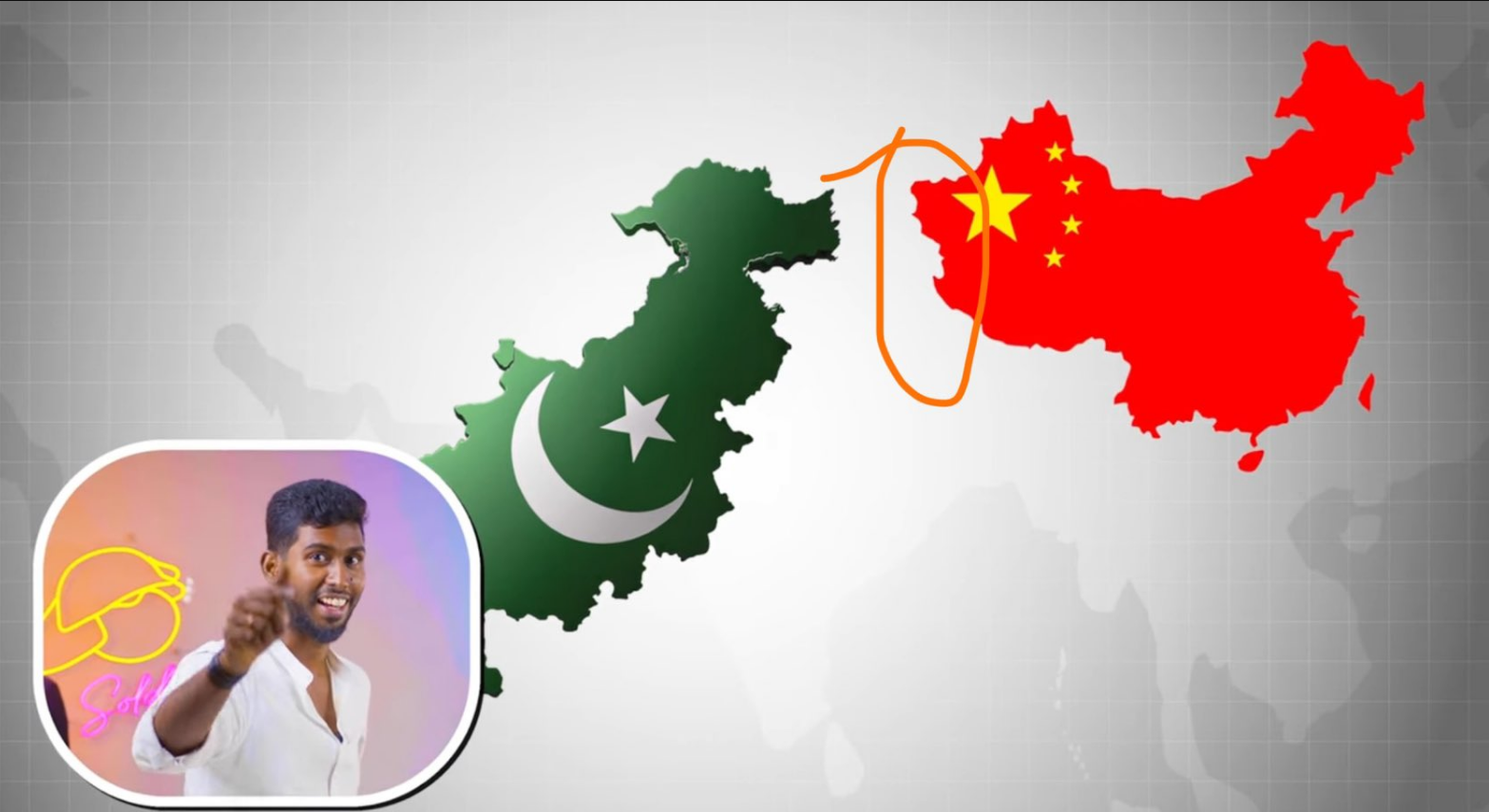
Another glaring example is Tamil tech YouTuber Nanda Kumar, also known as “PC Doctor,” who recently uploaded a video bizarrely portraying Pakistan as merely poor and uneducated, claiming we shouldn’t fight them but instead offer help. Shockingly, his video thumbnail features provocative visuals suggesting that parts of Jammu and Kashmir belong to Pakistan and China, and he even boldly declares “I support Pakistan,” and makes taglines stating, “Don’t hate Pakistan. No war only love.” Such content isn’t just tone-deaf—it crosses into blatantly anti-national territory.
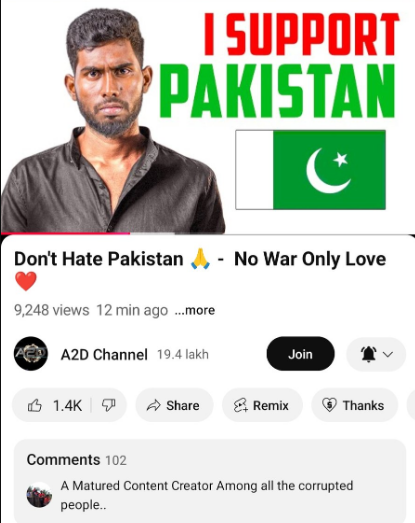
Right from the beginning of his video, he launches into anti-Indian rhetoric by stating: “India and Pakistan always mean trouble. If you ask me whether it’s in recent time—no, it’s been like this since the formation of Pakistan. From MG to news channels, everyone is posting videos about the recent incident. And if you see, all of India is speaking out against Pakistan. If you ask should we also talk like that? No. What I’m going to say today is: I support Pakistan.”
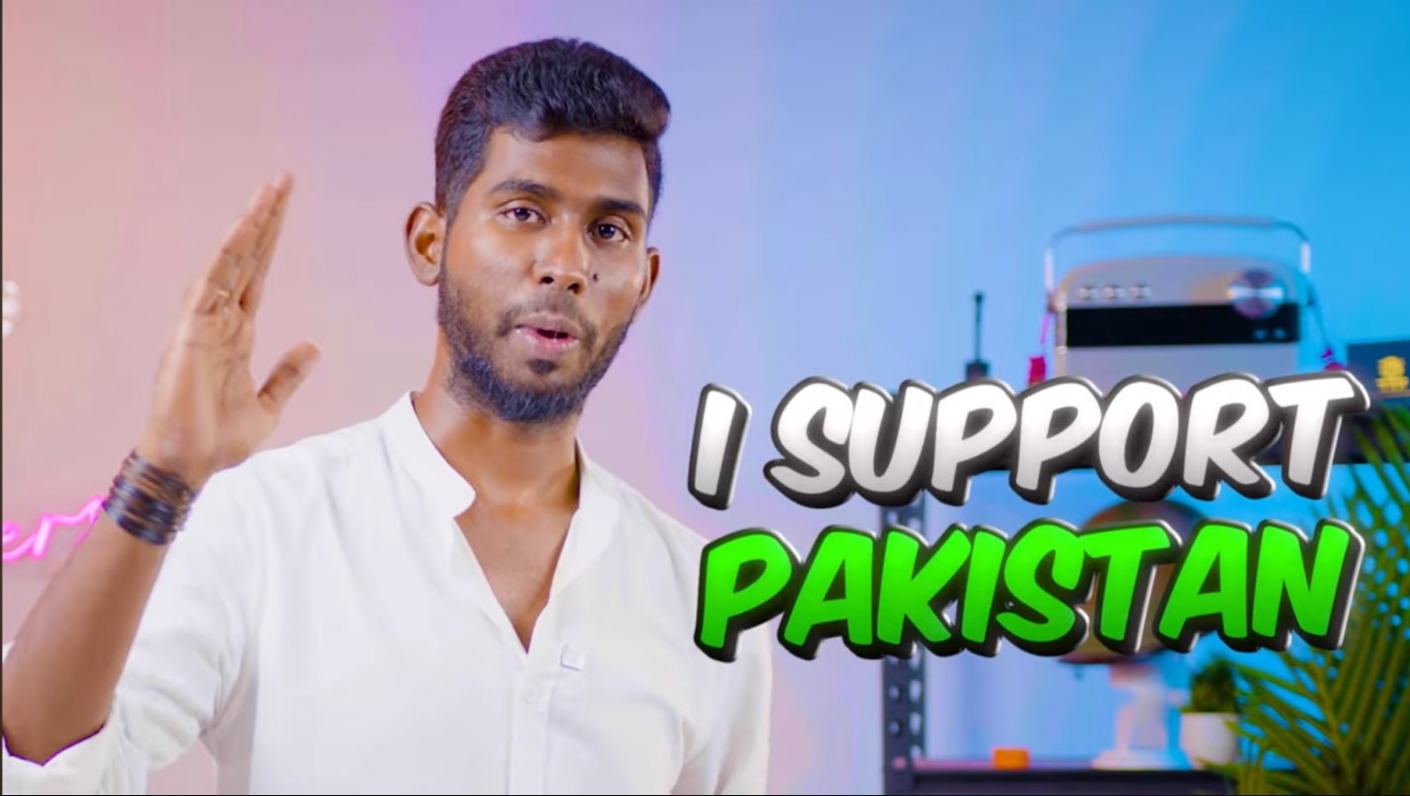
He begins by pushing a narrative aimed at lecturing the Indian government, claiming there’s no need for war because Pakistan’s economy is already in shambles. He goes on to compare Pakistan’s GDP and per capita income with that of Tamil Nadu, as if economic weakness somehow excuses or overshadows its long-standing support for terrorism.
Whitewashing Communal Riots Instigated by Jinnah While Painting Him as a Secular Icon
Nanda Kumar goes on to whitewash Pakistan’s communal foundation by portraying it as a secular state, claiming that Muhammad Ali Jinnah envisioned a nation where religion had no role in governance. To support this, he selectively cites Jinnah’s famous speech to Pakistan’s Constituent Assembly on 11 August 1947, in which Jinnah said, “You are free; you are free to go to your temples, you are free to go to your mosques or any other place of worship in this State of Pakistan. You may belong to any religion or caste or creed—that has nothing to do with the business of the State.”
However, what’s both ironic and deeply misleading is how this single speech is used to gloss over Jinnah’s actual political actions. Despite the idealistic tone of his address, Jinnah was the primary architect behind the creation of a separate Muslim nation—a decision that directly led to the catastrophic Partition of India. That event triggered one of the most violent episodes in the subcontinent’s history, causing the deaths of up to a million people and the displacement of over 10 million. For many, this makes it clear that Jinnah placed political ideology above human lives.
Even more disturbing is Jinnah’s call for Direct Action Day on 16 August 1946, a calculated move that sparked brutal communal riots in Calcutta (now Kolkata). Thousands were killed, and the event marked a turning point that intensified religious polarization. Yet, YouTubers like Nanda Kumar conveniently omit these facts, cherry-picking quotes to whitewash history and present Jinnah as a misunderstood secularist.
Later in the video, Nanda Kumar shifts gears to generate sympathy for Pakistan—a nation widely known for supporting and sheltering terrorist groups. He paints a picture of Pakistan as economically fragile, with no significant investment except from China, a struggling economy dependent mainly on agriculture and textiles, and a low literacy rate of just 60%. Using this as justification, he argues that India should refrain from retaliating or going to war.
Dravidianist Christian Priest Jegath Gaspar
In a shocking display of disregard for India’s sovereignty and security, Dravidianist Christian priest Jegath Gaspar has once again turned to YouTube to undermine India’s decisive military response to Pakistan-backed terrorism. During his discussion of Operation Sindoor India’s targeted strikes on terror camps in Pakistan-occupied Kashmir Gaspar echoed narratives more in line with Pakistani propaganda than with India’s national interests.
Gaspar dismissed India’s surgical strikes as “mere theatre” and criticized them as politically motivated. He mocked India’s response to the Pahalgam attack, stating that it was just a “drama” without achieving tangible goals. He further suggested that India’s strikes likely killed “innocent people” instead of terrorists, echoing talking points commonly used by Pakistan. He said, “This is just a drama… India has no intention of waging a full-scale war. According to me, this is ‘theatrics and optics”. This is a sensation that we have created here, and there is a need to respond.”
Gaspar cast doubt on the efficacy of India’s counter-terrorism operations, suggesting that Pakistan’s terror camps were empty during the strikes and that the situation only harmed civilians. He implied that Pakistan’s involvement in terrorism should be overlooked due to its economic struggles, which, according to him, justified India’s restraint.
Gaspar fear-mongered about nuclear escalation, portraying India’s military response as reckless. He used the number of nuclear warheads held by both India and Pakistan to argue against military action, effectively suggesting that nuclear deterrence should prevent India from defending itself.
In a bizarre attempt to portray Kashmiri Muslims as the true defenders of Kashmir, Gaspar glorified the 1947 invasion and praised Kashmiri Muslims’ resistance to Pakistani forces. He ignored the fact that this resistance, though significant, was not without the role of the Indian army. Gaspar also downplayed the strategic importance of India’s military presence in Kashmir, framing it as an oppression of Kashmiri self-respect rather than a necessary security measure.
Gaspar pushed the narrative that the Kashmir conflict could only be resolved by acknowledging the perspectives of the Kashmiri people, suggesting India’s actions were motivated by the RSS’s vision of a unified India under New Delhi’s control. He even promoted the idea of viewing the situation from Pakistan’s perspective, as though the solution lay in conceding to Pakistan-backed narratives.
Gaspar furthered the pro-Pakistan stance by claiming that the ceasefire violations and escalation were part of a larger conspiracy driven by Indian politics, rather than any legitimate security concerns. He called for a return to “trust” with the Kashmiri people, effectively suggesting that India’s sovereignty over the region was only valid if it adhered to Pakistani-backed ideologies of self-determination.
In conclusion, Gaspar’s rhetoric consistently undermines India’s military actions, supports Pakistani narratives, and promotes separatism under the guise of peace and reconciliation. His statements have attracted widespread criticism for sowing division and pushing foreign propaganda that is detrimental to India’s national security.
AR Rahman
Kollywood’s virtue-signaller AR Rahman, who remained completely silent on the horrific Pahalgam terror attack where innocent Hindu tourists were brutally killed has now found himself facing sharp backlash from netizens. Despite not having the courage to condemn the terrorist attack or acknowledge the victims, Rahman took to social media to preach vague messages of peace and love aimed at the Indian government after its decisive counter-terror strike.
On 7 May 2025, following the Indian Armed Forces’ precise retaliation against the Pakistani terrorists responsible for the attack, Rahman posted a cryptic message on X using just two emojis, “🕊️❤️🇮🇳.” While likely intended to signal peace, the post was seen as tone-deaf and morally inconsistent especially given his complete silence on the massacre itself.
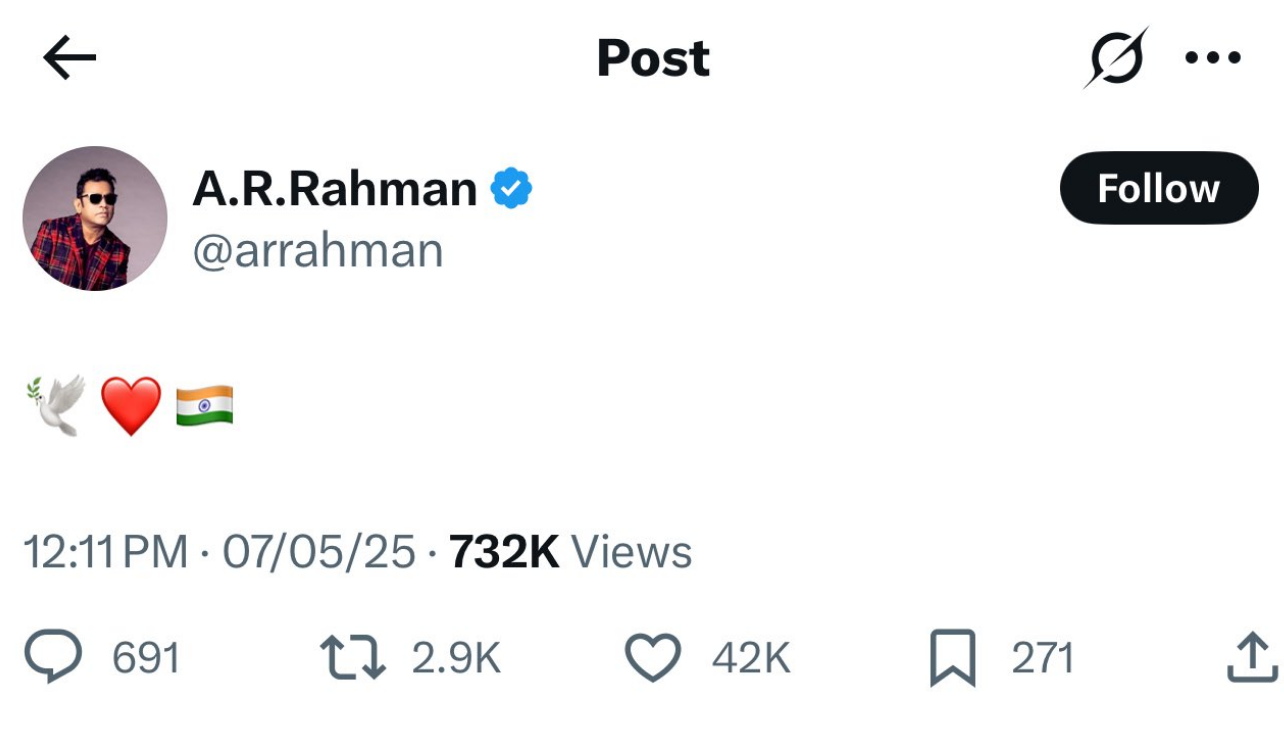
The backlash was swift and widespread, with users calling out his hypocrisy, ultimately forcing him to delete the post. Some of the netizens criticism given below
Dravidian Stockist Sundaravalli
In a now-deleted post that sparked outrage, Dravidar Kazhagam activist and self-proclaimed Periyarist, Sundaravalli, shamelessly floated a wild conspiracy theory suggesting that the recent terror attack in Pahalgam was orchestrated not by Islamist terrorists, but allegedly by the Indian Army in collusion with the BJP.
In her inflammatory statement, Sundaravalli claimed, “Those who came as tourists and took off their clothes to see if they were Muslims were in military uniforms. This further confirms suspicions about the BJP. Since a non-BJP opposition party is in power there, we also need to see if the BJP is conspiring with the army.”
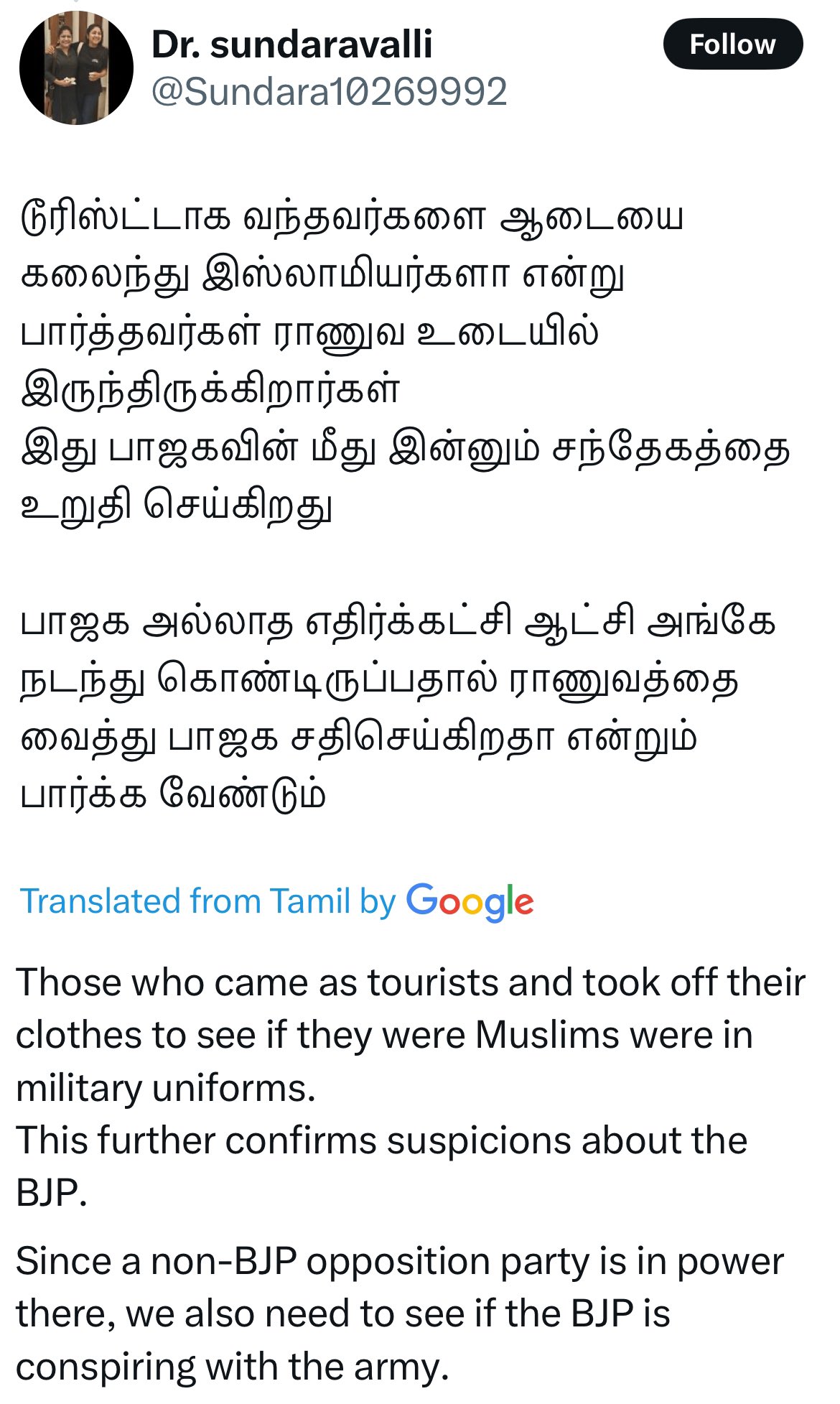
But she didn’t stop there. In another outrageous remark, she alleged, “Those who shot and killed tourists in Kashmir after checking if they were Muslims were dressed in military uniforms, carried guns, and have placed the blame on Muslims. The BJP has done this before, using the army.”
She attached pictures of an Indian Army soldier and the newly married tourist whose husband had been shot dead by the terrorists.
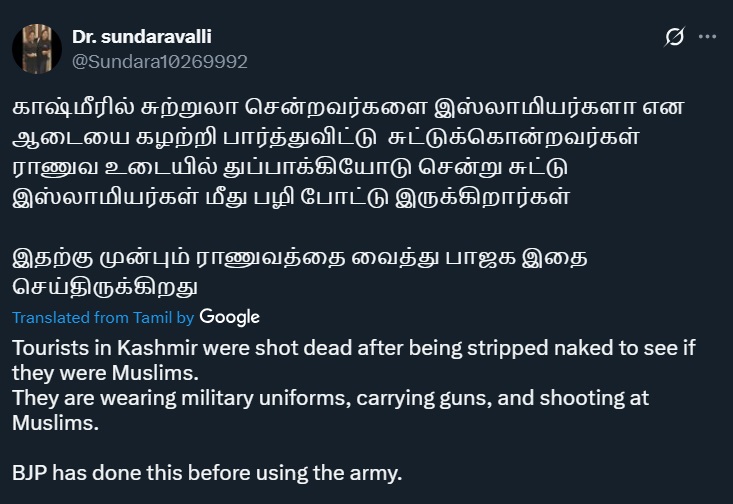
காஷ்மீரில் சுற்றுலா சென்றவர்களை இஸ்லாமியர்களா என ஆடையை கழற்றி பார்த்துவிட்டு சுட்டுக்கொன்றவர்கள்
ராணுவ உடையில் துப்பாக்கியோடு சென்று சுட்டு இஸ்லாமியர்கள் மீது பழி போட்டு இருக்கிறார்கள்இதற்கு முன்பும் ராணுவத்தை வைத்து பாஜக இதை செய்திருக்கிறது pic.twitter.com/f7ka6kr8VI
— Dr. sundaravalli (@Sundara10269992) April 22, 2025
Her baseless accusations not only targeted the ruling government but also cast a disgraceful shadow over the Indian Armed Forces—drawing widespread condemnation from netizens and political observers alike. Many have slammed her comments as reckless, deeply irresponsible, and a blatant attempt to politicize a national tragedy for ideological propaganda.
Dravidian Stockist Mathivadhani
In yet another inflammatory post, Dravidar Kazhagam’s Deputy General Secretary, Mathivadhani, ranted, claiming, “The Sanghis have started to paint a religious picture to hide their defeat. Even before they could write condolence messages to those who suffered the loss, they had already started using religion to incite riots. They are the threat to India!”
தங்களின் தோல்வியை மறைக்க மதச்சாயம் பூச தொடங்கிவிட்டனர் சங்கிகள்.
பேரிழப்பை சந்திருப்பவர்களுக்கு இரங்கல் செய்தி எழுதும் முன்பே, கலவரத்தை தூண்ட மதத்தை கையில் எடுக்கத் தொடங்கி விட்டனர்.
இந்தியாவிற்கு அச்சுறுத்தலே இவர்கள் தான்!#pahalgamattack
— S.M.Mathivadhani (@MMathivadhani) April 23, 2025
Dravidian Stockist Ashok
Another Dravidianist sympathizer in his post stated, “No matter which regime a terrorist attack takes place in, it is a stain on that regime. But it is only the BJP/Modi government that is inept and corrupt, that is blaming terrorist attacks on local Muslims, spreading and instilling fear in the minds of Hindutva fools that it would be better if they were in power. Think carefully. If terrorist attacks happen during a Congress government, the media will say that Congress should resign. But if attacks happen during a BJP government, the propaganda will be that this is the time for us to support the BJP government and Modi unconditionally. This rogueness is what saves the BJP. In fact, there has never been a government as weak as BJP/Modi in India. No one respects us living under the leadership of this comedian. As long as BJP is in power, there will be no security not only for Muslims but also for Hindus and Christians. “Munuswamy, you who are supposed to provide security, are well protected,” is the dialogue in the movie Beast, and that Munuswamy is Modi. Drive out Modi. India will become stronger. It will rise again. It will gain respect.”
எந்த ஆட்சியில் பயங்கரவாத தாக்குதல் நடந்தாலும் அந்த ஆட்சி மீதான களங்கம் அது. ஆனால் பாஜக/மோடி என்கிற கையாலாகாத களவாணி அரசு மட்டும்தான், பயங்கரவாத தாக்குதல்களை உள்நாட்டு இஸ்லாமியர்கள் மீது போட்டு, பயத்தைக் காட்டி, தாங்கள் ஆட்சியில் இருந்தால்தான் நல்லது என்பதைப் போன்ற ஒரு அச்சத்தை…
— Ashok R (@idonashok) April 22, 2025
In another post the same Dravidianist ranted, “A government that thinks that terrorist attacks are good for the elections will continue to have terrorist attacks as long as it is in the Union. Very simple logic!”
பயங்கரவாத தாக்குதல் நடந்தால் 'தேர்தலுக்கு' நல்லதுனு நினைக்கிற அரசு ஒன்றியத்துல இருக்க வரைக்கும் பயங்கரவாத தாக்குதல் நடந்துட்டுதான் இருக்கும். Very simple logic!
— Ashok R (@idonashok) April 22, 2025
Congress Spox Lakshmi Ramachandran
Moreover, Lakshmi Ramachandran, General Secretary of the Tamil Nadu Congress and TNCC spokesperson, in a blatant bid to appease the Muslim minority in the state, downplayed the clearly communal nature of the Pahalgam terror attack—where Hindu tourists were deliberately targeted. Instead of acknowledging the religious motive behind the massacre, she framed it merely as a generic act of terrorism by Pakistani militants, insisting it wasn’t a Hindu-Muslim issue. Her remarks drew heavy backlash, with critics slamming her for being tone-deaf and accused her of whitewashing the religious aspect of the assault to serve political interests.
In her post, she wrote, “Attack by Pakistani terrorists on innocent tourists in Pehalgam is extremely disturbing. The way Godi media is reporting the ghastly attack, treading a careful line lest they displease Modi-Shah, is highly irritating. They are making this a Hindu-Muslim issue to please their bosses. They are claiming that the terrorists made sure that the victims were Hindus before shooting them down. Some of the victims are Tamils and Telugus we hear. How the hell will Pakistani terrorists distinguish between a Tamil Muslim and Tamil Hindu? Shame on you Godi media. You have no humanity left in you. INDIANS were killed and the perpetrators should not be spared.”
Attack by Pakistani terrorists on innocent tourists in Pehalgam is extremely disturbing.
The way Godi media is reporting the ghastly attack, treading a careful line lest they displease Modi-Shah, is highly irritating.
They are making this a Hindu-Muslim issue to please their…
— Lakshmi Ramachandran (@laksr_tn) April 22, 2025
Dhivya Marunthiah – TNCC OBC State Secretary
Dhivya Marunthiah, who identifies herself as the OBC State Secretary of the Tamil Nadu Congress Committee. Since the news of India’s precision strike gained national attention, she has been vocal online—amplifying counter-narratives and attempting to portray the government’s action as religiously motivated rather than a legitimate act of national defense by a sovereign state in response to terrorism.
Immediately after news of the successful operation broke, Dhivya shifted focus instead of celebrating the retaliation like common citizens, she chose to lecturing the Indian government on peace and morality. In one of her posts, she wrote, “Cowards in suits send others to die so you can feel powerful. It’s not patriotism, it’s pathetic. War kills the poor, the innocent, the voiceless. It’s not your child orphaned, your home destroyed, your life shattered. War isn’t a game, it’s death, trauma and loss. SHAME on every war-monger. #SayNOToWar.”
Cowards in suits send others to die so you can feel powerful. It’s not patriotism, it’s pathetic. War kills the poor, the innocent, the voiceless. It’s not your child orphaned, your home destroyed, your life shattered. War isn't a game, it’s death, trauma and loss.⁰
SHAME on… pic.twitter.com/rpf44vKBtD— Dhivya Marunthiah (@DhivCM) May 7, 2025
Yet what stood out most starkly was her complete silence on the Pahalgam massacre itself. Not a single word condemning the terrorists who targeted unarmed Hindu tourists. The hypocrisy is glaring—quick to shame the nation for defending itself, but unwilling to speak against the barbarity that necessitated the response in the first place.
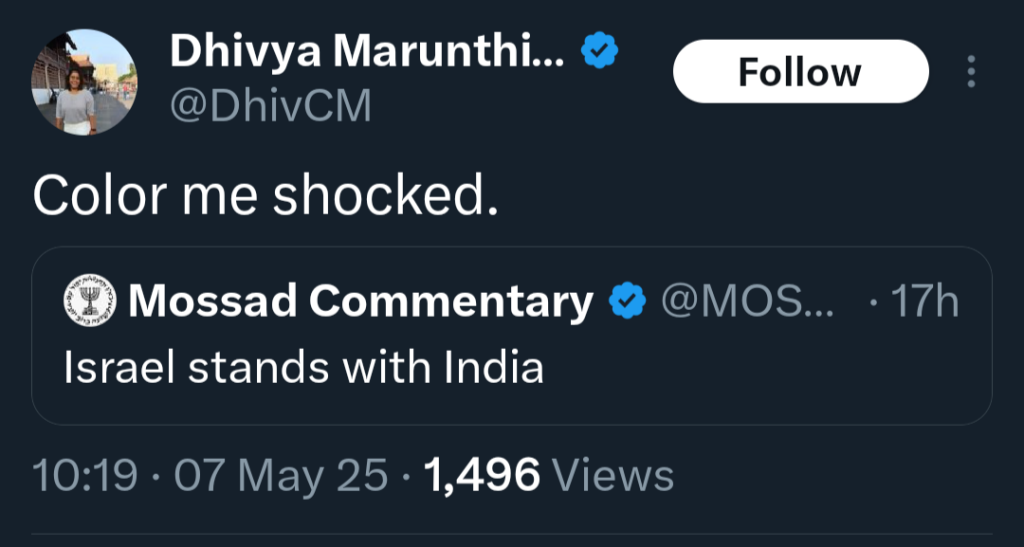
In another post, she responded mockingly to Israel’s official expression of solidarity with India by commenting, “Color me shocked.”
Her criticism didn’t stop there. She accused the Indian government of religious bias in its military action, despite the targeted nature of the operation against known terrorist camps. She wrote, “#OperationSindoor ? Terrorist attacks carried out by religious extremists are a grave threat to all humanity. But if a government, sworn to uphold a secular constitution and protect 1.46 billion people of diverse faiths, chooses to retaliate in the name of religion, it risks tearing apart the very fabric of our democracy. Retaliatory violence in the name of religion will not bring peace, it will only escalate fear, deepen divides, and perpetuate a cycle of conflict. What we are witnessing is not just a response to terrorism. It is a calculated political move by the BJP to manipulate grief, anger and religious identity for electoral gain. Playing politics with human lives is not only unethical, it is Un-Indian. We, the people of India, Hindus, Muslims, Christians, Sikhs and others stand united in our belief. We don’t want war. We demand conflict resolution. We seek justice rooted in truth, not vengeance. We want peace, not polarization. Let us not allow the politics of fear and hate to define our future. #EndWar #NotInOurName”
#OperationSindoor ? Terrorist attacks carried out by religious extremists are a grave threat to all humanity. But if a government, sworn to uphold a secular constitution and protect 1.46 billion people of diverse faiths, chooses to retaliate in the name of religion, it risks… pic.twitter.com/ugc9Fa39An
— Dhivya Marunthiah (@DhivCM) May 7, 2025
When none of her narratives gained traction, Dhivya Marunthiah finally resorted to attacking the very name of the operation—Operation Sindoor. She labeled it “patriarchal,” revealing just how far she was willing to stretch her criticism. It’s astonishing—and deeply telling—that someone holding a state-level position in a national party cannot even bring themselves to support a government action aimed at neutralizing terrorists.
She wrote, “Sindoor itself is patriarchal. In a society that is slowly shedding this kind of superstitions, it is regressive even dangerous to use state operations to reinforce them. Serves only narrow political goals.”
Sindoor itself is patriarchal. In a society that is slowly shedding this kind of superstitions, it is regressive even dangerous to use state operations to reinforce them. Serves only narrow political goals. https://t.co/xW0NvH5qDr
— Dhivya Marunthiah (@DhivCM) May 7, 2025
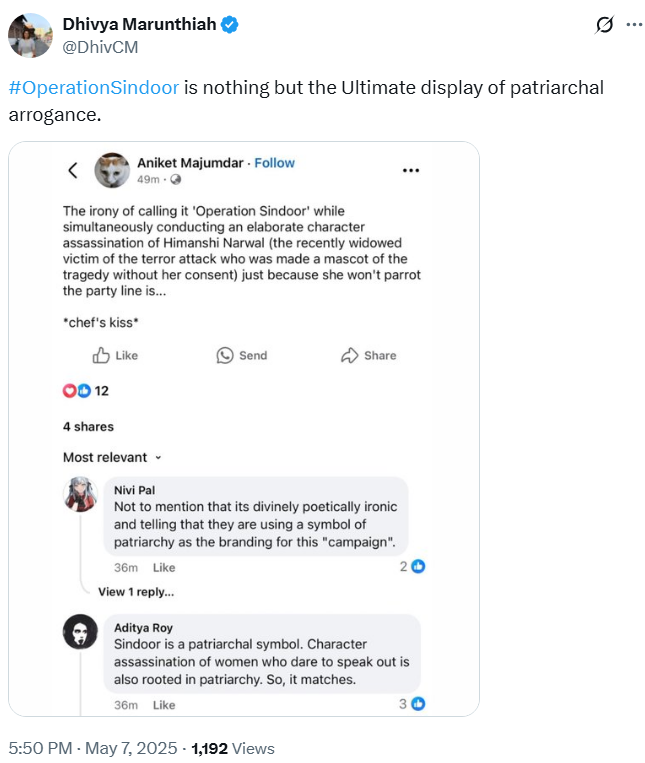
In another post she asserted, “#OperationSindoor is nothing but the Ultimate display of patriarchal arrogance.”
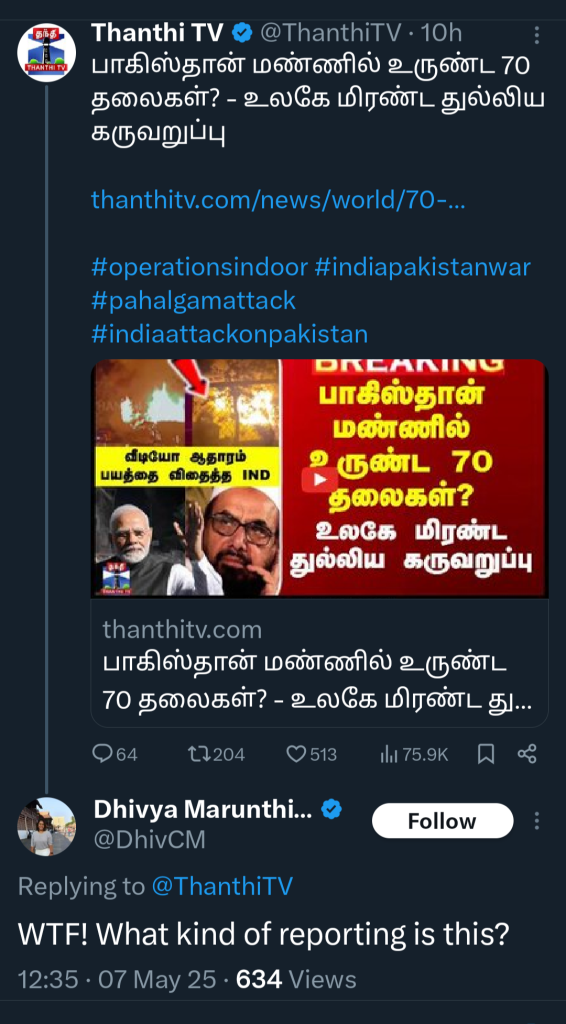
Her bangle breaking and crying didn’t end with her criticism directed against the government; she also attacked media outlets for reporting on the military’s success. When Thanthi TV published a video with the headline, “70 heads rolled on Pakistani soil – The precision operation that shocked the world,” she responded angrily, “WTF! What kind of reporting is this?”
What was most troubling was how Dhivya Marunthiah’s repeated anti-India statements seemed less about principles and more about signaling loyalty to her party by opposing the ruling government at any cost. Her comments reflect not just political rivalry, but a disturbing willingness to undermine national unity in moments of crisis, simply to appear aligned against the BJP.
This became even clearer when DMK spokesperson Saravanan Annadurai posted a unifying message, who praised the secular and inclusive spirit of India by highlighting Muslim and Hindu officers in the Armed Forces, Dhivya remarked, “Rather than standing with Modi, it’s better we keep silence.”
Rather than standing with Modi, it’s better we keep silence.
— Dhivya Marunthiah (@DhivCM) May 7, 2025
At a time when the nation is unified in mourning and determined to respond to terrorism with resolve, Dhivya Marunthiah’s comments not only appear out of touch but dangerously divisive. Her refusal to condemn terrorism, while choosing to vilify India’s sovereign right to defend itself, raises serious questions about her priorities and the values she represents.
If even state-level Congress leaders cannot support national efforts against terrorism, especially in moments of crisis, it points to a deeper ideological crisis within the party’s Tamil Nadu unit.
DMK-Supporting Dravidianist YouTuber Senthil Vel
In the aftermath of the Pahalgam terror attack in Jammu & Kashmir—where Hindus were reportedly singled out by Islamist extremists—DMK-aligned Dravidianist YouTuber Senthil Vel stirred controversy by diverting attention away from the religiously motivated nature of the massacre. Instead of condemning the perpetrators, he launched into a politically charged tirade against the BJP-led central government, accusing them of harboring terrorists and demanding the resignations of Prime Minister Narendra Modi, Home Minister Amit Shah, and the Defence Minister. Claiming to expose alleged links between terrorists and BJP members, Senthil Vel promised a “hard-hitting exposé,” though his assertions quickly unraveled.
“Let me be clear—the Prime Minister, Home Minister, and Defence Minister are directly responsible. They must resign. I’m accusing them that they are weak and going to criticize them even more. I’m not here to bluff anything. I’m going to show the links between terrorists and BJP members, explain in detail who were all arrested.”, he had said.
Rather than addressing the jihadist motivations behind the attack—where assailants reportedly asked victims to recite Islamic verses to identify Hindus—Senthil Vel attempted to blur the lines between Islamist terrorism and espionage cases involving Hindu individuals. His comparison not only deflected from the religious nature of the violence but also trivialized the gravity of the attack. Compounding this deflection was a series of casteist remarks. He singled out Brahmins, describing them as people who “claim to be born intelligent,” reinforcing the kind of caste-based hostility often found in radical Dravidianist rhetoric.
His narrative further collapsed when he falsely cited a Muslim BJP worker arrested for links with Lashkar-e-Taiba as an example of “Hindu terrorism.” Instead of correcting his misinformation, he doubled down on BJP criticism, exposing inconsistencies in his argument. Senthil Vel relied heavily on politically biased sources like Congress-affiliated YouTuber Dhruv Rathee and Alt News co-founder Mohammed Zubair—both of whom are often accused of pushing partisan agendas. He listed espionage cases involving individuals such as DRDO scientist Pradeep Kurulkar, MES employee Mahesh Kumar, HAL worker Deepak Shirsath, and journalist Rajeev Sharma. While these incidents are serious, they fundamentally differ from acts of terror driven by religious extremism.
In another flawed comparison, he pointed to journalist Ved Pratap Vaidik’s controversial meeting with Hafiz Saeed, attempting to portray it as an RSS scandal. However, this fell flat when contrasted with Tamil journalist Nakkeeran Gopal’s interview with bandit Veerappan, which was celebrated in Tamil Nadu and even supported by the state government. The double standard underscored the political motivations behind Senthil Vel’s statements.
Ultimately, what began as a supposed exposé turned into a confused monologue filled with misinformation, caste prejudice, and political deflection. Rather than holding the perpetrators of the Pahalgam attack accountable or acknowledging its anti-Hindu intent, Senthil Vel appeared more focused on shielding ideological allies and preserving a politically expedient narrative. His rhetoric has drawn significant backlash for downplaying religiously motivated violence and exploiting a national tragedy for partisan gain.
Tamil Dravidianist and Singapore-based stockbroker P. R. Sundar
Similarly, P. R. Sundar, a Tamil Dravidianist and Singapore-based stockbroker, who used his platform to question the credibility of the Indian Army and the central government, instead of unequivocally condemning the religiously motivated massacre.
Sundar began his video commentary by reciting an allegorical poem that subtly insinuated collusion between Indian soldiers and terrorists. This indirect accusation painted the Indian security forces as corrupt and incompetent, while shifting the focus away from the Islamist motivations behind the attack. Rather than supporting India’s fight against terrorism, Sundar cast doubt on the integrity of its armed forces and suggested the real enemy was internal rot rather than external threats.
Continuing this line of argument, Sundar mocked India’s military preparedness by highlighting statistics of aircraft crashes during peacetime. He cited past scandals and incidents—like the coffin scam and honey-trap cases—to argue that corruption and mismanagement defined India’s defense apparatus. However, this deflection from the terror attack ignored the ideological indoctrination behind such violence and trivialized national security concerns.
Like other Dravidianist figures such as YouTuber Senthil Vel, Sundar echoed the “terror has no religion” narrative, despite clear evidence from the Pahalgam attack that the terrorists had targeted victims based on religion. Reports confirmed that attackers asked some tourists to recite Islamic prayers or prove circumcision to identify Hindus. Ignoring these facts, Sundar instead advanced politically convenient arguments that aligned with leftist and Congress-Dravidianist narratives.
He went further by ridiculing India’s foreign policy and counter-terror actions, criticizing measures like suspending medical visas for Pakistanis and limiting water access under the Indus Water Treaty. He questioned why ordinary Pakistani citizens and farmers were being penalized, while conveniently overlooking the role Pakistan’s establishment plays in nurturing terror networks. Ironically, while praising American citizens for opposing their government during the Vietnam War, he condemned similar pressure tactics on Pakistani society—revealing a glaring hypocrisy in his arguments.
Sundar concluded his video by claiming neutrality, stating he had no political affiliations and was merely concerned as an Indian-born observer. However, his entire video was filled with partisan rhetoric, anti-government sentiment, and evasions regarding Islamist extremism. By refusing to acknowledge the ideological roots of the Pahalgam attack and deflecting blame onto India’s own institutions, Sundar ultimately aided the divisive goals of the terrorists.
In essence, Sundar’s video reflects a broader trend among certain influencers and commentators who exploit tragedies to push ideological agendas. Rather than fostering unity in the face of terror, they sow doubt, deflect accountability, and weaken the national resolve against extremist violence.
Subscribe to our channels on Telegram, WhatsApp, and Instagram and get the best stories of the day delivered to you personally.