


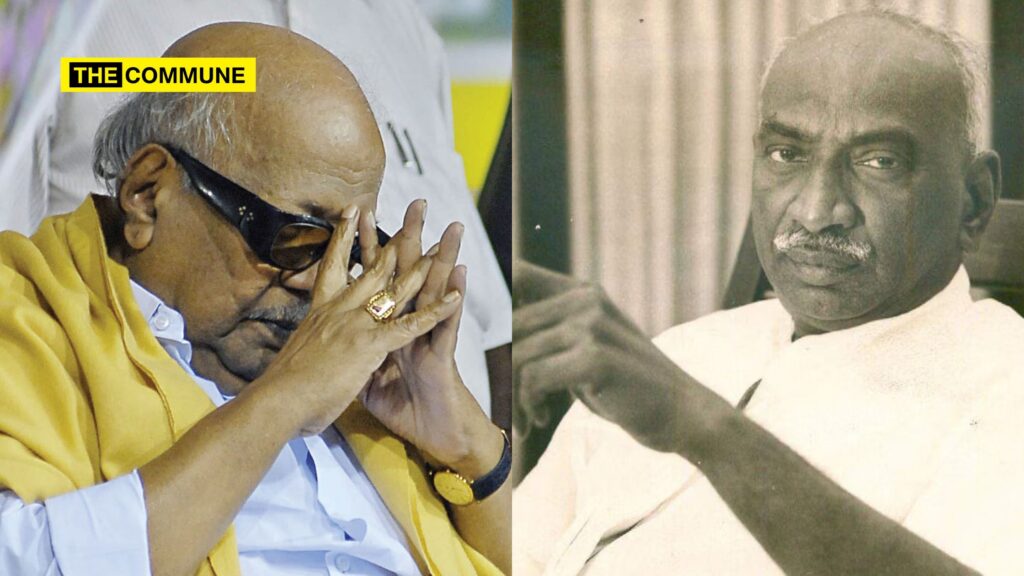
K. Kamaraj, fondly referred to as Kamarajar out of respect, remains one of the most influential political figures to emerge from Tamil Nadu, with a legacy that not only reshaped the state but also played a decisive role in shaping national politics. His leadership, often referred to as a golden era, left such an indelible mark that even today, Tamil Nadu politicians frequently promise to revive a governance model “on par with Kamaraj’s rule.” Yet, despite his towering contributions, the DMK has repeatedly mocked, minimized, or appropriated his legacy when it suited their political agenda attempting to overshadow his significance and remove him from historical memory.
Kamaraj’s contributions were so monumental that even EV Ramasamy Naicker (EVR), a known critic of the Congress, once admitted that what Kamaraj achieved for Tamil Nadu had never been done by any ruler before him, not the ancient dynasties of the Cheras, Cholas, or Pandyas, nor colonial rulers like the British or Marathas.
Legacy Of Kamarajar
During Kamaraj’s tenure as Chief Minister, often referred to as the golden era, significant strides were made in education and infrastructure development. Under his leadership, the local education rate soared from a meager 7% during the colonial era to a commendable 37% after his reforms. These reforms not only increased the number of schools but also focused on enhancing educational standards. Measures such as extending the number of working days to 200, reducing unnecessary holidays, and devising syllabi to accommodate various abilities were implemented.
Additionally, Kamaraj, alongside Bishnuram Medhi, the Governor, played pivotal roles in establishing prestigious institutions like IIT Madras in 1959. In the realm of irrigation, major schemes were undertaken, resulting in the construction of 13 dams and canals across various regions including Bhavani, Vaigai, and Amaravathi. These projects significantly expanded cultivable land, with notable successes such as the Lower Bhavani Dam in Erode district, which brought over 200,000 acres under cultivation.
Furthermore, Kamaraj’s era witnessed the inception of several industrial ventures with substantial investments. Projects like Neyveli Lignite Corporation, BHEL at Trichy, and Manali Refinery marked milestones in industrial development. Moreover, industries such as paper, sugar, chemicals, and cement flourished during this period. His retirement marked a remarkable nine years of service as the chief minister, setting an unmatched record in the history of Madras State. While subsequent chief ministers may have served longer in cumulative terms, none have achieved the level of uninterrupted tenure that Kamaraj held during his time in office.
Political Acumen And Rise To Power
Kamaraj’s journey from a modest educational background to national leadership is also a testament to his political insight and determination. Though he had only studied up to sixth standard, he was drawn to the freedom movement early on, participating in both the Non-Cooperation and Quit India Movements. He spent over eight years in jail for his role in the struggle against British colonialism.
A pivotal figure in his political evolution was S. Satyamurti, who recognized Kamaraj’s exceptional organizational abilities and mentored him. Their relationship is often likened to that of Arjuna and Dronacharya from the Mahabharata. Kamaraj’s rise as a non-Brahmin leader during the 1930s and 1940s was especially significant given the socio-political dynamics of the time.
One of his most notable political accomplishments was his ability to challenge and eventually surpass C. Rajagopalachari (Rajaji), a towering national leader. Despite being rivals, Kamaraj showed no insecurity and even appointed Rajaji’s protégé, C. Subramaniam, to his cabinet an example of his inclusive and pragmatic leadership style. Kamaraj’s connection to the people ran deep. He is believed to have personally visited each of Tamil Nadu’s 12,000 villages at least twice, often on foot, demonstrating a level of commitment that few leaders have matched.
On the national stage, Kamaraj played a crucial role in reshaping the Congress party following the 1962 Sino-Indian War. His “Kamaraj Plan” called on senior leaders to resign from government positions and dedicate themselves to rebuilding the party. He led by example, stepping down as Chief Minister. This bold move led to several key resignations, including those of Krishna Menon and Lal Bahadur Shastri.
Following Nehru’s declining health and eventual death in 1964, Kamaraj emerged as a kingmaker. He facilitated Shastri’s return to the cabinet and helped position him as Nehru’s successor. After Shastri’s untimely demise, Kamaraj played a pivotal role in making Indira Gandhi the Prime Minister, preferring her over Morarji Desai, whom many viewed as rigid and politically inflexible. However, this decision later proved problematic when Indira asserted her independence, leading to the 1969 split in the Congress party. Kamaraj led the breakaway faction, Congress (O), which continued to command loyalty in Tamil Nadu, where he remained the face of the party.
One major miscalculation on Kamaraj’s part was underestimating the DMK. He viewed Rajaji as his primary political rival until the early 1960s and failed to grasp the rising momentum behind the DMK’s identity-based politics. Their call for a separate Dravida Nadu, while radical, resonated with certain sections of the population. Kamaraj believed such ideas would not gain traction but his failure to effectively counter the DMK’s growing influence contributed to the Congress’s defeat in the 1967 state elections.
Kamaraj’s appeal never stemmed from charisma or oratory flair. His power lay in his simplicity and sincerity. He remained unmarried, lived modestly, and when he died, he left behind only a handful of personal belongings—some clothing, a few books, and very little money. His voters in Virudhunagar, however, eventually turned against him in his final election, believing he wouldn’t become Chief Minister again and questioning why they should elect someone unlikely to return to power.
Enduring Influence
Though half a century has passed since his death, Kamaraj’s name is still invoked by political parties, especially during election campaigns, with promises to emulate his governance. Yet, beyond rhetoric, his legacy has largely been ignored—even by the Congress party he once led, which struggles today to inspire the kind of mass support Kamaraj once effortlessly commanded.
Jealousy Of Karunanidhi
The DMK, in particular, has had a complicated relationship with Kamaraj’s legacy. During his lifetime, the party often belittled him through satire and caricature, working actively to diminish his standing and erase his role in shaping Tamil Nadu’s political identity. It is ironic that today, some within the DMK attempt to co-opt his memory, selectively highlighting moments that suit their narrative, while ignoring the years they spent undermining him.
Occasions Where Karunanidhi Derogated Kamaraj
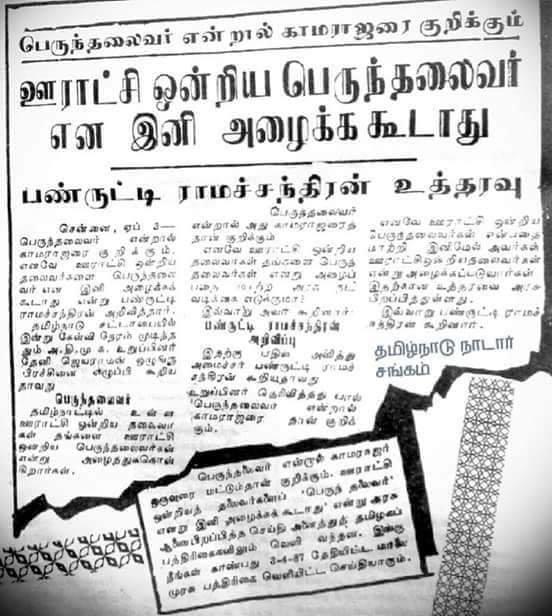
On one occasion, when Karunanidhi conversed with a leader and inquired about the leader’s whereabouts, the leader responded by mentioning that he had visited ‘Perunthalaivar‘ (Tall Leader) Kamaraj. This remark sowed seeds of jealousy in Karunanidhi to designate all panchayat council chiefs as Perunthalaivar.
In yet another incident where Karunanidhi disparaged Kamaraj was a visit to Russia. Karunanidhi stated “Earlier we used to send buffalo skins to Russia, now we have sent buffalo itself to Russia.” Additionally, in another incident where Karunanidhi referred to Kamaraj as the “Son of a woman who sells dried fish in Virudhunagar.”
— A Selvaraj (@Crime_Selvaraj) April 2, 2024
Similarly during his tenure as Chief Minister, the late DMK leader Karunanidhi mandated that all panchayat council chiefs be addressed as “Perunthalaivar.” However, this directive was rescinded on 3 April 1987 after MG Ramachandran (MGR) assumed power. Nevertheless, in certain areas, the practice persists.

Kamaraj, in his capacity as the chairman of the Indian National Congress, embarked on a visit to the Soviet Union. Initially, there seemed to be some uncertainty on the part of the Soviet government regarding how to regard Kamaraj. However, they eventually concluded that despite his official position, he held significant importance in India at that time. During his trip, Kamaraj visited Dushanbe, Volgograd, and Leningrad. His meetings with Aleksei Kosygin, the Soviet premier, and Leonid Brezhnev, the General Secretary of the Communist Party of the Soviet Union, were well-documented events. During his speech, Karunanidhi made derogatory and racially charged remarks about Kamaraj, referring to him as a buffalo due to the color of his skin.
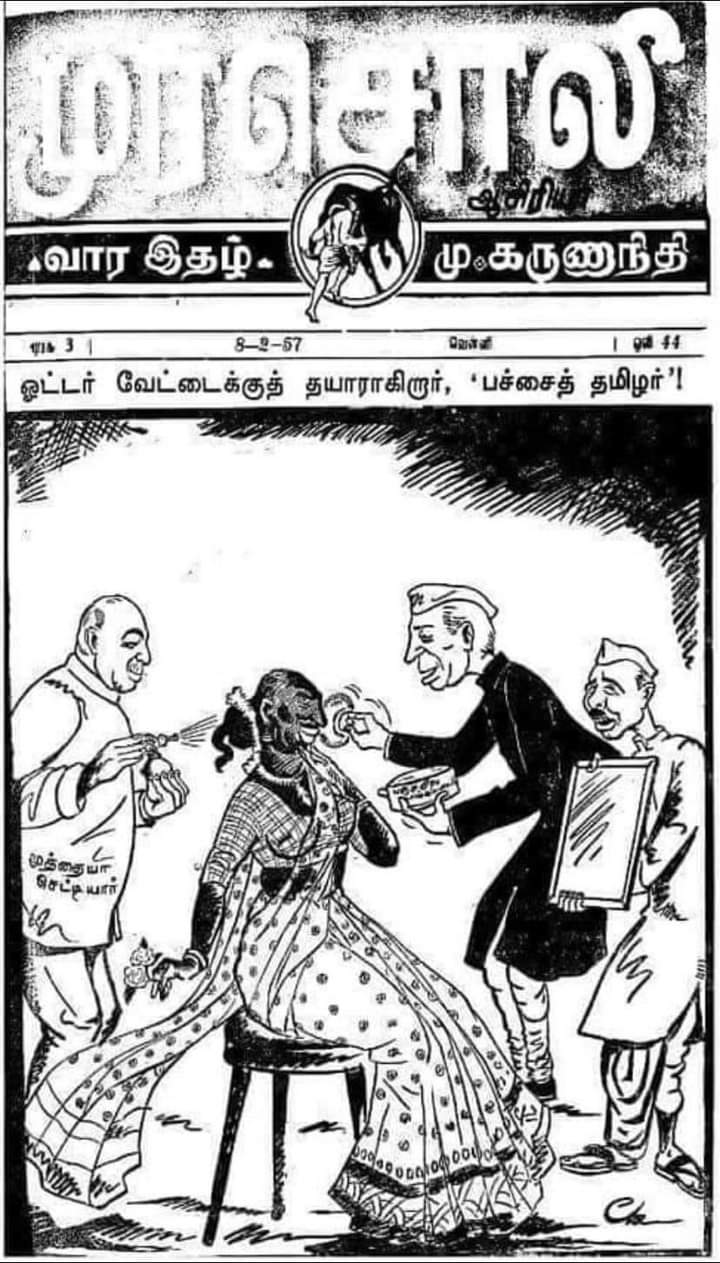
On 8 February 1957, in Murasoli magazine, Karunanidhi, serving as the chief editor at the time, published a controversial cartoon that depicted a derogatory portrayal. The cartoon featured a black woman undergoing makeup to resemble Kamaraj, with another figure representing Prime Minister Nehru as the makeup artist. The caption accompanying the cartoon read, “The true Tamilian is getting ready for vote hunting.” This portrayal aimed to ridicule Kamaraj for his deliberate decision not to marry. Karunanidhi ridiculed him by likening him to a woman dressed in a saree and wearing a nose pin. This has been widely condemned as one of the most disgraceful instances of mockery in political history, stemming from jealousy over Kamaraj’s effective governance.

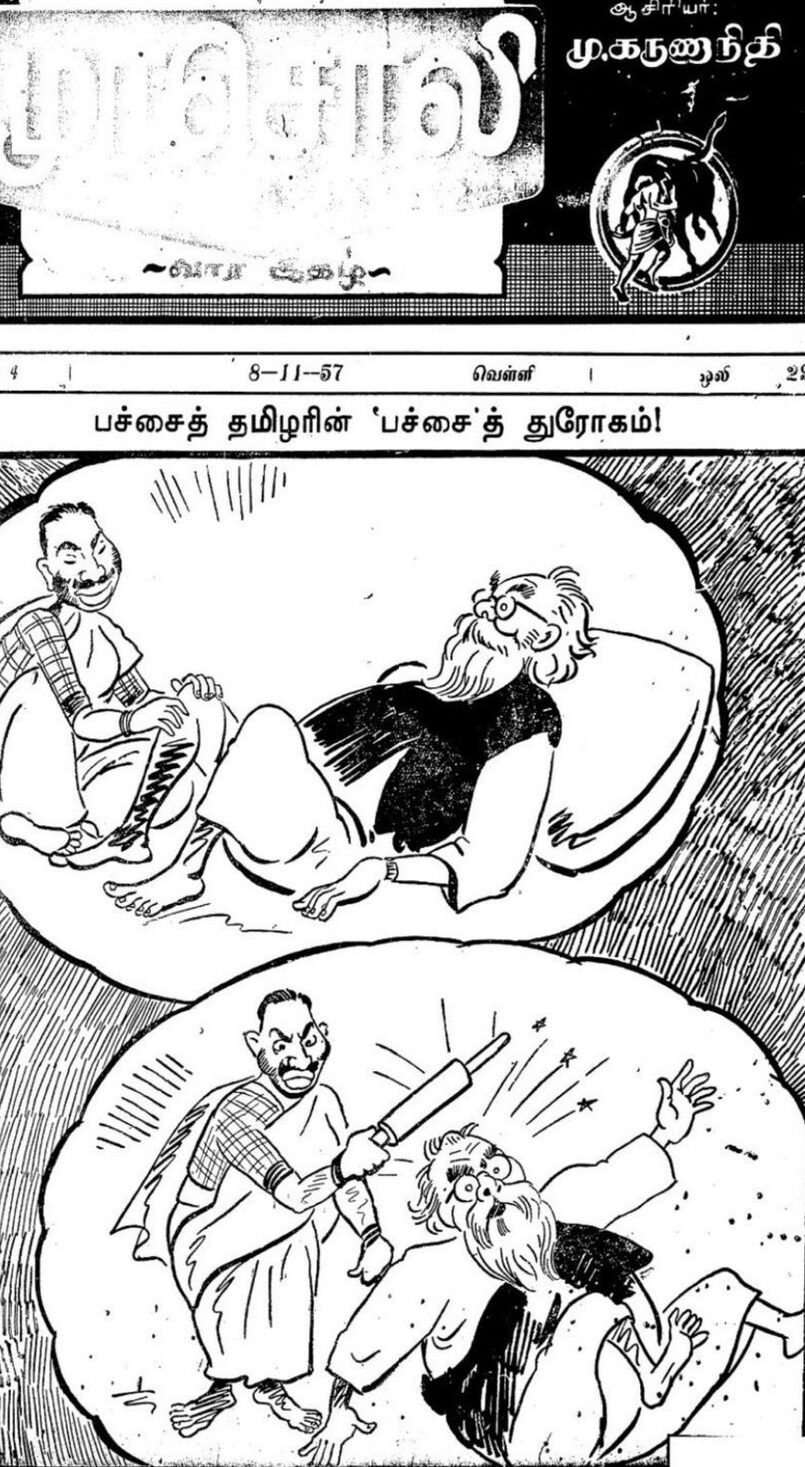
In the same Murasoli magazine dated 8 November 1957, Karunanidhi portrayed Kamaraj wearing a saree in a cartoon. In this one cartoon depicted Kamaraj seeking favors by massaging the legs of EV Ramasamy. In a subsequent cartoon, Karunanidhi depicted Kamaraj forcefully driving away EV Ramasamy, with a caption titled “True Tamilans, True treachery.” Once again, he created a cartoon mocking Kamaraj by portraying him as a woman.

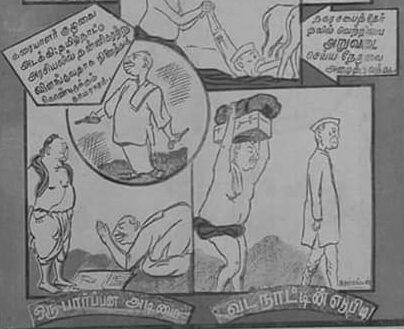
In the 1956 Pongal Malar edition of Murasoli, Karunanidhi featured a cartoon series titled ‘Kamarajar Puranam’ where he portrayed Kamaraj as prostrating before a Brahmin. This one was titled “A Brahmin Slave.”
Additionally, another cartoon depicted Kamaraj as a porter carrying the agendas of Prime Minister Nehru titled “Mere worker for North Indians“, which not only insulted both leaders but also demeaned the profession of the downtrodden who earn their livelihood through hard labor. Karunanidhi promoted a misleading narrative among the impoverished population of Tamil Nadu, portraying himself as a constructive force. However, in truth, Kamaraj held significant political sway as a kingmaker. His renowned “K plan” garnered praise, with even Prime Minister Nehru seeking counsel from Kamaraj. Following Nehru’s passing, Kamaraj played a pivotal role in determining who would assume the prime ministerial position in Delhi.

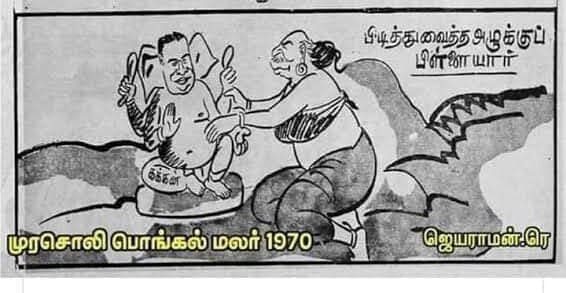
In 1970, amidst the Murasoli controversy surrounding the Pongal Malar, Karunanidhi published a cartoon that not only disrespected Kamaraj but also offended Hindu sentiments. In the cartoon, Kamaraj was depicted as a semi-clothed woman resembling a Hindu goddess, and Kakkan, another esteemed leader of the Congress known for his neutrality, was portrayed as a male Hindu deity. This portrayal was titled “A handmade dirty Pillayar,” adding insult to injury for many Hindus. Kakkan, hailing from a Scheduled Caste background, rose to the position of Home Minister. Despite his stature, even in his passing, he relied on a government hospital for his medical care. Surprisingly, he lacked financial resources at the time of his demise. The DMK, which boasts of advocating for social justice, ironically subjected such a man to derogatory caricatures, despite his significant contribution to the state.

The DMK, particularly under the leadership of Karunanidhi, has been cunningly focused on establishing their dynasty’s perpetual rule, ensuring that no other entity or ideology can rival theirs. This ambition has been meticulously sustained over five decades, exemplified by Karunanidhi’s refusal to permit a memorial for Kamaraj on Marina Beach, despite widespread pressure from various leaders. This illustrates Karunanidhi’s jealousy, as he seeks to monopolize praise and spotlight in Tamil Nadu, deterring any potential contenders from gaining recognition.
So even @the_hindu quoting party colleagues of #Kamaraj says #Karunanidhi turned down request for a memorial on Marina
Wondering what Vikatan based their article on. MuKa may have praised Kamaraj but refused Memorial on Marina was my pointCc: @dhanyarajendran for fact checking pic.twitter.com/R3U64RR8xU
— Suresh (@surnell) August 9, 2018
A figure such as Kamaraj will be eternally honored and revered by people across generations, despite attempts by politicians like Karunanidhi to overshadow his legacy by naming infrastructure projects after their own family members, such actions cannot conceal the genuine patriotism embodied by individuals like Kamaraj. When Kamaraj initiated the opening of irrigation canals to supply water to farmers for agricultural purposes, Karunanidhi, on the other hand, facilitated the proliferation of liquor shops, exacerbating the misery of the poor by providing unrestricted access to alcohol.
Subscribe to our channels on Telegram, WhatsApp, and Instagram and get the best stories of the day delivered to you personally.