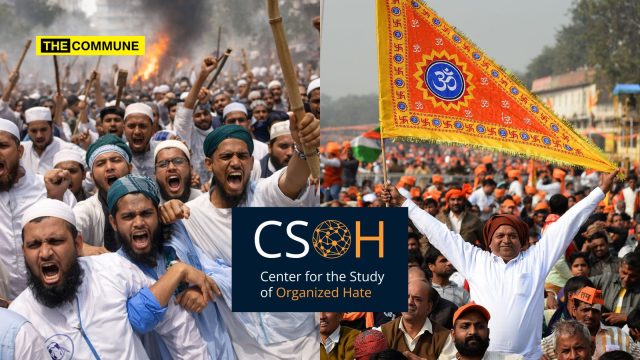
On 17 January 2026, Karnataka Congress MLA Priyank Kharge amplified a report published by the Washington-based Centre for the Study of Organised Hate (CSOH), claiming that a majority of alleged hate speech incidents in India during 2025 originated from Bharatiya Janata Party (BJP)-ruled states and were largely directed at minorities. In his social media post, Kharge presented the report’s conclusions as established facts and used them to attack the BJP, singling out Union Home Minister Amit Shah as one of the principal figures allegedly driving hate speech.
A report by the Washington-based research group India Hate Lab found that 88% of documented anti-minority hate speech events in India in 2025 occurred in BJP-ruled states. Of the 1,318 hate speech events recorded, 98% targeted Muslims.
308 speeches (23%) contained explicit calls… pic.twitter.com/v4P48q5b5z
— Priyank Kharge / ಪ್ರಿಯಾಂಕ್ ಖರ್ಗೆ (@PriyankKharge) January 17, 2026
Following Kharge’s post, several media outlets, including The Quint, Alt News, and The Wire, published reports based on the CSOH study. The Quint’s coverage focused on claims of hate speech targeting Christians and Muslims, while The Wire reported that 656 speeches allegedly revolved around what it described as “conspiracy theories” such as love jihad and land jihad.
India Saw 1,318 Hate Speech Events in 2025; 98% of Them Targeted Muslims: Report
Uttar Pradesh, with 266 instances, recorded the highest number of hate speeches in 2025, followed by Maharashtra, with 193 such cases.
Sharmita Kar✍️https://t.co/HGxa7MRBMX
— The Wire (@thewire_in) January 15, 2026
In 2025, on an average, four hate speech cases were reported every day.
2025 was a year which witnessed an increase in hate speech against Muslims and Christians, in newer forms, more intensity and magnitude. As per the new India Hate Lab report by @csohate showed how 1,164 hate… pic.twitter.com/RBfttbnpBd— The Quint (@TheQuint) January 14, 2026
The CSOH report, titled Hate Speech Events in India, claimed to have documented 1,318 in-person incidents across the country in 2025 and projected a sharp rise compared to the previous year. It asserted that expressions linked to Hindu organisations, religious events, political campaigns, and social mobilisation constituted an organised ecosystem of hate. However, the report largely relied on numerical claims and classifications, without providing specific examples or verifiable transcripts of speeches identified as hate speech.
As the report gained traction among opposition leaders and activist networks, there are severe concerns of lack of scrutiny being applied to its definitions, selection criteria, and analytical framework. A closer examination of the study has raised questions regarding its credibility, intent, and methodology, as it conflates lawful political speech, religious expression, and historical assertion with criminal incitement.
Methodology Under Scrutiny
CSOH stated that it classified hate speech using a “United Nations framework” and adopted a broad definition that categorised any communication deemed “pejorative” or “discriminatory” towards an identity group as hate speech. Such an expansive definition blurs distinctions between constitutionally protected speech and unlawful incitement, allowing a wide range of legal activities to be included in the dataset.
The report also introduced “dangerous speech” as a subcategory, drawing from the “Dangerous Speech Project”. Now instead of demonstrating how specific speeches led to actual or imminent violence, the methodology assumed causality by treating narrative expression itself as evidence of intent. This approach replaces legal thresholds with speculative interpretation and infers intent based on ideological content rather than demonstrable outcomes.
CSOH further suggested that expressions of anger by sections of the Hindu community were not organic responses but the result of strategic planning by what it described as “entrepreneurial merchants of hate”. Such framing leaves little room for acknowledging documented crimes, social anxieties, or legitimate grievances, and that this treatment appears to be applied selectively.
The study classified references to issues such as love jihad, land jihad, demands related to places of worship, calls for boycotts, and concerns about Bangladeshi or Rohingya infiltration as hate speech. These were labelled “conspiracy theories” without examination of police records, FIRs, court proceedings, or government data that might provide context or factual grounding.
Although the report claimed to apply the Rabat Plan of Action’s six-part threshold test, covering context, speaker, intent, content, extent, and likelihood of harm, it did not disclose how these criteria were applied in practice. There was no transparent explanation of how intent was determined or how the likelihood and imminence of violence were assessed.
Data Collection and Alleged Asymmetry
CSOH acknowledged that its data collection relied heavily on social media scraping, activist networks, and selected media reports, and that it specifically monitored Hindu right-wing groups and affiliated political actors. The absence of comparable tracking of Islamist groups, radical clerics, or organisations linked to violence against Hindus, creates an asymmetry that results in a skewed dataset.
The report also admitted that its dataset was not exhaustive and that many incidents lacked verifiable content, further raising doubts about methodological rigour. Despite this, its findings were presented in absolute terms and widely amplified in political and media discourse.
Love Jihad and Omitted Context
One of the most ridiculous aspects of the CSOH study is its categorical dismissal of love jihad as a baseless conspiracy theory. The report did not engage with police complaints, FIRs, court proceedings, or documented cases involving allegations of identity concealment, coercion, or forced conversion.
Data compiled by Hinduphobia Tracker indicates that in 2025 alone, more than 300 cases involving crimes against women in relationships (love jihad) were documented, with the total number exceeding 900 since the platform’s inception. These cases include allegations supported by victim testimonies, police action, and ongoing investigations.
By declaring love jihad fictitious at the methodological level, the CSOH report reframed responses to documented crimes as hate speech while excluding the crimes themselves from analysis. There are multiple cases from December 2025 across states such as Madhya Pradesh, Uttar Pradesh, Bihar, Uttarakhand, and Rajasthan, where police registered cases involving identity fraud, sexual exploitation, blackmail, and alleged coercive conversion.
Historical Commemoration and Religious Opposition
The CSOH report also categorised Shaurya Diwas, observed annually on 6 December to mark the demolition of the disputed Babri structure in 1992, as hate speech. This approach flattened a long-standing historical and legal dispute into a moral accusation, ignoring decades of litigation that culminated in the site being legally handed over to Hindus for the construction of the Ram Temple.
Similarly, opposition to Christian missionary activity was framed as hate speech without examining whether protests or statements were linked to documented grievances, FIRs, or ongoing investigations into alleged inducement-based conversions. The report seems to treat resistance itself as evidence of hostility while excluding scrutiny of missionary practices, including questions of foreign funding and compliance with state anti-conversion laws.
Who Is Behind the Study?
CSOH is headed by Raqib Hameed Naik, who is also the founder of Hindutva Watch and India Hate Lab, the latter being the primary source of data for the CSOH report. Naik is associated with academic initiatives at Bard College and the University of California, Berkeley, and his work has been cited by several international media outlets.
Hindutva Watch has previously faced criticism for selective portrayal of events in India and for conflating ideological disagreement with hate speech. In January 2024, the Hindutva Watch account on X was withheld in India following a report that flagged links between the platform and Pakistan-based propaganda networks.
Conclusion
The CSOH report, amplified by political actors such as Priyank Kharge and media platforms including The Quint, Alt News, and The Wire, has sparked debate over the line between research and activism. Its selective definitions, data collection methods, and omission of documented crimes have resulted in a one-sided narrative that criminalises lawful speech and historical expression while excluding inconvenient realities.
Source: OpIndia
Subscribe to our channels on Telegram, WhatsApp, and Instagram and get the best stories of the day delivered to you personally.