


On 17 May 2025, Congress leader Rahul Gandhi accused the central government of compromising national security by allegedly informing Pakistan in advance about planned strikes on terror targets under Operation Sindoor. Terming the act a “crime,” Gandhi demanded accountability, asking, “Who authorized this?”
In a post on X, Gandhi, as Leader of the Opposition in the Lok Sabha, took a direct swipe at External Affairs Minister S. Jaishankar. He referenced a undated video in which Jaishankar appears to say that India had notified Pakistan before launching the operation. “Informing Pakistan at the start of our attack was a crime. EAM has publicly admitted that GOI did it. Who authorised it? How many aircraft did our airforce lose as a result?,” Gandhi claimed in his post. He also questioned the consequences of this move, asking, “How many Indian aircraft did we lose because Pakistan knew? This wasn’t a lapse. It was a crime. And the nation deserves the truth.”
EAM Jaishankar’s silence isn’t just telling — it’s damning.
So I’ll ask again: How many Indian aircraft did we lose because Pakistan knew?
This wasn’t a lapse. It was a crime. And the nation deserves the truth. https://t.co/izn4LmBGJZ
— Rahul Gandhi (@RahulGandhi) May 19, 2025
However, the Press Information Bureau (PIB) swiftly responded through its Fact Check Unit, stating that Jaishankar had been misquoted. According to PIB, the minister did not say that India had alerted Pakistan prior to Operation Sindoor, and any such claims were misleading.
Social media posts quoting EAM @DrSJaishankar are implying that India gave advance information to Pakistan about #OperationSindoor#PIBFactCheck
▶️ EAM is being misquoted, and he has not made this statement
🔗https://t.co/DQriAgE56e https://t.co/05OiwE3kdV
— PIB Fact Check (@PIBFactCheck) May 16, 2025
Rahul Gandhi may have forgotten or have chosen to hide this fact but on 6 April 1991, both countries signed an agreement in New Delhi aimed at preventing misunderstandings and potential conflict through prior notifications about military activities. This agreement was officially registered by India on 15 December 1994.
Who Authorized the Agreement?
The pact was formulated during the tenure of Prime Minister Chandra Shekhar, who led a short-lived minority government from 10 November 1990, to 21 June 1991. His administration, a splinter faction from Janata Dal, received outside support from the Indian National Congress. Interestingly, Chandra Shekhar was the first Indian Prime Minister with no prior experience in any government role. Although signed under his leadership, the agreement was officially registered during P. V. Narasimha Rao’s Congress-led government.
What was the Agreement?
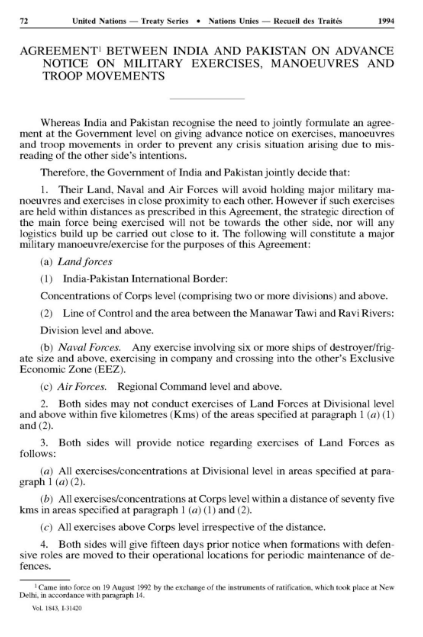
The Agreement was on Advance Notice on Military Exercises, Manoeuvres, and Troop Movements between India and Pakistan was designed to ensure transparency and avoid unintended escalation
Key Provisions of the 1991 Agreement
- Avoiding Provocative Exercises: Both India and Pakistan agreed to avoid major land, naval, or air exercises near the border or the Line of Control (LoC). Exercises were not to be aimed strategically at each other or involve significant troop or logistics buildup near the border.
- Definition of Major Exercises:
- Army: Corps-level or larger near the international border; division-level near the LoC.
- Navy: Exercises involving six or more destroyer/frigate-class ships crossing into the other’s Exclusive Economic Zone (EEZ).
- Air Force: Regional Command-level exercises or larger.
- Prior Notifications:
- 15 days for divisional-level land exercises.
- 30 days for major naval exercises and divisional-level land exercises.
- 60 days for corps-level movements.
- 90 days for full-scale army exercises.
- Specific Notification Requirements:
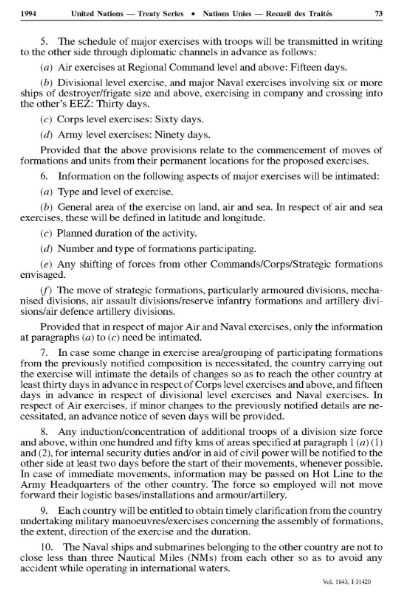
- Details such as type and scope of the exercise, location (with geographic coordinates for air and naval operations), duration, and participating units must be shared in advance.
- Any changes to previously notified exercises must be communicated at least 30 days in advance for corps-level or above, and 15 days for divisional-level or naval drills.
- Emergency troop movements (e.g., for internal security) within 150 km of the border must be notified at least two days in advance or immediately via military hotline if urgent.
- Operational Conduct:
- Military aircraft must maintain at least a 10-kilometer distance from the other’s airspace, except under agreed conditions for certain bases.
- Buzzing of ships or submarines in international waters was strictly prohibited.
- Naval vessels were not allowed within 3 nautical miles of one another.
- Supersession and Ratification:
- This agreement replaced previous bilateral understandings related to military activities near the border.
- It came into force once both countries exchanged instruments of ratification.
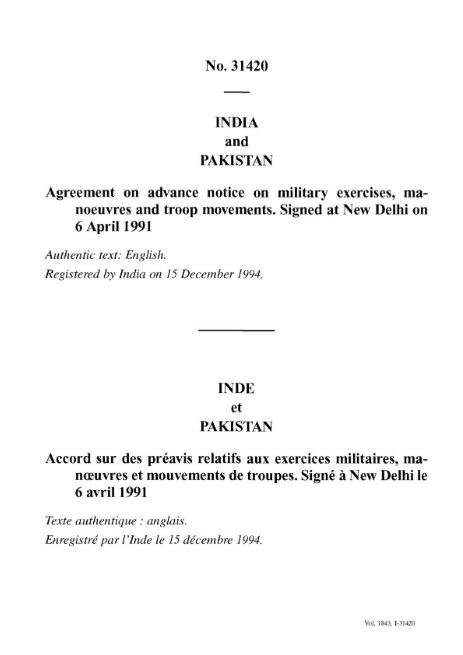
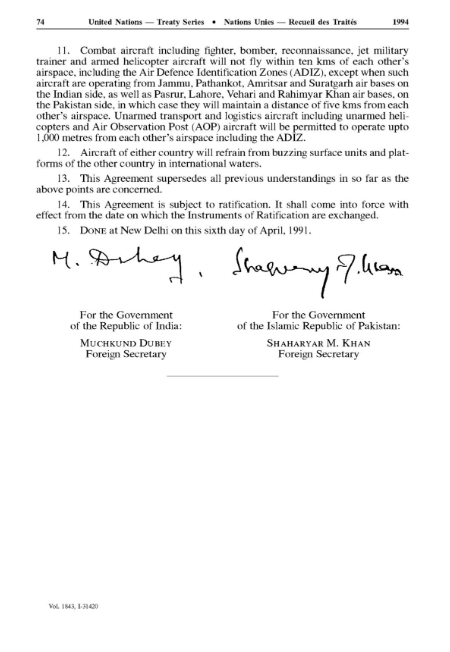


The 1991 agreement highlights that prior notification of troop movements between India and Pakistan was a policy supported by a Congress-backed government. Yet, in a seemingly contradictory stance, Congress leader Rahul Gandhi conveniently accuses the current government of committing a “crime” by allegedly informing Pakistan ahead of military action. However, if such transparency is now being labeled a crime, it raises questions about the Congress party’s own role in authorizing a similar policy in the past.
Rahul Gandhi's remote control is in Pakistan!
There is a pattern to Rahul wanting India to share operational details with Pakistan.
His party supported govt in 1991 had signed an agreement with Pakistan in 1991 to share information of troope and military movement with Pakistan… pic.twitter.com/pzIoquJfWN
— Pradeep Bhandari(प्रदीप भंडारी)🇮🇳 (@pradip103) May 23, 2025
Subscribe to our channels on Telegram, WhatsApp, and Instagram and get the best stories of the day delivered to you personally.