


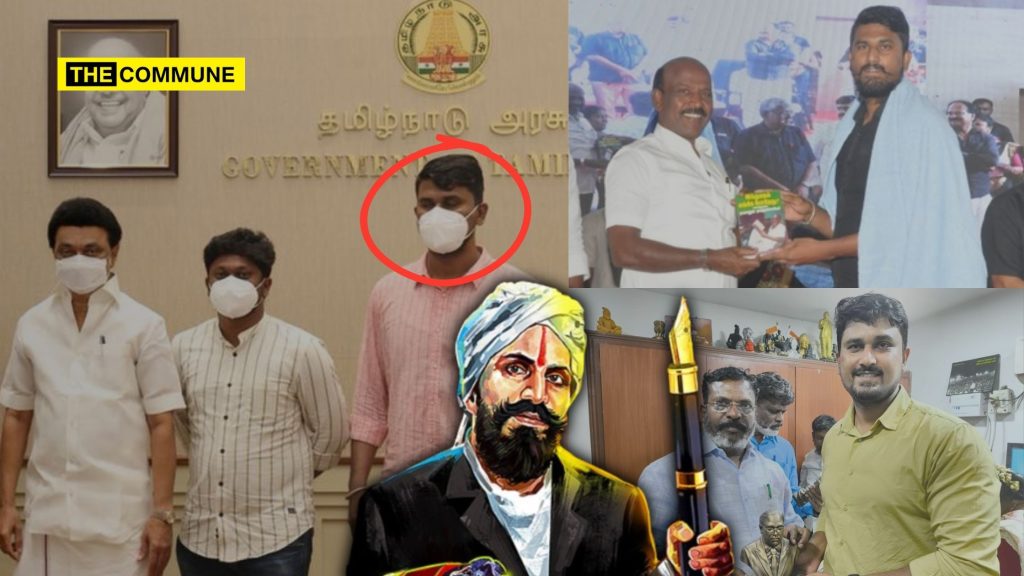
The recent resurfacing of a vile monologue by a Dravidianist YouTuber, known as “Minor” of the U2 Brutus YouTube channel, is a damning indictment of how the Dravida Munnetra Kazhagam (DMK) ecosystem actively enables, legitimises, and rewards systematic denigration of Hindu faith and icons, particularly Brahmins while pretending to occupy the moral high ground of rationalism and social justice.
Calling Bharathiyar A Coward, ‘Ganjakudiki’
In his videos, ‘Minor’ does not offer historical criticism or ideological disagreement. Instead, he descends into gutter-level slander against Subramania Bharathi, one of India’s most revered nationalist poets. Bharathiyar is mocked as a ‘ganja addict’, a ‘coward who trembled at the sight of khaki’, and a hypocrite on women’s emancipation. His revolutionary poetry is reduced to intoxicated hotel-bill rage, his courage to farce, and his ideals to fraud.
He says, “Bharathiyar is a ganjakudiki (ganja addict), and this fellow (Seeman) is a OC (free) drinker. Both of them match correctly. Nivedita asks “What Subramani? You have come alone? Did you not invite everyone at home and bring them? You are a big women’s empowerment hero, right? Did your wife not come? Did your mother, elder sister, younger sister, uncle’s wife, aunt, mother‑in‑law, sister‑in‑law, all of them not come?’ he was asked so. ‘No, no, all that is just empty talk, bro; you are expecting actions. You are talking here the way it is in your country. In our house we will not allow all that. According to them, beyond a certain point, women are like “pathinis” (chaste wives).’ This is what Bharathiyar has spoken. For us, even Bharathiyar is a salli (cheapo). Bharathiyar is a (sappa) useless piece; Who is this Seeman for us?”
Further denigrating Bharathiyar, Minor says that Bharathiyar wrote “Accham Illai Accham Illai Achham Enbadhillaiye” (No fear no fear, there’s no fear at all) when he was ‘hiding’ in Pondicherry ‘fearing’ arrest by British. “Think and see: while he was writing that, if the police had come there, how would he have reacted?”, he says.
He also goes below the belt to slander saying that Bharathiyar would get so afraid that he would piss in his pants. “Ticket examiners, inspectors will get in and get down, passengers will get in and get down. When the train stops and someone gets in, Bharathi would get terribly, terribly scared; he would shiver and tremble all over, it seems. He would keep watching: ‘Ayyo, who is coming? If by chance someone in khaki uniform climbs in, that’s it, everything is finished.’ It would be like that whole carriage has been sprayed with cold water, like how our Vadivelu is bathed in that comedy scene. ‘Hey, why is it stinking! I thought it would get camouflaged with the water flow’ – like that scene you have seen in the film. In that way, that whole carriage would feel like it had been soaked and stinky. Good thing nobody in khaki shirt got in.”
Further denigrating him, he says “You would have seen the film ‘Pudhupettai’. You would’ve seen how Dhanush travels in that right? Afraid that someone might see him, he sits near the bus window and travels. You would have seen him sitting like that, right? Like that, until he (Bharathiyar) got down from that train, he travelled in fear. This is not something that we are saying, Chellamma: his wife has recorded this.
Adding to the slander he says ‘If there is no food for a single man, we will destroy the whole world’ — do you know when he actually wrote that? Actually, when he was hiding in Pondicherry, after “Savukku” Shankar supplied him nicely with good stuff to smoke, you know after blowing well, you feel hungry. People who take ganja will say, ‘After smoking ganja, you will feel terribly hungry.’ After rolling it well and smoking well, in that hunger he must have gone to a hotel in Pondicherry and eaten. When he came out, the shop owner was sitting on a stone. He will ask for money, right? He will give the bill, right? The moment he gave the bill, the leader got angry in that intoxicated state, and then he said, ‘If there is no food for a single man, we will destroy this world.’ That era’s Kishore K Swami is exactly Bharathiyar, no one else. You are following one Kishore K. Swami, right?”
#காமராஜரை தொடர்ந்து, பாரதியாரை இழிவாக பேசும் #திமுக கூட்டம்!#கருணாநிதி தவிர யாரும் தமிழகத்தின் அடையாளமாக இருக்க கூடாதுனு திட்டம் போட்டு செயல்படுறானுங்க!😡🖤❤️ pic.twitter.com/w7ftjzUzNZ
— Praveen Kumar G.L💚🧡 (@praveen_kgl) December 18, 2025
Continuous Hate Propaganda Against Bharathiyar
In a recent speech, he is seen peddling lie after lie about Bharathiyar and quoting random documents and articles. Let us take a look at his lies one by one.
On “சாதிகள் இல்லையடி பாப்பா” (There are no castes, dear child), Minor says that “Bharathiyar did not write “சாதிகள் இல்லையடி பாப்பா” (There are no castes, dear child).”
He says he allegedly wrote “சாதி பெருமை இல்லையடி பாப்பா” (There is no caste pride, dear child). The version “சாதிகள் இல்லையடி பாப்பா” is claimed to be a printing error introduced in 1917 by Nellaiyappar Press. According to Minor, the original poem was published in 1913 in Gnana Bhanu magazine as “சாதி பெருமை இல்லையடி பாப்பா”. The 1915 March collected edition (pages 287–288) allegedly also carries “சாதி பெருமை”.
Therefore, Minor claims that Bharathiyar accepted the existence of caste but opposed only caste pride.
On Bharathiyar being a caste-abolition leader
Minor says, “Writing a few anti-caste lines does not automatically make Bharathiyar a caste-abolition leader. You cannot elevate someone to the status of a full social justice warrior only on that basis. Bharathiyar is excessively glorified as a radical reformer without proportional evidence. There were reformers in the same period who spoke far more sharply and extensively on caste”
On Bharathiyar’s alleged references to Paraiyars
Minor alleges that Bharathiyar used the term “ஈனப் பறையர்கள்” (“low/ignoble Paraiyars”). Minor claims this shows derogatory language toward Paraiyar communities. He cites Ayothithassa Pandithar as having directly questioned Bharathiyar on this usage.
Minor adds, “If Bharathiyar had written “low Brahmins,” Brahmins would never accept it. Then why should Paraiyars accept being described that way? Anger from Paraiyar communities toward Bharathiyar is therefore justified. Celebrating Bharathiyar ignores this insult.”
On Bharathiyar and Brahmin identity
Minor denies that Bharathiyar is criticised only because he was a Brahmin. He insists, “Bharathiyar is not criticised merely because he was a Brahmin. However, he never fully detached himself from a Brahminical worldview. His writings do not dismantle caste structure at the root. He retained caste consciousness even while speaking about equality.”
On Bharathiyar and Hindu scripture (Vedas)
On this, Minor says, “Bharathiyar lamented that the British did not respect the Vedas. He feared that foreigners would insult Vedic texts. He portrayed this as a civilisational loss. But British rejection of Vedas enabled education, rights, and reforms. Bharathiyar seeing this as a tragedy shows attachment to Vedic authority. This places him closer to religious orthodoxy than liberation politics.”
On Bharathiyar’s portrayal of “foreigners”
Minor claims Bharathiyar reportedly used the term “மிலேச்சர்” (Mleccha / barbarian / foreigner) for the British. He says, “Bharathiyar referred to the British as “mlecchas” (foreign barbarians). He framed them as a threat to civilisation. This framing mobilised people through fear. It did not focus on dismantling internal caste oppression.”
On Bharathiyar and beef / cow symbolism
Minor claims Bharathiyar portrayed cow slaughter as a civilisational danger. He says, “Bharathiyar warned that foreigners would slaughter cows. He portrayed cow slaughter as a civilisational danger. This reflects hostility toward beef consumption. Beef was historically consumed by Dalits and Muslims. Bharathiyar showed no sensitivity to those communities. His rhetoric positioned them implicitly as cultural outsiders.”
On Bharathiyar and temple destruction rhetoric
Bharathiyar wrote lines warning that temples would be destroyed by foreigners, says Minor. He adds, “Bharathiyar warned that temples would be destroyed by foreigners. This was used to instil fear and mobilise people. It is fear-based politics, not social reform. This mirrors later Hindu mobilisation narratives.”
On Bharathiyar’s selective praise of historical figures
Minor claims Bharathiyar was selective in his praise of historical figures. He says, “Bharathiyar wrote extensively praising Shivaji. He did not write poems praising Kattabomman, Maruthu brothers, Tipu Sultan, VO Chidambaram Pillai, When praising Shivaji, Bharathiyar focused on military strength and kingdom. He did not highlight Shivaji’s humiliation by Brahmins. He did not present Shivaji as an oppressed Shudra. This reflects ideological selectivity.”
On Bharathiyar vs Periyar/Ambedkar
Minor claims Bharathiyar never attacked Hinduism’s internal hierarchy. He says, “Bharathiyar never attacked Hinduism’s internal hierarchy. He never challenged the Vedas. He never attacked Manusmriti. He never questioned the religious foundations of caste. His anxiety resembles Savarkar’s—uniting Hindus against outsiders. Periyar and Ambedkar attacked internal oppression; Bharathiyar did not.”
On how Bharathiyar should be treated today
Minor says, “Bharathiyar is not sacred. Bharathiyar can and should be criticised. No leader is beyond criticism. If any of these claims are proven false with evidence, correction is possible. Counter-books and evidence are invited.”
It is these kind of people that the DMK government praises and felicitates. Remember in 2022, at a Dravidar Kazhagam–aligned event, Minor was felicitated alongside other ideologically aligned YouTubers and presented with an idol of EV Ramasamy. The event carried political legitimacy because it was endorsed by a serving DMK minister Ma. Subramanian.
This matters because Bharathiyar is not just a poet. He is the symbol of Tamil self-respect, linguistic pride, anti-colonial resistance, and social awakening. He wrote in Tamil when English education was the elite norm. He sang of women’s liberation, national freedom, and spiritual confidence when submission was fashionable. DMK politics routinely appropriates this Tamil pride—while honouring someone who tears Bharathiyar down using gutter language.
The message is unmistakable: Celebrating Tamil is acceptable only when it fits Dravidian orthodoxy. A Tamil icon who does not fit that frame can be mocked, defamed, and erased.
This pattern does not stop with Bharathiyar. The same YouTuber publicly abused Lord Shiva, mocked Goddess Kaali, vulgarised the Nataraja form of Chidambaram, said Vedas had porn and insulted temple priests. None of this triggered moral outrage within the DMK ecosystem. Instead, the offender was elevated.
The contrast is revealing. Others have faced police action, arrests, and even preventive detention for far less, sometimes for content involving Hindu deities that did not align with party ideology. Here, open abuse was not merely tolerated but rewarded.
Subscribe to our channels on WhatsApp, Telegram, Instagram and YouTube to get the best stories of the day delivered to you personally.