


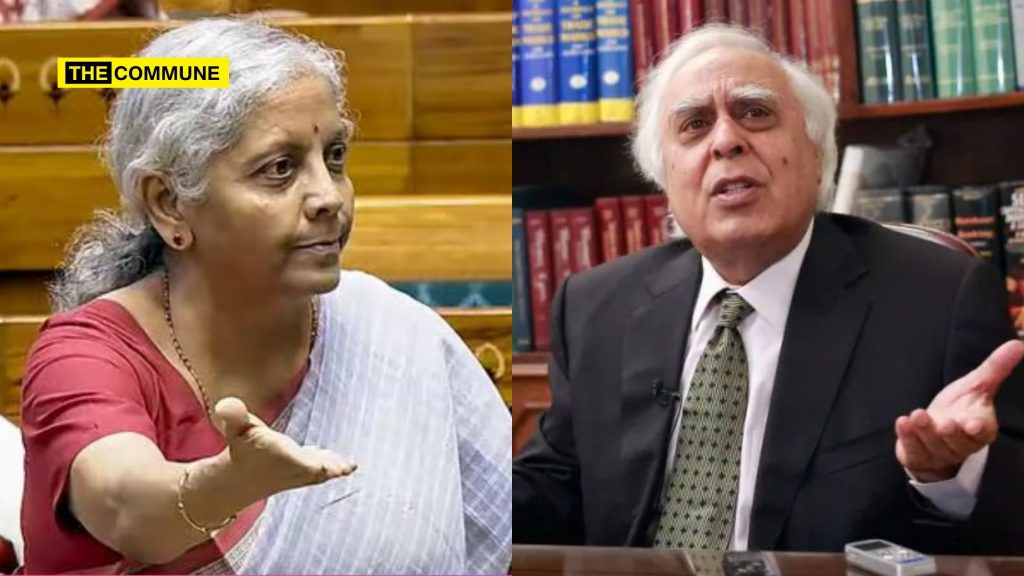
A heated debate erupted in Parliament as Union Finance Minister Nirmala Sitharaman and Law Minister Kiren Rijiju clashed with senior Congress leader Kapil Sibal over the management of Waqf and Hindu temple properties. The discussion, which took place during a session on amendments to the Waqf Board laws, saw Sitharaman delivering a sharp rebuttal to Sibal’s claims, leaving the veteran lawyer visibly cornered.
Sibal’s Claims on Waqf vs. Temple Lands
Kapil Sibal, while opposing a bill related to Waqf properties, argued that Hindu temples possess significantly more land than Waqf boards. He cited figures from Tamil Nadu, Andhra Pradesh, and Telangana, claiming that Hindu religious institutions hold nearly 10 lakh acres, compared to Waqf’s 8 lakh acres. He said, “First, let us understand a fundamental point: I own property. Whether I am Hindu, Muslim, Christian, or Sikh, if I wish to donate my property to charity, who can stop me? No one. Yet, the law being proposed restricts this right. Historically, non-Muslims also had the right to create Waqf. However, amendments in 1954 and 1995 stated that only Muslims could create Waqf. This restriction was removed in 2013, but now, this bill seeks to reinstate the same restriction, allowing only Muslims to create Waqf. I want to cite historical legal precedents:
- In the 17th century, Hindu zamindars allowed Muslims to create Waqf within their territories.
- In Arur Singh vs. Badar Dan (Lahore case), the court upheld the right of a Hindu to create Waqf for a Muslim graveyard.
- After independence, the Nagpur High Court also upheld the right of non-Muslims to create Waqf.
Yet, now, we are regressing. Our Prime Minister often speaks of “One Nation, One Law.” If we truly believe in this principle, how can we justify a law that says only Muslims can donate property to Waqf? This law is neither secular nor just. If I want to donate my property to charity, why should I be stopped? This is my property, my choice. The state has no right to dictate how I use it. If we truly want One Nation, One Law, then this restriction must be abolished.
He then started comparing Hindu temple property with that of Waqf. He said, “Naddaji spoke about the vast Waqf properties in India. But let me tell you the real numbers. Hindu religious institutions in Tamil Nadu, Andhra Pradesh, and Telangana alone own:
-
- 4.47 lakh acres in Tamil Nadu
- 4.65 lakh acres in Andhra Pradesh
- 87,000 acres in Telangana
- Tirumala Tirupati Devasthanam (TTD) alone holds 723 acres
In total, in just four states, Hindu temples control nearly 10 lakh acres of land. Yet, you only highlight Waqf properties, which cover 8 lakh acres nationwide. Why this selective concern?”
Sibal then claimed it was the government that had control over Waqf Boards. He said, “Another issue in this bill is the government’s total control over Waqf Boards. Earlier, these boards included MPs, Supreme Court and High Court judges, and civil servants. The Chief Executive Officer (CEO) of the board was a civil servant, and the government could issue directives to the board. Now, the government has superseded these provisions and taken full control. If the previous system was functioning, why dismantle it? If any wrongdoing occurred, it was under the government’s watch anyway.”
Sitharaman’s Sharp Rebuttal
Nirmala Sitharaman swiftly countered Sibal’s argument, pointing out that Hindu temples are already under government control, unlike Waqf properties. She said, “There are 1 or 2 points on which I want to give clarification as much as the Minority Affairs minister says, we are talking to a senior legal luminary so I humbly submit if I heard him right, hon’ble member. In Tamil Nadu or in Andhra, and he also took the name of the Tirumala Tirupati Devasthanam. In all this, the HR&CE is with the government. Government appointed people monitor it., they execute it, they run it. Second, in TTD, the Executive Officer is appointed by the government of Andhra Pradesh. The Endowment Board has people are appointed by the government of Andhra Pradesh and the entire system is completely under the government of Andhra Pradesh. So it is not as if Hindus are not being touched at all, only Muslims are.. no! There is a huge, in fact, it has led to a lot of feeling that Hindu pilgrims have started feeling that only our temples are being completely controlled by government and government-appointed men. It is leading to a lot of confusion among Hindu pilgrims and its a matter of concern for all religions,” highlighting that Hindu devotees have long raised concerns about government interference in temple affairs.
In Tamil Nadu, HR & CE (Hindu Religious and Charitable Endowments Department) is with the state government. Government-appointed people monitor it, they execute it and they run it.
In the Tirumala Tirupati Devasthanam, the executive officer is appointed by the Government of… pic.twitter.com/jTSZ5WVq89
— Nirmala Sitharaman Office (@nsitharamanoffc) April 3, 2025
Subscribe to our channels on Telegram, WhatsApp, and Instagram and get the best stories of the day delivered to you personally.