


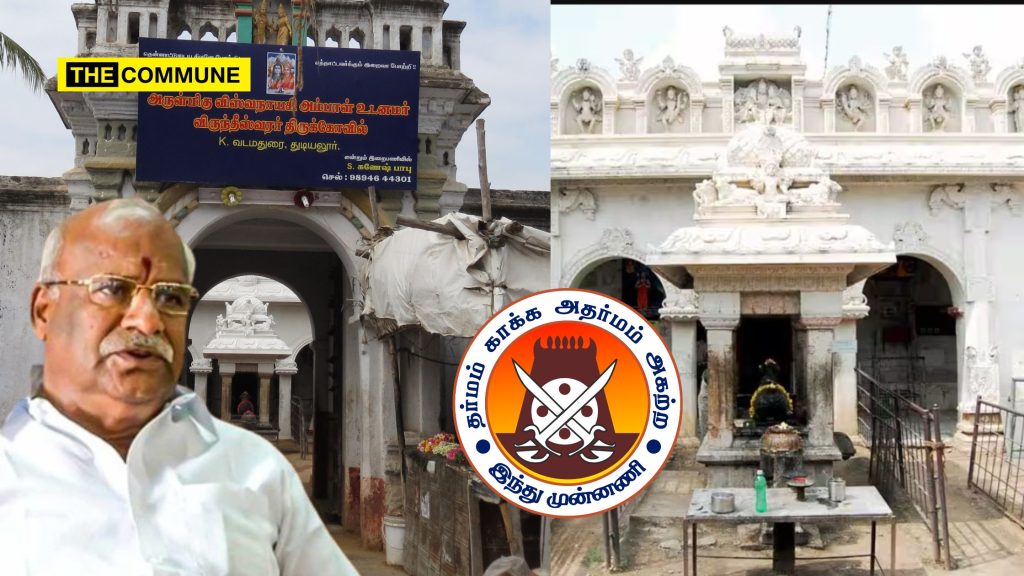
Hindu Munnani State President, Kadeshwara C. Subramaniam, has strongly opposed the restriction on playing traditional musical instruments in temples governed by the Hindu Religious and Charitable Endowments (HR&CE) Department. He emphasized that this move, which undermines the rich cultural and artistic heritage of the Tamil people, must be reversed immediately.
In his statement, Subramaniam referred to the historic Virundeeswarar Temple in North Madurai, a significant religious site in Coimbatore. Known as a sacred place where Lord Shiva is believed to have delighted his followers, this temple has a long-standing tradition of incorporating musical instruments such as the Shiva vadyam and Kailaya vadyam into its rituals.
However, a new notice has been displayed at the temple banning instruments such as the horn, urumi, conch, drums, jamab, and others typically associated with Shiva worship. This decision has stirred outrage among devotees, who view music as an integral part of their spiritual practice — from waking the deity with devotional sounds to offering music during night rituals.
Subramaniam criticized the HR&CE Department, accusing it of failing in its duty to uphold and promote the cultural traditions it is meant to protect. He expressed concern that a systematic erosion of Tamil Nadu’s traditional arts is underway. Forms like Silambam, Karagattam, Oyilattam, Nadaswaram concerts, and ancient temple music traditions are slowly vanishing, replaced by influences from Western culture with the HR&CE Department allegedly playing a part in this decline.
Historically, temples served not only as places of worship but also as cultural hubs where the arts were nurtured. Many temples were equipped with special halls for devotional music, dance, and singing, such as those still visible in places like Srirangam, Madurai Meenakshi Amman Temple, Rameswaram, and Tiruchendur. These spaces were created by the kings and ancestors of Tamil Nadu to preserve and promote the arts.
Unfortunately, under HR&CE management, these structures have become inactive and neglected, no longer serving their intended purpose. At the same time, despite drawing revenue from temple activities, the Department reportedly fails to address the basic needs and facilities required for temple operations, while also interfering with religious traditions and rituals.
Subramaniam recalled previous instances of such interference, two years ago, musical instruments were banned at the Palani hill temple, and last year, the chanting of “Om Namah Shivaya” in unison was halted at the Kapaleeswarar Temple in Chennai. These actions, he noted, have deeply disturbed spiritual communities.
He also raised concerns over the double standards questioning whether similar intrusions would be tolerated in the worship practices of minority religions, and whether the so-called “Dravidian model” government has the right to alter longstanding Hindu temple customs.
Traditional Tamil devotional singers, who once recited the Thevaram and Thiruvasagam hymns in temples, are now rarely seen, and no support is extended to them by the authorities. Subramaniam accused the Tamil Nadu government of systematically dismantling the cultural fabric of Hindu temples and urged a reversal of this approach.
He concluded by stating that Tamil Nadu, a land rich with musical devotion and temple traditions, must not allow ancient musical practices to be silenced. On behalf of the Hindu Munnani, he demanded that the HR&CE Department not only revoke the instrument ban at the Virundeeswarar Temple in Coimbatore but also uphold and respect these sacred traditions across all temples under its administration.
His full statement read, “Ban on musical instruments in temples under the HR&CE Department! The action, which seeks to destroy the traditional music and arts of Tamils, must be stopped immediately.
A statement from Hindu Munnani State President Kadeswara C. Subramaniam
The ancient Virundeeswarar Temple is located in Vadamadurai, a key area of Coimbatore city. It is called the Vrintheeswarar Temple as it is believed to be a sacred site where Lord Shiva hosted his devotees. It is a tradition to play Siva Vadyam and Kailaya Vadyam during the temple’s worship services from its very beginning. Currently, a notice board has been placed in that temple. It states, Musical instruments like kombu, murasu, urumi, sangu, parai, jamap, Siva Vadyam, and Kailaya Vadyam are not permitted inside the inner sanctum halls by Temple Administration. Hindu devotion is intrinsically linked with music. The traditions of invoking God and putting him to sleep with music continue to this day. It is heartbreaking that the Hindu Religious and Charitable Endowments (HR&CE) Department, which should be cherishing and nurturing these traditions, is instead destroying them.
The public and devotees were shocked to see the notice that musical instruments will not be allowed at the Vrintheeswarar Temple, which is under the HR&CE Department.
Generally, many famous ancient arts in Tamil Nadu are dying out. It is painful to see that hundreds of arts, including Silambattam, Karakattam, Oyilattam, Nadaswaram concerts, and Siva Vadyam are gradually disappearing and Western culture is being introduced, and the HR&CE Department is complicit in this. Our ancestors used temples as places to nurture the arts precisely to protect these traditions. Many famous large temples had separate halls to promote singing, playing musical instruments, and Bharatanatyam. Even today, such halls can be seen in temples like Srirangam, Madurai Meenakshi Amman Temple, Rameswaram, and Thiruchendur. However, since the HR&CE Department began managing the temples, the halls built by our kings and ancestors to nurture the arts have become mere exhibits, with no events taking place in them.
On one hand, the HR&CE Department takes the temples’ income, but it makes no effort for their basic development or administrative convenience. On the other hand, incidents of violating the temple’s Agama rules and inconveniencing devotees with a darshan fee continue. In addition, ancient traditions are being destroyed by interference in temple worship practices.
Two years ago, the HR&CE administration banned the playing of musical instruments on the Palani hill. Last year, the temple administration at Chennai’s Kapaleeswarar Temple stopped devotees from collectively chanting the mantra “Om Namasivaya.” Such incidents have profoundly shocked spiritual seekers. The people’s question is whether the Dravidian model government, which is systematically destroying Hindu temple traditions one by one, can interfere with the religious rights and customs of minorities. Odhuvars, who sing Thevaram and Thiruvasagam, are not seen in many temples now. The HR&CE Department does not provide facilities for them.
The Tamil Nadu government, which is trying to destroy the traditions of Hindu temples one by one, must change its course. It is an unacceptable action to ban the playing of ancient and revered instruments in temples in Tamil Nadu, a land filled with sacred sites celebrated in songs by sivanadiyars and where God was found through music. On behalf of the Hindu Munnani, we request that the existing practices in the Coimbatore Virundeeswarar Temple and all other temples under the HR&CE Department not be changed and that musical instruments not be banned.”
Subscribe to our channels on Telegram, WhatsApp, and Instagram and get the best stories of the day delivered to you personally.