


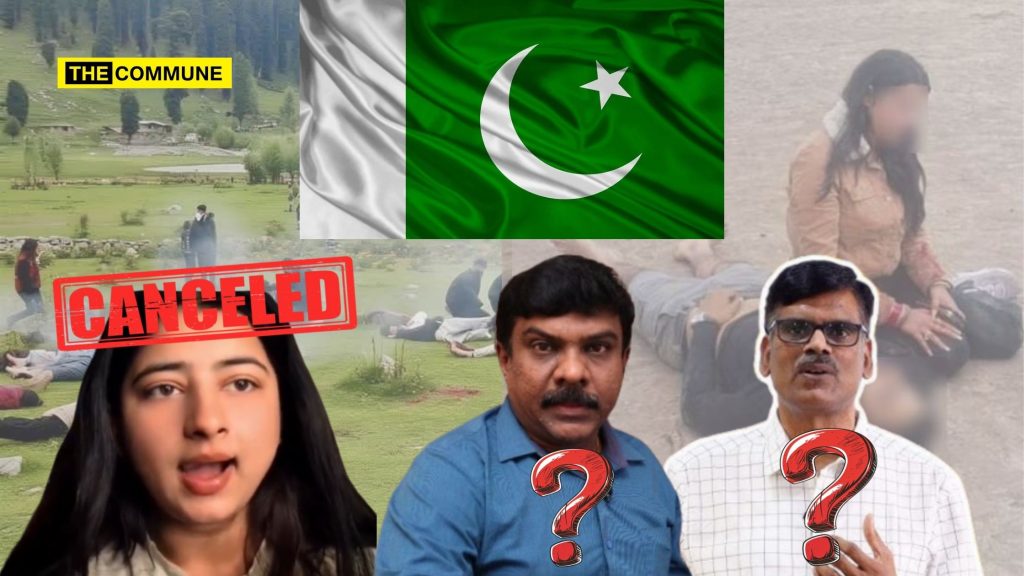
In a major crackdown on anti-India propaganda, the Government of India has blocked 16 Pakistan-based YouTube channels and withheld access to few Indian accounts found amplifying Pakistan’s narrative after the Pahalgam terror attack.
Based on recommendations from the Union Home Ministry, the Modi government banned prominent Pakistani news channels and YouTube outlets — including Geo News, Dawn, Bol News, ARY News, Samaa TV, Raftar, and Suno News. These channels, collectively boasting over 63 million subscribers, were reportedly disseminating inflammatory content, spreading disinformation about India, and attacking the Indian Army and security agencies.
In addition to targeting Pakistani propaganda channels, the GOI also acted against domestic influencers found echoing similar narratives. Notably, the Instagram account of Shreshtha Jha (@shesh_diaries) — who had over 1.8 million followers, mostly Indian — was withheld after she accused the Indian government of orchestrating the Pahalgam attack.
Her name is Shreshtha Jha a Pea-brained girl,she is a big Influencer in Instagram even many RW folks follow her & trust her blindly,but now she is showing her true colours.Many people say that she is a Hindu atheist but then she follows Darul Islam pages. pic.twitter.com/Z4gCYdaYdp
— Anshul Pandey (@Anshulspiritual) April 27, 2025
This girl on Instagram named Shreshta Jhaa (@/shesh_diaries) is openly accusing the Government of India of planning the Pahalgam Terrorist attack. She’s accusing the Government of India of killing its own innocent people. @MIB_India @AshwiniVaishnaw @DelhiPolice care to act? pic.twitter.com/sapD0xsStQ
— Madhur (@ThePlacardGuy) April 25, 2025
>This is Shrestha Jha
>She had 1.8 million followers
>Her 95% followers are Indians
>She used to earn 2 Lakhs/month through monetisation/brand promotion/advertisements
>She said Terrorism has no religion to please her Bulla bf
>Her account is banned in India
>She loses her only… pic.twitter.com/U3niJYMx6l— Hindutva Knight (@HPhobiaWatch) April 28, 2025
Her posts, many of which allegedly circulated on Pakistani media, directly blamed India for the killings carried out by Islamic terrorists from The Resistance Force, an offshoot of Lashkar-e-Taiba.
Jha’s account takedown signals a broader shift in policy: the government is no longer limiting action to foreign sources of disinformation, but is moving against Indians who serve as domestic amplifiers of Pakistan’s propaganda.
Such posts not only insulted the victims of the Pahalgam massacre — where Hindus were specifically targeted — but also undermined national security at a critical time.
While the crackdown on Pakistani news outlets and social media propagandists has been welcomed by many, questions are now being raised as to when the government extend similar action to Tamil YouTubers and other regional influencers within India who are spreading identical anti-India narratives in local languages?
The Commune had reported on a few such channels which have been peddling an anti-India narrative and blamed the centre for the horrendous attack.
One notable example is Senthil Vel, who runs the Tamil Kelvi YouTube channel and former anchor for the Tamil news outlet Maalai Murasu. He controversially questioned why those calling the Pahalgam terrorists “Muslims” don’t also label espionage suspects arrested in India as “Hindus.” Another channel, Arakalagam, echoed this exact sentiment, further fueling confusion and deflection.
Claiming to expose links between BJP members and terrorism, Vel’s video quickly derailed into misinformation and casteist rhetoric. He cited outdated or misrepresented cases, such as Lashkar-e-Taiba terrorist Talib Hussain Shah—who was Muslim, not Hindu as implied—and espionage cases involving individuals from various backgrounds, falsely branding them as examples of “Hindu terrorism.”
Vel’s monologue, laced with hardline Dravidianist bias, included a caste-based attack on Brahmins, reflecting the deep-rooted animosity common in such circles. He leaned heavily on reports from known Congress sympathizers like Dhruv Rathee and Alt News’ Mohammed Zubair, raising questions about credibility and selective outrage.
Attempts to link journalist Ved Pratap Vaidik’s meeting with Hafiz Saeed to Hindu terror ignored the broader journalistic context, especially considering Tamil Nadu’s own precedent of using interviews with criminals like Veerappan.
Ultimately, Vel’s effort to dilute the religious motivation behind attacks like Pahalgam — where Hindus were specifically targeted — by invoking espionage cases involving Hindus failed. His false equivalence between terrorism and espionage sparked public outrage, exposing the political desperation behind the narrative.
Another Dravidianist masquerading as a financial influencer, PR Sundar, pushed the same narrative as Senthilvel did. A Singapore-based Tamil Dravidianist and stockbroker, sparked outrage with a video posted after the 22 April Pahalgam terror attacks, in which he appeared to indirectly accuse the Indian Army of collusion with terrorists. Using a poetic allegory, Sundar insinuated that internal corruption allowed the attack to happen, deflecting blame from the terrorists and shifting focus onto the Indian establishment. He ridiculed the Indian military’s capabilities by citing aircraft crash statistics and invoking the “flying coffins” trope, using corruption scandals to further undermine trust in India’s defense forces.
Echoing leftist and Dravidianist narratives, Sundar also pushed the “terror has no religion” line, even though reports confirmed the Pahalgam terrorists specifically targeted victims based on their religion. Despite these facts, Sundar avoided condemning the Islamic extremist nature of the attack, choosing instead to mock India’s counter-terrorism and diplomatic efforts, such as cutting trade with Pakistan or halting the Indus Water Treaty. He labeled these measures as unjust punishments of Pakistani civilians, ignoring their role in enabling terrorism.
Sundar’s commentary closely mirrors other known anti-India voices like journalist Senthilvel, who downplayed the religious targeting and human cost of the attacks. Although Sundar claimed to speak from a place of neutrality and concern for India, his arguments reveal a consistent bias against the Indian government and armed forces, while excusing or minimizing Islamic terrorism. His narrative ultimately serves to erode national unity and distract from the core issue: the threat of radical extremism.
Rather than highlighting national security threats seriously, influencers like Senthil Vel and Sundar appeared more focused on reinforcing the DMK-Congress line, shielding Islamist violence from scrutiny while stoking caste tensions — a move seen by many as politicizing a grave national tragedy.
Subscribe to our channels on Telegram, WhatsApp, and Instagram and get the best stories of the day delivered to you personally.