The Bengal Files film has brought to focus some of the dark chapters of Indian history, especially the circumstances around the Direct Action Day. Videos/clippings of the interaction between Gopal Patha and Mahatma Gandhi regarding the 1946 Noakhali genocide of Hindus, women especially, in the film have gone viral. This brings us to the topic of how the attitude of the so-called “father of the nation” was towards Hindu women amid a genocide.
The non-violent formula of the great soul to avoid brutal r@pes, ‘take poison before submitting’.
Yes, that’s right. He doesn’t tell Hindu women to fight, resist, speak up. Just take poison ‘before submitting’!
What a father for a nation to have! pic.twitter.com/3Eclew2zMn
— Shefali Vaidya. 🇮🇳 (@ShefVaidya) September 8, 2025
In the scene, Gandhi is shown telling women to embrace death rather than resist sexual assault, advice that is now being widely circulated in the form of archival newspaper clippings and references from Gandhi’s own collected works.
Gandhi was a bigger enemy of Hindus than Muslims. Gandhi weakened the Hindu psyche.
The coward was not a Mahatma.#TheBengalFiles pic.twitter.com/473XL2TThx
— Kashmiri Hindu (@BattaKashmiri) September 6, 2025
The controversy stems from Gandhi’s statements made during the October 1946 communal violence in Noakhali and Tipperah districts of Bengal, where large-scale killings, forced conversions, rapes, and abductions of Hindus were carried out by Muslim League mobs demanding the creation of Pakistan. According to contemporary records, over one lakh Hindus were affected, with confirmed casualties crossing 285, though some estimates put the number in the thousands.
Faced with reports of women being abducted, raped, and forcibly converted, Gandhi did not call upon Hindu women to resist with arms or to organize for self-defense. Instead, he advised them to consider suicide as a way of preserving their “honour.”
In his collected writings, later published under the title My Non-Violence, Gandhi is quoted as saying: “They ought to learn to die before a hair of their head could be injured… It was possible for a woman to put an end to herself by choking or biting the tongue. The only way known to medicine for instant self-immolation was a strong poisonous dose. If this was so, I would advise every one running the risk of dishonour to take poison before submission to dishonour.”
He added that he “meant all he had said” and that “the very fact of steeling oneself for death before dishonour braced one for the struggle.” Gandhi also declared that when it came to choosing between killing oneself or the assailant, he had “no doubt in [his] mind that the first should be the choice.”
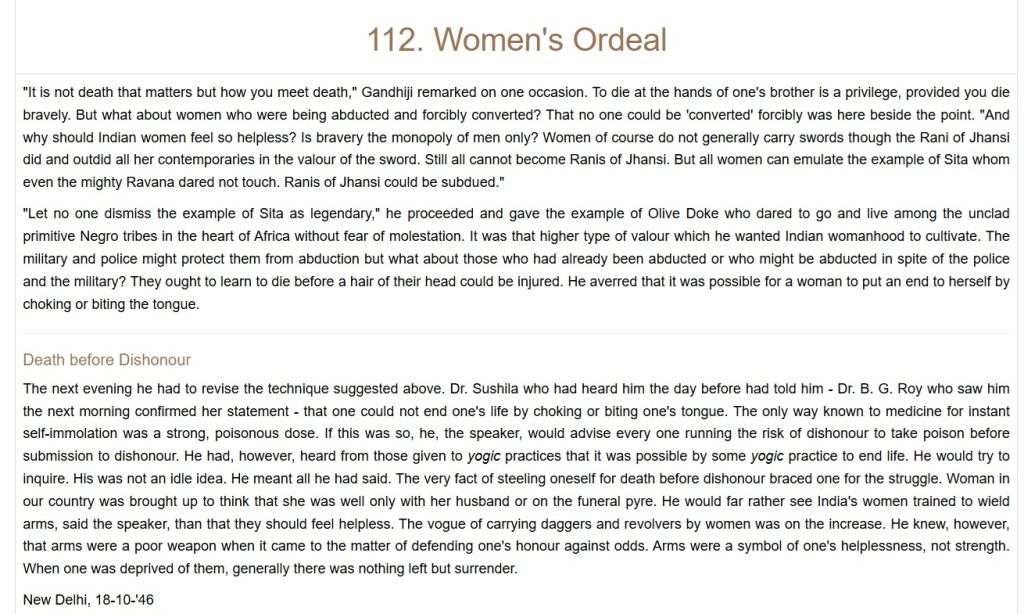
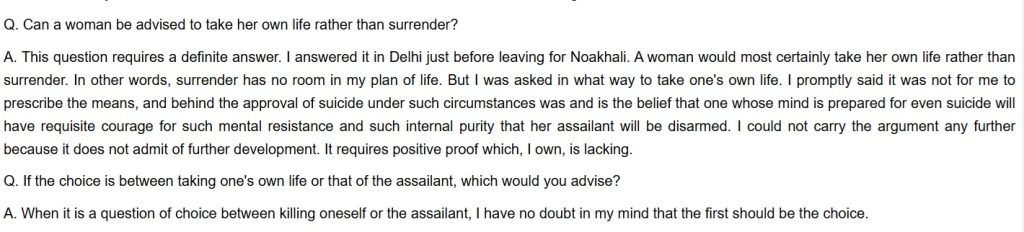
International press at the time captured this extraordinary advice. A New York Times report from late October 1946 ran with the headline: “Gandhi Urges Women To Take Poison”, noting that he was counseling Hindu women “running the risk of dishonor” during the Noakhali carnage to kill themselves rather than be violated.
Bengali historian Dinesh Chandra Singha, in his book 1946: The Great Calcutta Killings and Noakhali Genocide, corroborates this, recording Gandhi’s remarks delivered in his evening prayer meetings in Delhi before he set out for Noakhali. Gandhi reportedly told the gathering: “Self-immolation by taking poison was a better way out than surrender to dishonour.”
The book further notes that in some affected villages, Hindu women did in fact commit suicide by poison, fire, or hanging to avoid abduction and forced conversion. The Hindustan Standard at the time compared the tragedy to the Rajput tradition of jauhar — mass self-immolation by women in the face of invading armies.
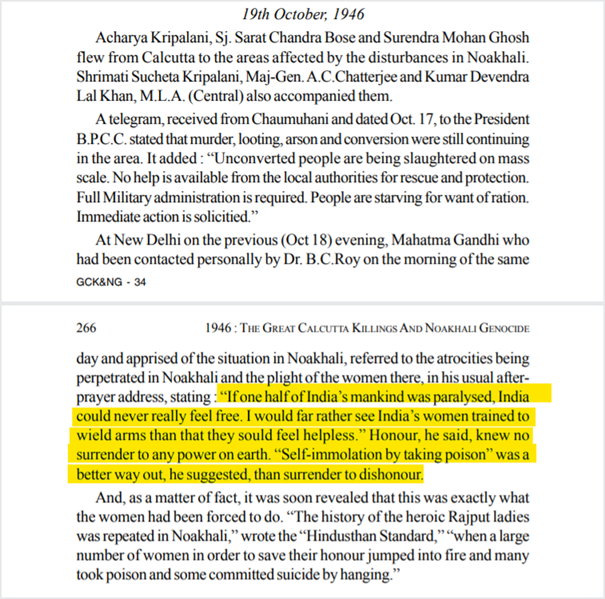
Critics argue that Gandhi’s stance, while framed in the language of “bravery” and “non-violence,” effectively denied Hindu women the right to resist, fight back, or demand protection. Instead, it reduced them to passive victims whose only “non-violent” option was death.
The resurfacing of these writings has shocked many modern readers, especially given Gandhi’s global reputation as an apostle of peace and justice. Social media commentary in the wake of The Bengal Files has been scathing, with users questioning how the “Father of the Nation” could advocate poison and suicide as a response to systematic sexual violence.
This episode adds to the long list of Gandhi’s controversial positions including his advice to Jews under Hitler to embrace suffering rather than resist, his experiments with chastity, and his appeasement of communal forces in the name of non-violence.
Subscribe to our channels on Telegram, WhatsApp, and Instagram and get the best stories of the day delivered to you personally.