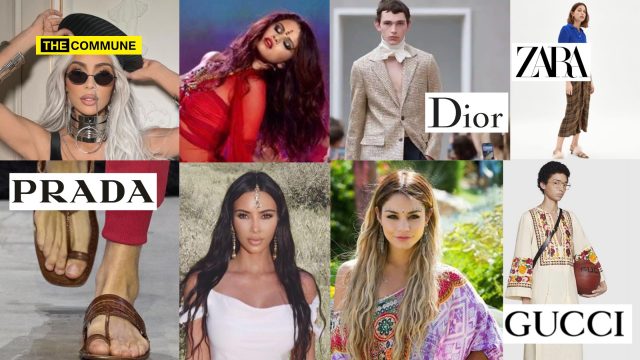
On 16 June 2025, during Milan Fashion Week, Italian luxury label Prada unveiled its Men’s Spring/Summer 2026 collection, which featured open-toe leather sandals that closely resembled Kolhapuri chappals – traditional handcrafted footwear from the Kolhapur district in Maharashtra, India. The striking similarity led to widespread criticism, particularly because Prada initially failed to acknowledge the Indian origin or the artisans behind the original design.
The controversy deepened when it was revealed that Prada’s version of the sandals was priced at approximately ₹1.2 lakh (around $1,400), a stark contrast to authentic Kolhapuri chappals which typically retail in India for between ₹1,000 and ₹4,000. This significant price markup, coupled with the lack of attribution, sparked anger among over 20,000 artisans from Kolhapur who felt their cultural legacy and craft were being exploited for commercial gain without due recognition.
Kolhapuri chappals just hit the Prada runway—at ₹1.16 lakh—with zero credit to India’s craftsmen.
These iconic sandals, handmade in Maharashtra for centuries, tell stories of tradition, resilience, and royalty. Yet, artisans still battle low profits and fading recognition.… pic.twitter.com/iZsdgndCW2
— The Better India (@thebetterindia) June 24, 2025
Kolhapuri chappals are unisex leather sandals renowned for their braided straps, detailed cutwork, and use of vegetable-tanned leather. Rooted in regional identity, these sandals have been crafted using traditional techniques passed down through generations and were granted a Geographical Indication (GI) tag on 11 December 2018, to protect their authenticity and origin.
Following the backlash, Prada issued a statement on June 28, 2025, acknowledging that the design was indeed inspired by traditional Indian footwear from Maharashtra and Karnataka. The company stated its commitment to responsible design, cultural sensitivity, and initiating meaningful dialogue with local Indian artisan communities.
Prada has publicly acknowledged that its Spring/Summer 2026 Milan Fashion Week sandals were inspired by India’s traditional Kolhapuri chappals, following strong backlash over the lack of initial credit.#Prada #KolhapuriChappal #Kolhapurichappals #MilanFashionWeek #Footwear… pic.twitter.com/8x2jF64vai
— Business Standard (@bsindia) June 28, 2025
This incident is not an isolated case. Over the years, there have been several instances of Indian culture being appropriated in global fashion and entertainment. From Western celebrities wearing bindis and nose rings without context, to the use of maang tikkas in stylized shoots, to yoga being repackaged devoid of its Indian roots, cultural borrowing has repeatedly crossed into appropriation, especially when done without respect or credit. Let’s take a look at few of them.
#1 Dior Faces Backlash for Not Crediting Indian Artisans For Mukaish Embroidery
Days after Prada’s Kolhapuri chappal controversy, Dior is under fire for failing to credit Indian artisans for intricate mukaish embroidery in a $200,000 coat from Jonathan Anderson’s debut collection. Fashion commentator Hanan Besnovic highlighted that the detailed metal-thread embroidery, native to Lucknow, was crafted by 12 Indian artisans over 34 days. The absence of acknowledgment has sparked criticism online, with users questioning the disparity in recognition and compensation.
$200K Mukaish Coat
How Dior “Stole” the Show with Indian CraftAfter Prada’s Kohlapuri controversy, French luxury brand Dior is facing backlash after unveiling a $200,000 coat featuring traditional Indian Mukaish embroidery at Paris Fashion Week. Despite reportedly employing 12… pic.twitter.com/bYOxKCrgaD
— Augadh (@AugadhBhudeva) July 6, 2025
#2 Kim Kardashian And The Nath
In 2022, Kim Kardashian found herself at the center of a cultural appropriation controversy. During Paris Fashion Week earlier this year, Kardashian and her daughter North West were seen wearing nose rings. The issue resurfaced when singer Lizzo wore a similar accessory at the MTV Video Music Awards, and a British publication credited Kim Kardashian with popularizing the trend.
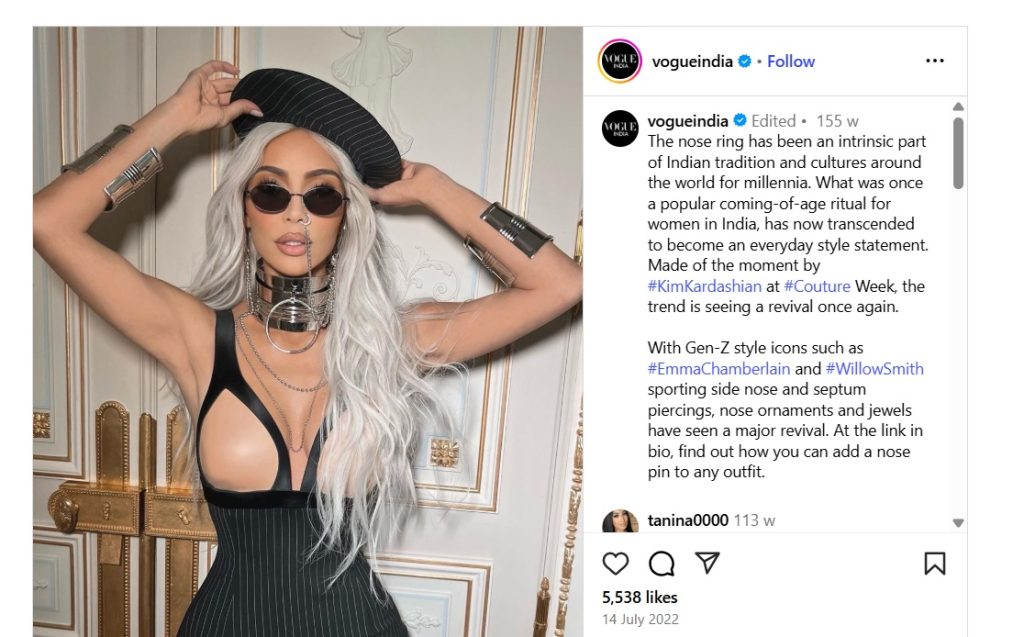
Although the article acknowledged the nose ring’s roots in Indian culture, it angered many Indian social media users, who pointed out that South Asian and African women have worn nose rings for centuries. Critics accused the publication of cultural insensitivity, saying traditional practices are often labeled “uncivilized” when worn by people of color but become fashionable when adopted by Western celebrities. While some defended Kardashian, arguing she didn’t intend to appropriate, most criticism was directed at the media for erasing cultural history and misattributing long-standing traditions.
#3 Gucci’s ₹2.5 Lakh ‘Kaftan’
In 2021, luxury fashion house Gucci drew backlash after listing a new “kaftan” for $3,500 (around ₹2.5 lakh), which many Indians pointed out looks identical to a traditional kurta. Social media users quickly mocked the pricing and mislabeling, with many sharing photos and sarcastic comments like, “I can get this for ₹500 from a local market.”
Gucci ladies Kaftan for 3500 dollars 😱
How much would u get almost same Kaftan in your local market? pic.twitter.com/QJzhbQ1paH— Pradeep Rawat🇮🇳 (@ThePradeepRawat) June 3, 2021
Critics also slammed Gucci for calling it a kaftan, despite its clear resemblance to a kurta, and for selling a common South Asian garment at an exorbitant price without cultural acknowledgment. Others joked about selling similar designs to Gucci or flying to India to buy dozens of such outfits for the same amount. This isn’t the first time a global brand has been accused of repackaging South Asian staples.
#4 Zara’s ₹5,700 ‘Mini Skirt’ That Looked Exactly Like a Lungi
In 2019, Zara’s design, a ₹5,728 ($89.90) “check mini skirt”, stirred a wave of mockery online for its uncanny resemblance to a traditional Indian lungi. Described as a “flowing skirt with draped detail,” the design immediately caught the eye of Indian X users, many of whom pointed out that similar lungis are sold for as little as ₹357. Users joked that Zara was simply rebranding Indian staples at luxury prices.
Western Muslims need to stop bringing American culture wars into Islam.
A White Muslim wearing a thobe to the masjid is not 'cultural appropriation.' True appropriation is when Zara sells a lungi made by Muslim sweatshop workers in Bangladesh to hipsters for $70. pic.twitter.com/7R3MY4Igza— شرقزده sharghzadeh (@sharghzadeh) April 23, 2021
The lungi, a common garment worn across South Asia, has also featured in pop culture – from Shah Rukh Khan’s Chennai Express to Kevin Spacey’s “lungi dance” at IIFA 2014. While Zara continued to enjoy celebrity endorsements, many questioned the ethics of turning everyday desi wear into overpriced high fashion without context or credit.
#5 Kim Kardashian Wears Maang Tikka to Sunday Service
In April 2019, Kim Kardashian sparked accusations of cultural appropriation after she wore a traditional Indian maang tikka to a Christian Sunday Service. In an Instagram post captioned “Sunday Service Vibe,” she appeared in a white off-shoulder gown accessorized with gold earrings, a cuff bracelet, and the maang tikka – a ceremonial hair ornament typically worn by Indian brides.
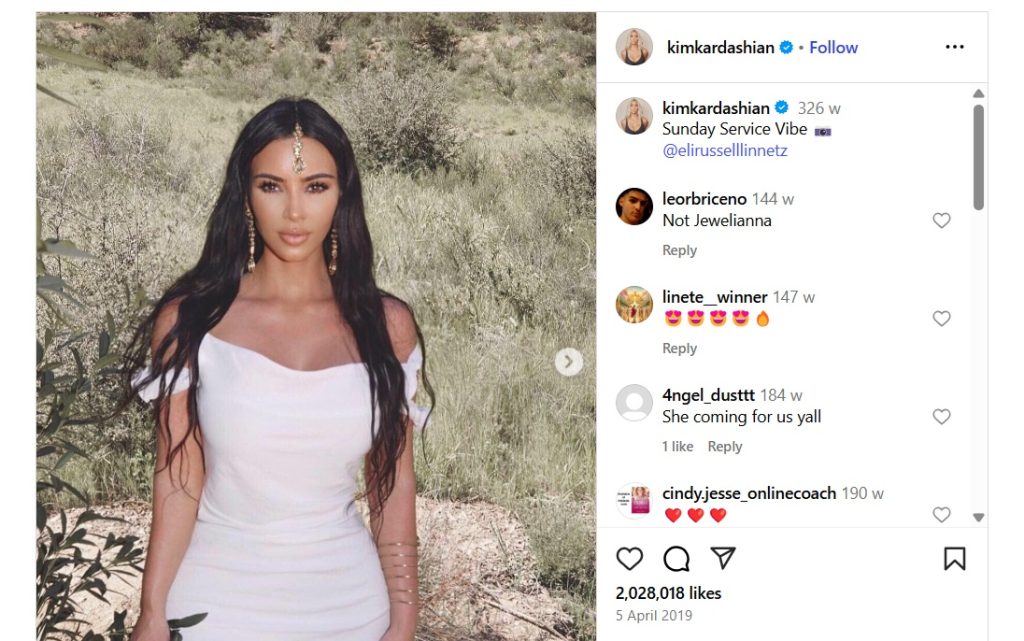
While some admired the look, many criticized it for being culturally insensitive, pointing out that the maang tikka holds deep cultural and religious significance in Indian weddings. Social media users also noted that white is traditionally worn during mourning in Indian culture, making the styling further inappropriate. Comments flooded her post, calling out the lack of cultural awareness and accusing her of using sacred symbols as mere fashion accessories.
#6 Coldplay and Beyoncé in “Hymn for the Weekend” Song Video
Coldplay’s 2016 music video for “Hymn for the Weekend,” featuring Beyoncé, was filmed in India and showcased vibrant colors, traditional clothing, Holi celebrations, temples, and religious imagery to present Indian culture. The director stated that the goal was to capture “the essence of incredible India.” However, the video faced backlash for portraying India as an exotic backdrop and was accused of reinforcing colonial stereotypes.
Many critics pointed out that the use of Indian visual elements was primarily for aesthetic appeal, without providing proper cultural or spiritual context. This led to accusations of cultural appropriation, as the video seemed to reduce complex cultural symbols to decorative props rather than representing them with authenticity and respect.
#7 Selena Gomez’s Bindi at Billboard and MTV Awards
Selena Gomez sparked controversy in 2013 for wearing a bindi during her live performance of “Come & Get It” at the MTV Movie Awards. The look included Bollywood-inspired choreography and traditional Indian aesthetics. Critics, including Rajan Zed, President of the Universal Society of Hinduism, condemned the performance for trivializing a religious symbol with deep spiritual significance. The bindi, traditionally worn on the forehead and symbolizing a third eye or spiritual focus, was viewed by many as reduced to a fashion accessory.
Hi, i will never forgive selena gomez for wearing a bindi and using hinduism to make a sexy music video. Bye pic.twitter.com/pEehmQ8iH5
— ArcticAngels✨ (@ArcticAngelss) May 1, 2018
The controversy resurfaced a month later when Gomez wore another bindi-accessorized outfit during her Billboard Music Awards performance.
Despite prior criticism, she repeated the look, prompting renewed backlash from Hindu leaders. Zed criticized Gomez for remaining insensitive to Hindu sentiments, emphasizing that Hindu symbols have defined meanings and should not be used casually for onstage dramatics.
#8 Vanessa Hudgens Appropriating Bindi at Coachella
Actress Vanessa Hudgens has also been criticized for incorporating Indian elements like bindis and henna tattoos into her Coachella outfits. This happened in 2014.
Vanessa Hudgens looked flawless at Coachella pic.twitter.com/SNerPlH2c4
— Stumbler Videos (@StumblerVideos) May 18, 2014
While intended as aesthetic choices, these accessories sparked backlash from those who felt that deeply cultural items were being reduced to fashion trends in a festival setting, often associated with oversexualization and frivolity.
Vanessa was earlier called out for appropriating other cultures such as wearing dreamcatchers on her hair and box braids.
#9 Iggy Azalea’s “Bounce” Video
In the music video for “Bounce,” Iggy Azalea dons saris, rides an elephant, and dances through an Indian wedding procession, attempting to recreate a Bollywood-inspired spectacle. However, the video was widely criticized for cultural appropriation and exoticizing Indian culture. Critics argued that Azalea reduced sacred and traditional Indian symbols to fashion accessories and entertainment props, devoid of context or understanding.
Wired magazine’s Bruce Sterling attempted to excuse the appropriation by comparing Azalea’s video to Kareena Kapoor’s “Hai Re Hai Re” from Khushi (2003), invoking a misplaced class analysis to defend Azalea’s background as a high-school dropout who used to clean hotels, as opposed to Kapoor’s Bollywood lineage. This deflection, seen by many as textbook “hipster racism,” ignored the core issue of cultural misuse.
# 10 Appropriation Of Yoga, Ayurveda & Indian Traditions
Yoga and Ayurveda, deeply rooted in Hindu, Buddhist, and Jain traditions, are often reduced to commercial trends in the West. Yoga is marketed primarily as a fitness regimen, while Ayurveda is treated as a wellness fad. The spiritual and philosophical essence of yoga has been sidelined by rebranded versions like Christian yoga, goat yoga, and rage yoga—alongside slogans like “Namaste Bitches” and products like Yoga Barbie dolls. Meanwhile, the U.S. Patent and Trademark Office has granted 150 yoga-related patents, 134 trademarks on accessories, and over 2,300 yoga trademarks, with 1,500 more patents pending. Ayurvedic herbs and treatments have been patented by Western companies without recognizing or compensating the Indian communities from which this ancient knowledge originates. This commodification strips these traditions of their cultural and spiritual integrity, perpetuating appropriation rather than appreciation.
Some of the appropriation of yoga poses and techniques include:
- Pranayama appropriated as Cardiac Coherence Breathing
- Sama vritti pranayama appropriated as Box breathing
- Brahmari pranayama appropriated as Bumble bee breathing
- Yoganidra appropriated as “Non-sleep deep rest”
- Dandayamana Bharmanasana appropriated as Balancing Table Pose
- Renaming Yoga as Christian/Cross/Jesus yoga
Some other appropriations include Ayurvedic therapies like Shirodhara rebranded as “Mindful Mind Cleanse,” haldi doodh/turmeric milk as Golden Milk or Turmeric Latte, upvaas (fasting) as intermittent fasting, mantra chanting as “affirmations”,
#11 ‘Scandinavian’ Fashion Draws Backlash for Cultural Appropriation
In April 2025, controversy erupted again as Western fashion brands label garments resembling South Asian attire as “Scandinavian” outfits. Viral TikTok videos highlighted that these so-called Scandinavian dresses and scarves closely mirrored kurtas, anarkalis, and dupattas. Indian-origin creators accused brands of cultural appropriation, repackaging traditional styles without acknowledgment.
Critics slammed the hypocrisy of celebrating these designs while historically dismissing South Asian fashion and communities. Many pointed out the irony of borrowing from a culture still facing racism, calling the trend exploitative and disrespectful.
Subscribe to our channels on Telegram, WhatsApp, and Instagram and get the best stories of the day delivered to you personally.