


C.P. Radhakrishnan, the Governor of Maharashtra and a senior BJP leader, has been elected as the 15th Vice-President of India. Representing the NDA, he defeated I.N.D.I bloc candidate and retired Supreme Court judge B. Sudershan Reddy by a margin of 152 votes.
While this marks a historic and proud achievement for Tamil Nadu with a native Tamil ascending to one of the highest constitutional offices in the country the ruling DMK chose not to support him. The party, which frequently accuses the central government of undermining Tamil identity, claimed that ideological commitment mattered more than linguistic or regional pride in this instance.
DMK spokesperson T.K.S. Elangovan made it clear, “We will give preference only to ideology. We cannot support Radhakrishnan merely because he is Tamil. What matters are his ideologies.”
DMK’s History Of Voting Against Tamilians To Highest Offices
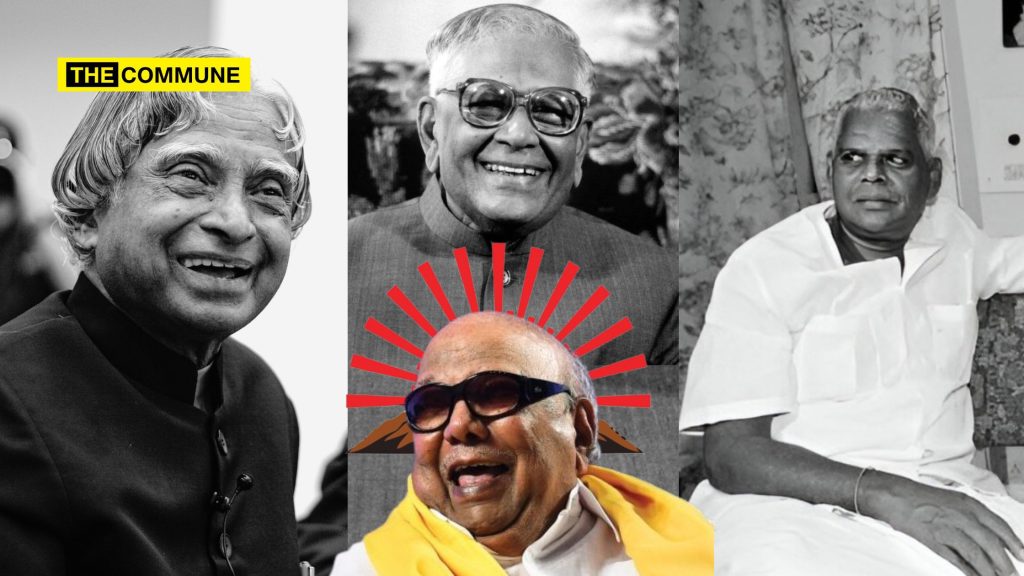
This is not the first instance of DMK dismissing the “Tamilian” factor when it doesn’t suit their political agenda. Let’s take a look at the inglorious history of the DMK which claims it stands for Tamils, while voting against Tamilians becoming President, Vice President or Prime Minister.
When Karunanidhi Questioned R. Venkatraman’s Credentials
History offers a parallel in 1987, during the Presidential election, when R. Venkataraman, a distinguished Tamil leader, was nominated. Back then, AIADMK founder and Chief Minister M.G. Ramachandran (MGR) pointedly remarked that “not supporting a Tamilian is their stand” in reference to DMK’s reluctance. DMK patriarch M. Karunanidhi responded by downplaying Tamil identity, stating that “it is important to see what he has done for Tamil people rather than whether he is Tamil.”
Ironically, R. Venkataraman’s record showed remarkable contributions to Tamil Nadu. A freedom fighter who played a role in the Quit India Movement, he went on to spearhead the state’s industrialisation. As Industries Minister in 1957, he established industrial estates such as Guindy, brought in major national investments, and was instrumental in the founding of the Integral Coach Factory (ICF) and Neyveli Lignite Corporation (NLC). Under his leadership, automobile giants like Ashok Leyland and Hindustan Motors set up base in Tamil Nadu laying the foundation for the state’s emergence as India’s automobile hub. To question “what he has done for Tamil Nadu” is either historical ignorance or deliberate distortion.
R. Venkataraman was not only a freedom fighter who actively participated in the Quit India Movement, but also a visionary statesman who transformed Tamil Nadu’s industrial landscape.
As the Industries Minister of Tamil Nadu in 1957, he was instrumental in setting up industrial… https://t.co/PnntTMUBKC
— 𑀓𑀺𑀭𑀼𑀱𑁆𑀡𑀷𑁆 🇮🇳 (@tskrishnan) August 20, 2025
When Karunanidhi Abused Abdul Kalam When He was Chosen in 2012
When the NDA proposed Dr A.P.J. Abdul Kalam as its candidate for the 2012 Presidential election, the DMK then an ally of the UPA dismissed the idea and reaffirmed its backing for the Congress nominee. Party chief M. Karunanidhi even mocked the suggestion, remarking, “Kalam in Tamil also means chaos (Kalagam). Anyhow, chaos has broken out in the Presidential election.”
Despite the buzz created by TMC leader Mamata Banerjee’s push for Kalam, Karunanidhi made it clear that the DMK would stand by its earlier commitment. “We are firm on what we had said. Defence Minister A K Antony who is said to be a honest man met me (last month) on behalf of Congress. I had extended my support to the message he had brought from (Congress chief) Sonia Gandhi,” he said, stressing that the party’s stance remained unchanged.
He explained that Defence Minister A.K. Antony, whom he described as an honest man, had visited him on behalf of the Congress a month earlier. During that meeting, Antony conveyed a message from Congress president Sonia Gandhi, and Karunanidhi confirmed that the DMK had pledged support to the Congress candidate at that time. Asked whether the Presidential election outcome would influence the next Lok Sabha polls, Karunanidhi declined to speculate.
Tale Of Betrayal Shunning GK Moopanar’s Chance to become PM
Perhaps the most revealing episode was in 1996–1997, when G.K. Moopanar a respected Tamil leader and founder of the Tamil Maanila Congress was a potential Prime Ministerial candidate after the fall of Atal Bihari Vajpayee’s short-lived government.
During key meetings of the United Front in Delhi, Karunanidhi expressed lukewarm support for Moopanar, even as other leaders debated options. Though Karunanidhi later claimed he had canvassed for Moopanar, many insiders suggest his efforts were half-hearted. TMC leaders at the time felt that Karunanidhi was unwilling to allow another Tamil, especially a political peer, to surpass him at the national level. Eventually, the United Front chose H.D. Deve Gowda, a relatively unknown leader from Karnataka, followed by I.K. Gujral neither of whom had deep ties to Tamil Nadu. Moopanar’s name faded from contention, and speculation remains that Karunanidhi’s ambivalence played a key role.
The 1996 general elections delivered a hung verdict. The BJP emerged as the single largest party and formed a short-lived government under Atal Bihari Vajpayee, which collapsed within 13 days. The anti-BJP parties, including the Janata Dal, Left Front, DMK, TMC, and others, rallied under the banner of the United Front, with the Congress offering outside support.
This created a window of opportunity for a non-Congress, non-BJP Prime Minister. Within this coalition, several names were floated— Mamata Banerjee briefly suggested Jyoti Basu, but the CPI(M)’s politburo vetoed it. Ultimately, H.D. Deve Gowda, then Karnataka Chief Minister, was chosen a relatively obscure leader at the national level.
Overlooking Moopanar’s Candidacy For PM
Despite his acceptability across parties, Moopanar’s candidacy never fully materialized. Though there were murmurs of support, including from CPI’s Indrajit Gupta and leaders in the Congress, the push lacked momentum. Multiple political analysts and insiders have pointed to DMK chief M. Karunanidhi’s ambivalence as a key factor.
Karunanidhi, while publicly claiming he would be “the happiest man” if Moopanar became PM, never used his political capital to aggressively advocate for Moopanar in the way he could have. Instead, he stayed passive in crucial meetings, allowing Deve Gowda’s candidacy to take shape.
Later, in 1997, when Deve Gowda’s government collapsed and the search for a new PM resumed, Moopanar’s name again came up. Yet once again, Karunanidhi’s support appeared half-hearted. He claimed to have lobbied other leaders like Lalu Prasad Yadav and Harkishan Singh Surjeet, but by then, the momentum had shifted to I.K. Gujral. TMC insiders and observers later remarked that Karunanidhi possibly feared being overshadowed by another Tamil leader on the national stage.
Several reasons have been attributed to the lack of serious backing for Moopanar and one among that was Karunanidhi’s political insecurities. Many in the TMC felt Karunanidhi was unwilling to be in a position where he would have to politically defer to a fellow Tamil, especially someone who could eclipse him on the national stage.
There was also speculation that Karunanidhi preferred a weak, consensus candidate like Gujral, who would allow the DMK greater influence in decision-making at the centre. By contrast, a strong Tamil leader like Moopanar could have changed the DMK-TMC power balance in Tamil Nadu and at the national level. TMC leaders like P. Chidambaram later implied that if Karunanidhi and Chandrababu Naidu had come together to endorse Moopanar, he could have been PM. But the opportunity was lost twice and the DMK’s lack of enthusiasm was seen as a contributing factor.
G.K. Moopanar’s story remains one of Indian politics’ great “what ifs.” He was a Tamil leader with a clean image, wide acceptability, and genuine statesmanlike qualities. Yet, when the moment arrived, he was either too reluctant or was let down by those who could have championed his cause, particularly Karunanidhi.
This episode is yet another example where DMK’s commitment to “Tamil pride” failed to translate into political support for capable Tamil leaders at the national level, especially when party interests or alliances were at stake.
Subscribe to our channels on Telegram, WhatsApp, and Instagram and get the best stories of the day delivered to you personally.