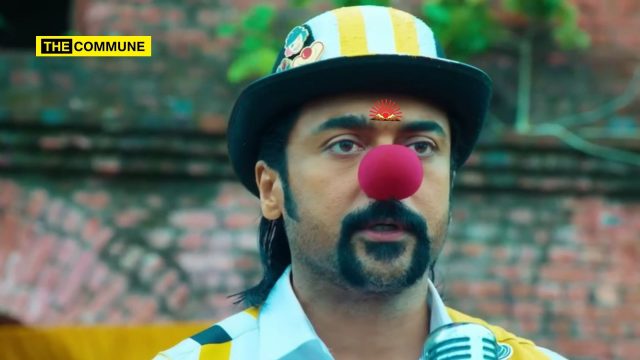
Actor Suriya rose to prominence as Tamil cinema’s self-proclaimed voice of social justice. His 2021 film Jai Bhim, based on the custodial death of tribal victims under police torture, earned him accolades for championing the cause of the marginalized. His 2022 film Edharkum Thunindhavan, inspired by the Pollachi sexual assault scandal of 2019, positioned him as cinema’s crusader against sexual violence.
Yet as Tamil Nadu spirals into a crisis of unprecedented crime and state indifference under the DMK government since 2021, Suriya has transformed from propagandist into accomplice through profound silence. The contrast isn’t just striking; it reveals a calculated political allegiance that places party loyalty above principles.
The Pollachi Case: From Crusade to Compromise
The Pollachi sexual assault case of 2019 shook Tamil Nadu. A gang systematically lured, sexually assaulted, and blackmailed over 200 women through social media. In May 2025, all nine accused were convicted and sentenced to life imprisonment, with the court ordering ₹85 lakh in compensation to survivors. The case represented institutional failure, police negligence, and systemic vulnerability that made women targets for predators.
Suriya’s Edharkum Thunindhavan was released in March 2022, riding the wave of public outrage over Pollachi. The film, while addressing sexual violence, received mixed reviews for its preachy execution and diluted messaging. Critics noted it fell short of delivering a hard-hitting indictment of the system that enabled such crimes. Yet Suriya used the platform to position himself as the concerned actor, the voice demanding justice for women.
That voice has gone silent.
The Coimbatore Airport Gang Rape: November 2025
On 2 November 2025, three men abducted a 20-year-old MBA student near Coimbatore International Airport after attacking her male friend with a machete. The victim was gang-raped at knifepoint and later found unconscious. The accused, who had prior criminal records, were arrested after a police encounter where they were shot in the legs for resisting arrest. This brutal attack mirrors past horrors like the Pollachi case, revealing continued vulnerabilities in public safety.
As of 4 November 2025, Suriya has issued no statement, no condemnation, no letter expressing solidarity with the victim or demanding systemic accountability.
The silence is deafening.
A Pattern of State Criminality: The DMK’s Year of Violence
The Coimbatore case exists within a broader framework of violence that has engulfed Tamil Nadu under DMK rule. Since 2021, Tamil Nadu has recorded 25 custodial deaths resulting from police torture; a figure that exposes systemic brutality masked by administrative incompetence. This is double the number reported under the AIADMK regime’s final years, according to human rights organizations
Custodial Deaths Under DMK Rule
Under the DMK government, custodial violence in Tamil Nadu has escalated alarmingly. The brutal death of 27-year-old Ajith Kumar, who showed 44 injury marks post-autopsy, is a grim highlight. Between 2017-2022, there were zero convictions for custodial deaths, yet the torture continues unabated, with over 300 inmates entering Puzhal Prison with broken limbs in 2024 alone. The Madras High Court has slammed the police for their lack of transparency. Notably, actor Suriya, who championed this cause in his film Jai Bhim during the previous regime, remains conspicuously silent now that the perpetrators – the police, come under the direct purview of the Chief Minister himself!
The Anna University Sexual Assault (December 2024)
In December 2024, a 19-year-old student at Anna University was gang-raped by a repeat offender, exposing severe security lapses including non-functional CCTVs. While the perpetrator received a life sentence, actor Suriya, who built his public image on films like Jai Bhim addressing such injustices, remained conspicuously silent.
The contrast with his vocal activism during AIADMK rule is impossible to ignore.
Drug Crisis: Silence on a Spiraling Catastrophe
Tamil Nadu is increasingly being likened to Colombia for its escalating drug menace – in fact it is competing with Punjab to become the drug capital of the country. The state has witnessed multiple seizures of cocaine at Chennai Airport, transforming it into a smuggling hub. In October 2025 and early November, Chennai Airport continued to cement its reputation as a key smuggling hub for high-value narcotics in India, rivaling major international drug routes.
On 1 October 2025, officials seized 3.5 kg of cocaine valued at ₹35 crore from a passenger who reportedly had links to an international syndicate, with Bollywood connections being speculated but not officially confirmed.
A second major operation on 8 October 2025 resulted in drugs worth ₹52 lakh and cash of ₹51 lakh being confiscated by Air Intelligence and Customs.
On or around 12 October 2025, the Narcotics Control Bureau (NCB) Chennai Zonal Unit intercepted a mini truck near the Karanodai Toll Plaza and seized 320 kg of cannabis (ganja) worth approximately ₹2 crore. Two people, including the driver, were arrested. The ganja, which was hidden in a specially designed cavity, was being transported to Chennai from Andhra Pradesh.
On 31 October 2025, Tiruvallur police arrested a Nigerian national in Chennai for possessing 39g of methamphetamine valued at ₹75,000. The individual was also suspected of being involved in hawala transactions linked to drug smuggling.
The trend continued into November, with five individuals being arrested on 3 November 2025 and heroin, as well as large quantities of ganja, being seized during anti-drug operations.
Suriya, who positioned himself as the voice of Tamil Nadu’s youth through his socially conscious films, has maintained a conspicuous silence on this grave issue. There have been no statements, no activism, no use of celebrity to highlight the crisis. His activism was loud under previous regimes but conspicuously muted under the DMK government.
The Kallakurichi Hooch Tragedy: A Diluted Response
The 2024 Kallakurichi hooch tragedy, which killed over 50 people, exposed the state government’s failure to prevent a repeat of a similar 2023 incident.
In response, actor Suriya issued a notably diluted statement. He used the euphemism “poisonous liquor” instead of “illicit hooch,” offered only token criticism of the “administration,” and praised the ruling party’s other schemes.
Compare this to his vocal condemnation during AIADMK rule and the contrast becomes glaring: his criticism is softer, his language gentler, his accountability dispersed when the perpetrators are political allies.
The Vengaivayal Atrocity: Selective Solidarity with Dalits
In the Vengaivayal atrocity, human feces were dumped in a Dalit community’s water tank – a direct attack on their dignity. This is precisely the kind of caste oppression that Suriya’s film Jai Bhim claimed to confront. Yet, the actor remained completely silent. His film had presented itself as a manifesto for Dalit rights and police accountability. Yet when actual Dalit communities faced this grotesque humiliation under the current regime, Suriya offered no solidarity, no statement, no activism.
The inescapable conclusion is that Suriya’s activism is performative – active when it serves political opposition to AIADMK, dormant when it might offend DMK allies.
Suriya – An On-and-Off Microphone
Suriya’s cinema presents a binary narrative: police are brutal, governments are indifferent, systems are rigged against the marginalized. Yet his actual activism operates within a competing binary: if the government wears DMK colours, silence is safety; if it wore AIADMK colors, volume is capital.
The victims of custodial torture, sexual violence, and state indifference deserve more than a champion who only speaks when it aligns with electoral politics. The actor who made Jai Bhim to challenge impunity now perpetuates it through his complicit silence.
His transformation from crusader to accomplice is a betrayal of the marginalized communities he once claimed to represent.
When Suriya finally breaks his silence, it will not be because he has discovered his conscience. It will be because the next election cycle demands a new narrative, and Tamil Nadu’s suffering has become politically convenient again.
Until then, his silence speaks volumes about the true nature of his activism: not principle, but propaganda.
Subscribe to our channels on WhatsApp, Telegram, Instagram and YouTube to get the best stories of the day delivered to you personally.