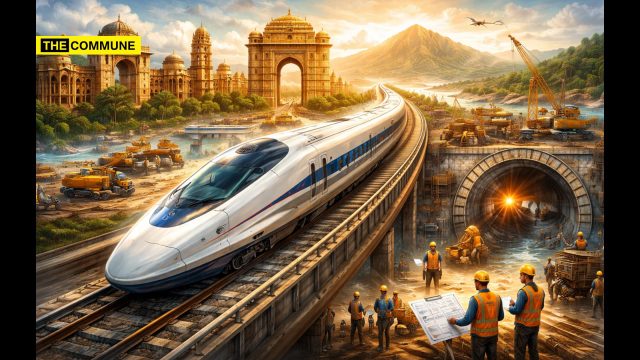
On 1 February 2026, Finance Minister Nirmala Sitharaman presented the Union Budget 2026-27, and once again, the “mocking brigade” was ready with their stale scripts. For years, a specific section of the political ecosystem has treated the Mumbai-Ahmedabad High-Speed Rail (MAHSR) as a ghost project – something to be ridiculed in drawing rooms and cynical tweets as a “waste of money” or a “perpetual delay”.
When the Finance Minister, as part of the proposals, had announced on another 7 High Speed Rail projects (including two connecting Chennai with Bangalore and Hyderabad), with a capital outlay of almost Rs.2.90L Crores, the visionless political opposition and their subservient media persons started their usual rant on “paper-train” theory.
In this article, I seek to explain why the critics have no feet to stand, with decades being spent in “feasibility study paralysis”, and how the current leadership is making sure that these “Growth Connectors” aren’t just lines on a map, but a blueprint for the new India.
The Cost of Lost Decades: 2004–2014
If the leaders who ruled India between 2004 and 2014 had even a fraction of the current government’s vision, Indians would already be traveling in Bullet Trains today. Instead, those ten years were defined by:
- Policy Paralysis: Infinite “pre-feasibility” reports that gathered dust in Rail Bhavan while the world raced ahead.
- Lack of Ambition: A mindset that believed India was “not ready” for world-class technology, preferring to keep the common man stuck in crumbling, slow-moving infrastructure. It was almost as if the ruling dispensation found perverse pleasure in the poverty porn that they were the sole creators.
- Inefficiency & Apathy: It took the current government to move from paper to pillars, signing the landmark deal with Japan in 2015.
It is a rich irony that the same ex-rulers, who were thrown out not just for historic corruption, but for their sheer inability to execute a single transformative project, are the ones mocking the “delay” today. Their mocking comes from a place of deep insecurity: they are baffled by a government that actually delivers.
The Global Context: India is Racing, Not Crawling
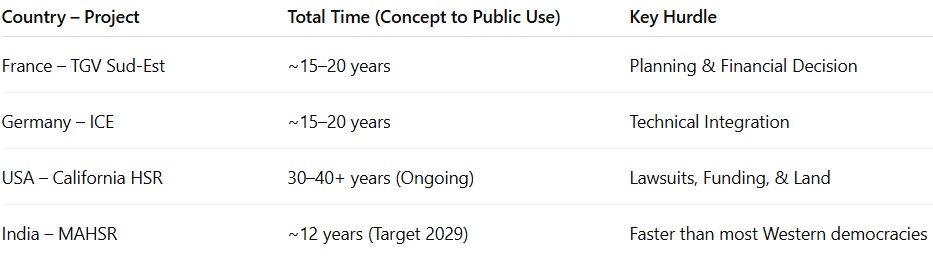
Building a Bullet Train is not like laying a highway; it is building a 500-kilometer precision instrument. When critics compare India to other nations, they conveniently hide the facts about “Democratic Friction”, inherent in a free nation. Despite being a vibrant democracy navigating intricate land laws, India is on track to complete its first HSR in roughly 12 years, outpacing the timelines of veteran players like France and Germany.
The only nations moving faster are autocracies where land is seized overnight and dissent is met with silence. Naming this specific neighbor often rattles India’s previous rulers, who had the audacity to sign a private MoU with the perpetual masters of that regime, a place where dictatorship is the law, and opposition can lead to instant disappearance. India has chosen the harder, more honorable path: building world-class infrastructure while respecting the rule of law.
Crushing the “Delay” Narrative: February 2026 Status
The “Bullet Train” is no longer a PowerPoint; it is a 508-km construction site humming with activity.
- 56% Physical Progress: As of February 2026, the project has crossed the halfway mark and entered its decisive phase.
- 100% Land Acquired: Despite years of sabotage by the previous state government in Maharashtra, the current administration has secured 100% of the land (1,396 hectares).
- Engineering Feats: In January 2026, engineers achieved a major breakthrough in the 1.5-km Mountain Tunnel-5 in Palghar, followed by the MT-6 breakthrough on February 3, 2026.
- Undersea Milestone: Work is in full swing on the 7-km undersea tunnel – a first for Indian infrastructure.
The “Growth Connector” Era
Budget 2026 has proven that Mumbai-Ahmedabad was just the laboratory. The future is a 4,000 km HSR network attracting ₹16 lakh crore in investment.
- Mumbai-Pune: Reducing a 3-hour crawl to a 48-minute dash.
- Delhi-Varanasi: Connecting the National Capital to the Spiritual Capital in just 3 hours 50 minutes.
- Chennai-Bengaluru: Shrinking the journey to a mere 1 hour 13 minutes.
- Chennai-Hyderabad through Amaravati and Tirupati: Three State Capitals. Four Cities. One speedy route to economic prosperity.
The savings in time, and a significant savings in cost compared to an air travel, implies that the distance shrinks and the city expands. One can work for a Bangalore company staying in Chennai. A comfortable return trip to Hyderabad from Chennai can be a daily affair. The fact that it connects another Capital city, and the spiritual destination in Tirupati implies a potential for much bigger and better infrastructural utilisation.
Conclusion
The mocking comes from those who couldn’t even electrify half of India’s rail tracks in 60 years. They are naturally baffled by a government that is building undersea tunnels and 350 km/h corridors.
India didn’t just need a train; it needed the WILL to build it. And this Government has it in abundance. In 2029, when the first Shinkansen-class train rolls out, it won’t just be carrying passengers; it will be carrying the pride of a Viksit Bharat that finally left the “efficiency-less” past behind.
Subscribe to our channels on Telegram, WhatsApp, and Instagram and get the best stories of the day delivered to you personally.